On this page
Many students spend the half hour before a mock scrolling, or flipping through a new chapter. Neither helps the three hours that follow. A short, fixed routine does: remind yourself of the mistakes you actually make, get your hand moving, and make the hard decisions before the clock starts.
What should you do 30 minutes before a mock test?
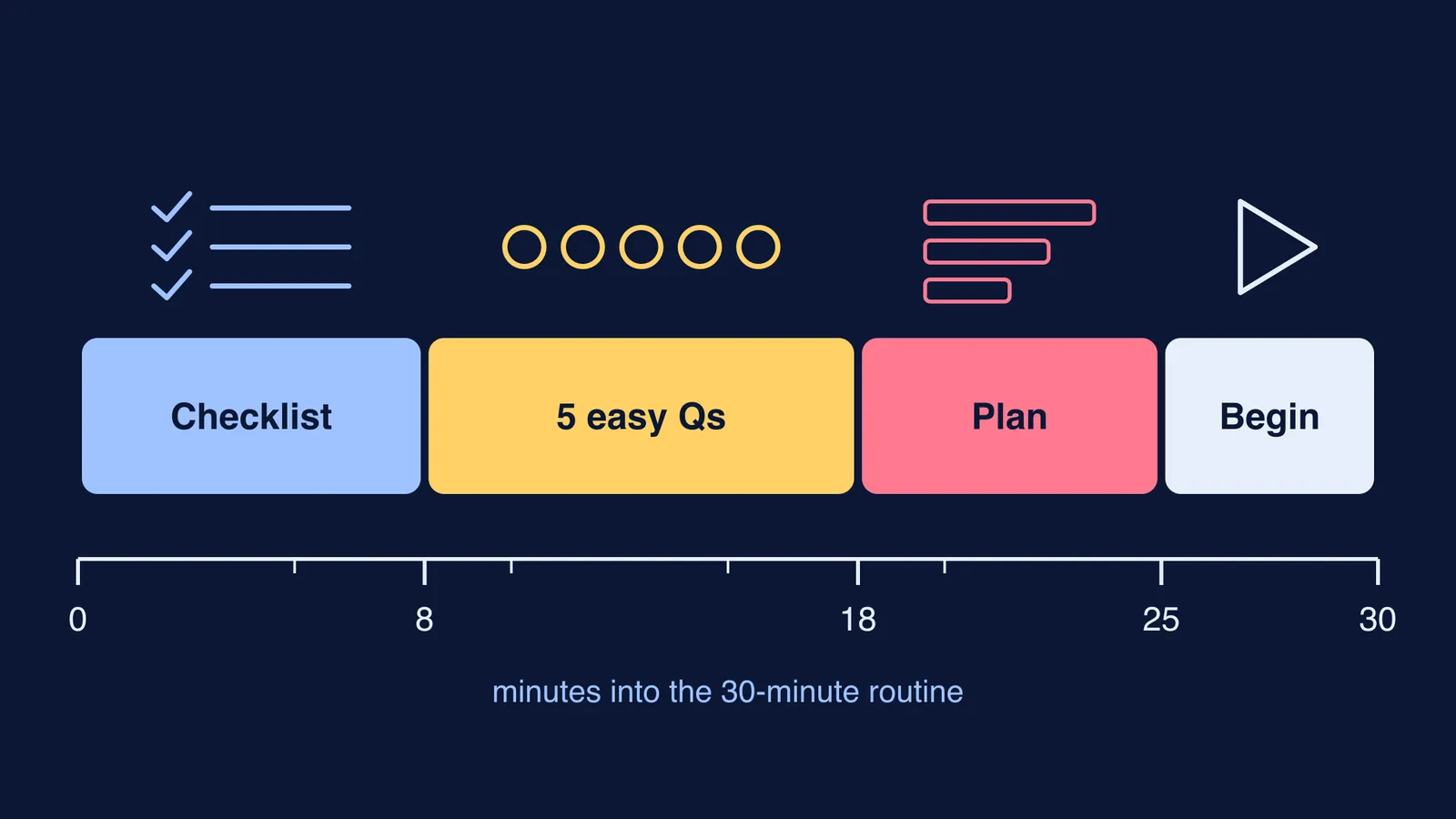
Run the same four steps, in the same order, before every mock:
Minutes 0 to 8: read your personal error checklist.
Minutes 8 to 18: solve five easy questions you have solved before.
Minutes 18 to 25: write a section plan with a few if-then rules.
Minutes 25 to 30: put everything away, settle, and begin.
Keep it identical each time, so on exam day it is one familiar thing in an unfamiliar hall. For the rest of the set-up, see simulating real exam conditions with a full mock.
What goes on a personal error checklist?
An error checklist is a short list, in your own words, of the mistakes that have cost you marks in recent mocks. It is not a formula sheet. Take five to seven lines from your last three mock reviews, keeping only mistakes that repeat. A JEE aspirant's list might read:
Sign of g when I take upward as positive.
Kelvin, not Celsius, in gas law questions.
Read "incorrect statement" twice in chemistry.
Enter the answer against the question number I actually solved.
Read each line and picture the question where it caught you. If a line is really a concept you never understood, move it to this week's revision; the Fermi Concept Library has a lesson for every concept in physics, chemistry, biology and mathematics. See also whether revising only your mistakes is enough.
Which five easy questions should you warm up with?
Pick five questions you have already solved correctly, one or two per subject, with at least one that tests a line on your checklist. Easy means about two minutes each. You are not learning here; you are bringing your pen, arithmetic and reading up to working pace.
No new questions: getting stuck now shakes you, with no time to repair it.
Check each answer at once.
If one goes wrong, note what slipped and move on.
Look at any slip after the mock. The Fermi Problem Library has worked problems with a step-by-step solver that explains the reasoning, which helps when the slip was the method rather than the arithmetic.
How do you make a section plan before the mock?
A section plan turns "I will manage my time" into rules you can follow when tired. Psychologists call these implementation intentions, which take the form "If Situation Y arises, then I will perform Behavior Z".
A meta-analysis by Peter Gollwitzer and Paschal Sheeran of 94 independent studies, with more than 8,000 participants, found that adding if-then plans to a goal had a medium-to-large effect on reaching it (d = 0.65), as summarised in a review chapter by Parks-Stamm and Gollwitzer.
A worked plan for a three-subject, three-hour mock:
Order: chemistry first (my fastest), then maths, then physics.
Checkpoints: chemistry done by 0:50, maths by 1:55, physics by 2:45; the last 15 minutes go to marked questions.
If a question has no clear path after 3 minutes, then I mark it and move on.
If I am more than 10 minutes behind a checkpoint, then I switch subject and come back later.
Set your own checkpoints from a time log per question from your last few mocks.
What if you feel nervous just before the mock starts?
How you read nervousness matters. In a study by Jeremy Jamieson and colleagues, students preparing for the GRE who were told that "your arousal could be helping you do well" outperformed a control group on the maths section, both in a practice test and later on the real exam (Journal of Experimental Social Psychology, 2010). The study was small: only 28 of the 60 students recruited sat the real GRE in time.
Gerardo Ramirez and Sian Beilock found that a brief expressive writing task about test worries, done immediately before an important exam, improved scores, especially for usually anxious students (Science, 2011). In step four, write two or three lines about what worries you, then fold the paper away.
If exam worry is affecting your sleep, eating or mood for days, talk to a parent, teacher or counsellor, or call Tele MANAS on 14416, the free, 24x7 national mental-health helpline of the Ministry of Health and Family Welfare.
The printable pre-mock card
Copy this onto an index card and fill in the blanks the night before:
0 to 8 min: read my error checklist. Picture each mistake.
8 to 18 min: five old, easy questions. Do not chase a wrong one.
18 to 25 min: order ___, ___, ___. Checkpoints ___, ___, ___.
If stuck for 3 minutes, then mark and move.
If 10 minutes behind a checkpoint, then switch subject.
25 to 30 min: books away. Nerves mean I am getting ready. Begin.
After each mock, add any mistake that has happened twice and drop any line that has not caught you in three mocks.