On this page
A friend's mock score, a "was ₹2,999" price tag, your first chapter-test marks: the first number you see quietly becomes your starting point. Psychologists call this anchoring.
What is anchoring bias?
Anchoring bias is the tendency to start from an initial number and adjust away from it too little, so that "different starting points yield different estimates, which are biased toward the initial values", in the words of Amos Tversky and Daniel Kahneman's 1974 paper in Science. The starting number can come from the question itself, from someone else, or from a rough calculation in your head. It does not need to be relevant to work.
What did the classic anchoring experiments find?
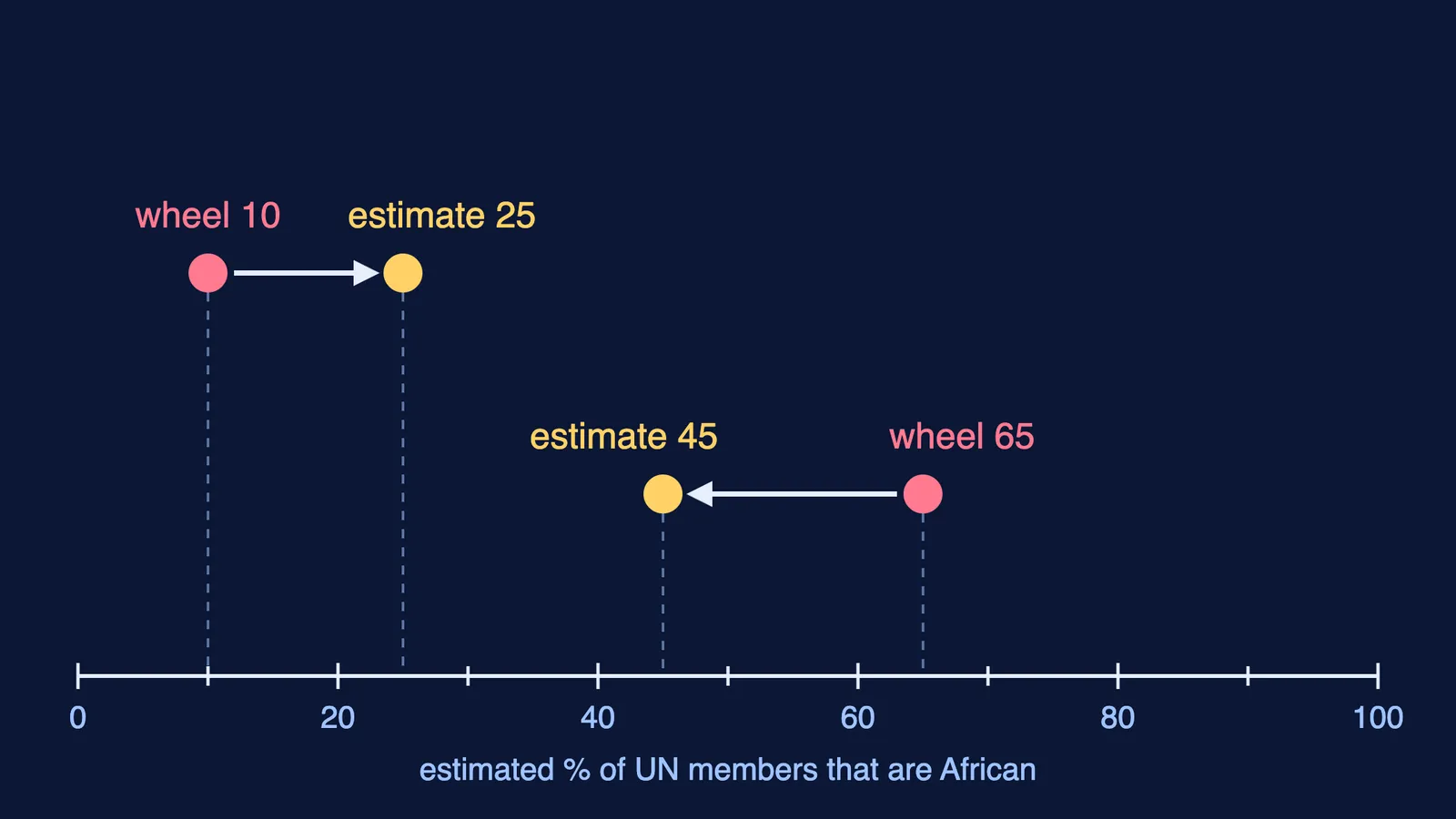
In the best-known demonstration, Tversky and Kahneman spun a wheel of fortune numbered 0 to 100 in front of participants, then asked them to estimate quantities such as the percentage of African countries in the United Nations (full text of the 1974 paper). Groups that started from 10 gave a median estimate of 25; groups that started from 65 gave a median estimate of 45. Paying people for accuracy did not reduce the effect.
The same paper gave high school students five seconds to estimate 8×7×6×5×4×3×2×1 or 1×2×3×4×5×6×7×8. Median estimates were 2,250 and 512; the correct answer is 40,320. The first few multiplications set the anchor.
Anchors move prices too. In a 2003 study in the Quarterly Journal of Economics, Dan Ariely, George Loewenstein and Drazen Prelec asked 55 MBA students whether they would buy each of six products, such as a cordless keyboard and bottles of wine, for a dollar amount equal to the last two digits of their social security number (paper PDF). Students with above-median numbers then stated values 57 to 107 percent higher than students with below-median numbers. For the cordless keyboard, students whose numbers were in the top fifth were willing to pay $56 on average, against $16 for those in the bottom fifth.
How do first numbers skew your mock-test targets?
The classic experiments used numbers people knew were arbitrary (Tversky and Kahneman, 1974). Mock scores look meaningful, so it is easy to miss when one of them is working as an anchor too. Three anchors show up often:
Your first mock. A very low first score can set a ceiling in your head, so you aim for "a bit more than that" for months. We have written about what a very low first mock score means and how to pick your next target.
Someone else's score. A topper's number shared on a group chat becomes your yardstick, though it says nothing about your own gaps.
Last week's single score. One bad paper can drag your sense of where you stand. A trend over several mocks is a better guide, as our post on reading a drop in JEE mock scores explains.
How do anchors work on prices when you shop?
The social security number study shows that a first number can shape what you are willing to pay (Ariely, Loewenstein and Prelec, 2003). In a shop or an app, the first number is usually the struck-through MRP or "was" price. A calculator marked "₹1,999, now ₹999" feels like a bargain because ₹1,999 is the anchor, not because ₹999 is a fair price.
How can you set targets and prices without the anchor?
Since people adjust too little from wherever they start (Tversky and Kahneman, 1974), the fix is to build your own number before you see anyone else's. Use a three-number check:
Baseline: the average of your last three mocks, not the first or the latest.
Fixable marks: from your error log, count marks lost to careless slips and to chapters you have since revised.
Target: baseline plus fixable marks. Only now look at friends' scores or a topper's.
A worked example. Your last three mocks scored 31%, 35% and 30% of the maximum, so your baseline is 32%. Your error log shows about 6% lost to sign errors and unit slips, and about 4% from one chapter you have now finished. Your next target is about 42%. That is a target you can explain; "aim for 80% like the topper" is not.
For shopping, ask three questions:
What would I pay if no "was" price were shown? Write it down first.
What do two other sellers charge?
Is the discount the main reason I want it?
Parents can try one line: "Before we look at anyone else's marks, what is a fair next target for you, and why?" Our guide to teaching your teenager to make good decisions has more on these talks.
If you are not sure which chapters hold your fixable marks, Fermi's AI tutor works out what you already know and builds a plan for the session, so your next target rests on evidence rather than the first number you heard.