On this page
Many students revise by rereading notes the night before a test. Successive relearning turns that around: you close the book, try to recall each answer, check it, and keep going until every item comes back right. Then you return on later days and do it again.
What is successive relearning?
Successive relearning means practising a task until it is performed correctly, then practising it again until it is correct in other spaced sessions, as defined by Rawson and Dunlosky in Current Directions in Psychological Science (2022). It joins two well-studied habits: retrieval practice, which is the "what", and spaced practice, which is the "when", in the words of the researchers' guide for educators.
The difference from ordinary self-testing is the stopping rule. Answering one quiz question and moving on, right or wrong, is not successive relearning. You keep testing until every item has been recalled correctly at least once in that session, then you come back to the same items in later sessions.
How many times should you recall each answer?
The clearest answer comes from a 2011 study in which 533 students learned concepts across 3 experiments. Each item was practised to between 1 and 4 correct recalls in a first session, then relearned to 1 correct recall in 1 to 5 later sessions, and memory was tested 1 to 4 months afterwards.
Relearning had large effects on long-term retention for relatively little extra practice. The authors' advice to students was to reach 3 correct recalls in the first session, then relearn each concept 3 times at widely spaced intervals.
Does successive relearning work for real exams?
Classroom studies, mostly with college students, say yes. These figures come from the educators' guide by Dunlosky and colleagues unless another link is given.
In an introductory psychology course, students scored 84% on exam questions about concepts they had successively relearned, against 72% on concepts they studied their own way.
Tested 24 days after that exam, the same students recalled over 60% of the relearned concepts but under 20% of the ones they had learned on their own.
In a difficult biopsychology course, successive relearning boosted students' learning of course content, measured on a high-stakes exam, by at least 10% in two experiments (Janes and colleagues, 2020).
In a study of 174 eighth graders learning statistics definitions, those who did three relearning sessions recalled nearly 60% of the concepts a month later.
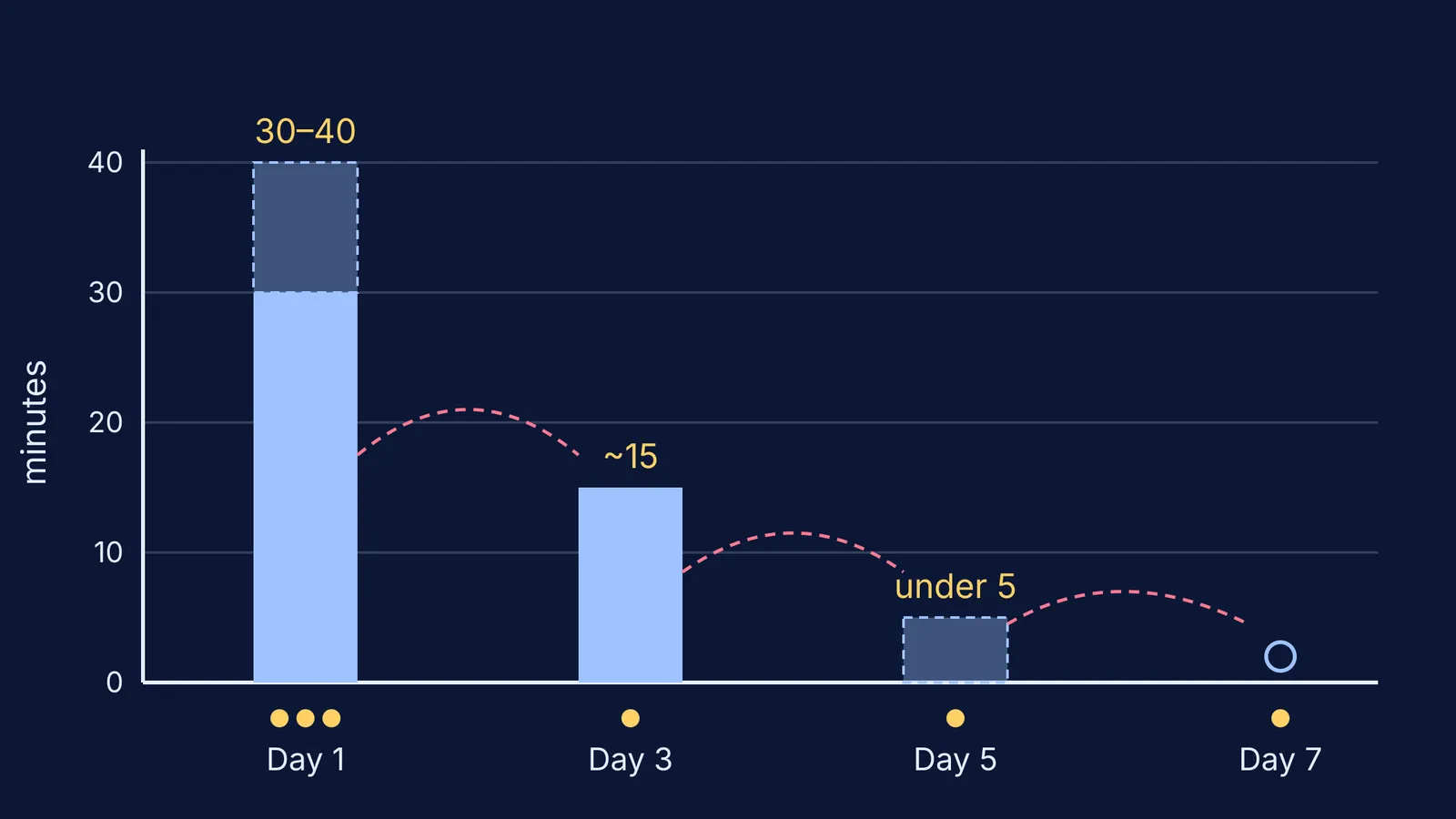
The cost is time at the start. The guide estimates 30 to 40 minutes to first learn eight to ten long definitions, about 15 minutes for the first relearning session, and under 5 minutes for the next. The evidence is thinner for solving new problems: in a probability study the benefit was small, so keep doing fresh numericals alongside it.
How do you use it for board exams, JEE or NEET?
Here is a one-week plan for one chapter, say Class 11 cell organelles. The two-day gaps follow the educators' guide example of three extra sessions separated by 2 days.
Day 1, after class: make 8 cards, with a question on the front ("What does the Golgi apparatus do?") and the answer in your own words on the back.
Write each answer on paper before you flip the card. Right: set it aside. Wrong: read the back, then put the card at the bottom of the pile.
Keep going until the pile is empty. If time allows, run it again until each card has come back right three times.
Day 3: shuffle and test cold. Stop when each card has come back right once.
Day 5 and Day 7: repeat Day 3.
The same cards work for physics formulas with their conditions, named reactions in chemistry, or definitions CBSE asks for word for word.
What if a card keeps coming back wrong?
That can mean the idea itself is not clear yet, and more testing alone may not fix it. Go back to the concept itself, for example in the Fermi Concept Library, which has a lesson for every concept in physics, chemistry, biology, mathematics and computing, then rewrite the card.
If you are not sure which chapter to start with, Fermi's AI tutor can work out what you already know and build a plan for the session, so you sit down to a clear first pile.
If writing everything you remember on a blank page suits you better, the blurting revision method uses the same recall-then-check idea. For mixed problem sets, try this interleaved practice plan. Parents can read why a child who studies hard still forgets.
Start tonight with eight cards from today's class, and put Day 3, 5 and 7 in your calendar.