

On this page
Hours at the desk can leave little in memory if most of them go into reading. The fix is usually a change of method, not more time.
Why does my child forget what they studied for hours?
Rereading notes feels productive because the page becomes familiar, and familiarity is easy to mistake for memory. In a 2006 experiment by Henry Roediger and Jeffrey Karpicke, students who restudied a passage did better on a test 5 minutes later, but students who had practised recalling it remembered substantially more after 2 days and after 1 week. Restudying also made students more confident, which is the trap: the method that feels better fades faster.
When Karpicke, Andrew Butler and Roediger surveyed 177 college students, a majority said they repeatedly reread their notes or textbook, and relatively few tested themselves. More in why rereading feels like learning.
What should you check first?
Watch one ordinary study session and look for these signs:
Most of the time goes to reading, highlighting or copying notes neatly.
Each chapter is revised once, the night before the test.
The book stays open the whole session; nothing is answered from memory.
Your child says "I understood it" but cannot explain it in their own words.
Sleep is short on school nights (see how much sleep teenagers need).
If you tick two or more, the method is a good place to start. The 2013 review led by John Dunlosky weighed 10 study techniques and rated rereading and highlighting low utility, because they do not consistently boost performance. It rated practice testing and distributed practice (spacing) high utility, and self-explanation moderate.
Does quizzing work better than rereading?
For remembering over days and weeks, yes. Retrieval practice means pulling information out of memory, such as answering with the book closed. In a 2008 study in Science, Karpicke and Roediger found that repeatedly studying words students had already learned had no effect on delayed recall, while repeated testing produced a large positive effect. Students' predictions of their own scores did not match how they actually did.
At home, quizzing can be simple:
Close the book, write everything you remember on a blank page, then check.
Turn each chapter heading into a question and answer it aloud.
Try the end-of-chapter exercises before rereading, not after.
How far apart should revision sessions be?
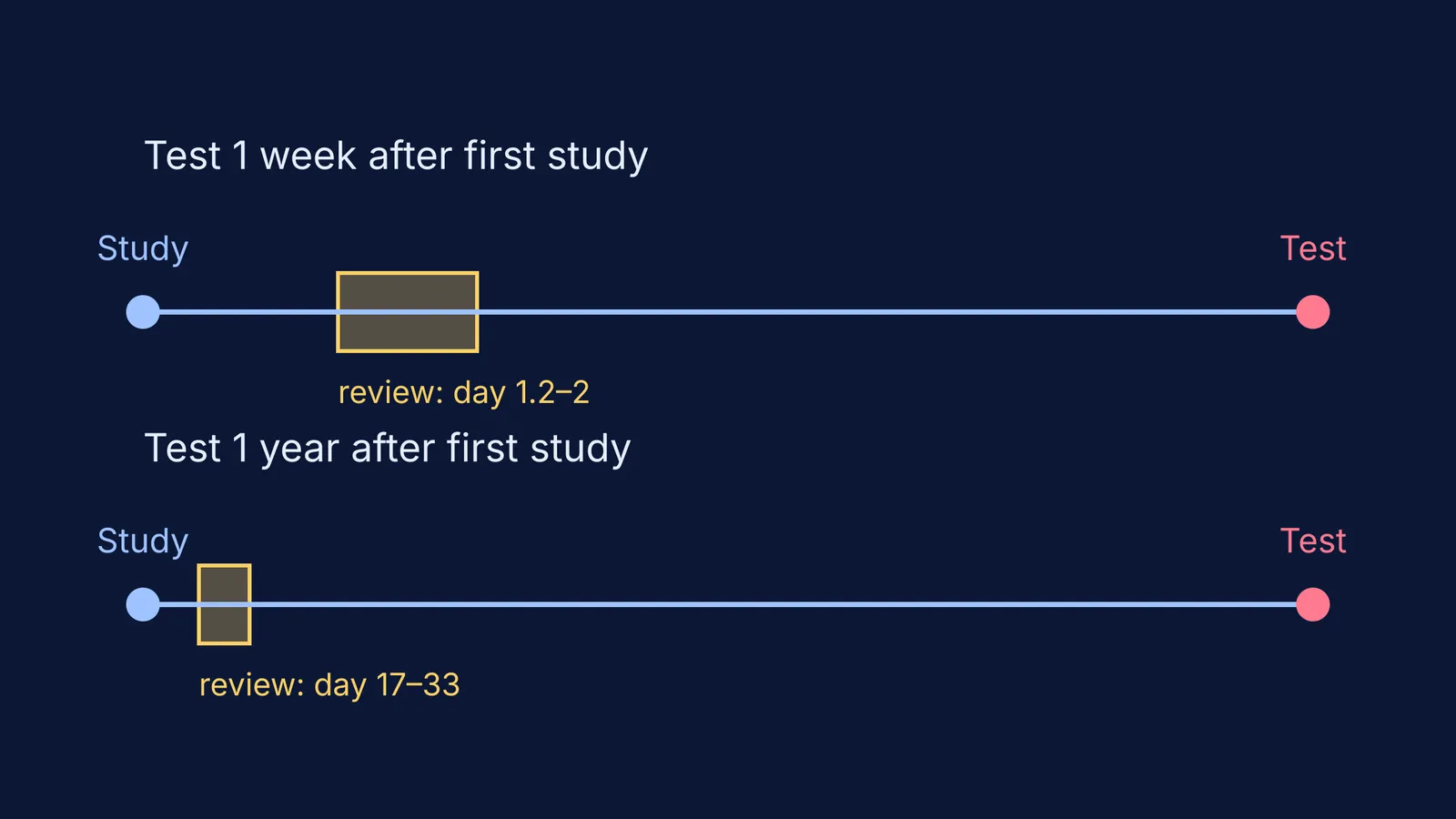
Spacing means coming back to the same material on separate days instead of in one long block. A 2006 meta-analysis by Nicholas Cepeda and colleagues pooled 839 assessments from 317 experiments and found that the best gap between sessions depends on how long you need to remember. A 2008 follow-up study taught more than 1,350 people a set of facts, then gave them one review before a final test. When the test came a week after the review, the best gap was about 20 to 40% of that week; when it came a year after, the best gap was about 5 to 10% of the year.
So if a unit test is a week away, review once after a day or two; for an exam about a year away, the same ratios point to a first review after roughly 2 to 5 weeks. Our 4-week spaced revision schedule turns this into a calendar.
How does explaining aloud help?
Self-explanation means saying why each step works, in your own words, while you study. The Dunlosky review rated it moderate utility, with less classroom evidence than quizzing or spacing.
You do not need to know the subject to help. Try this script:
"Teach me what you studied today, as if I were in Class 6."
"Why does that step work?"
"What is one question an examiner could ask about this?"
"Which part was hardest to explain? Let's mark it for tomorrow."
If the explanation keeps breaking at the same idea, that is a concept gap, not a memory problem. The Fermi Concept Library has a lesson for each concept in physics, chemistry, biology, mathematics and computing, so your child can rebuild the missing step.
A one-week plan to try at home
Keep total study time the same; change only how it is used:
Day 1: learn the new topic, then finish with 10 minutes of blank-page recall.
Day 2: quiz Day 1's topic from memory before opening the book, then start the next topic.
Day 4: quiz the Day 1 and Day 2 topics again, and explain one of them aloud to you.
Day 7: do a mixed quiz on everything from the week, then reread only what was missed.
Expect the first days to feel harder than rereading. If your child does not know where to begin, Fermi's AI tutor can work out what they already know and build a plan for the session, then check understanding as it goes.
If forgetting comes with constant tiredness, low mood, worry or trouble focusing beyond studies, talk to your child's doctor or school counsellor. Tele MANAS, the free 24x7 national mental-health helpline from the Ministry of Health and Family Welfare, is on 14416.


