On this page
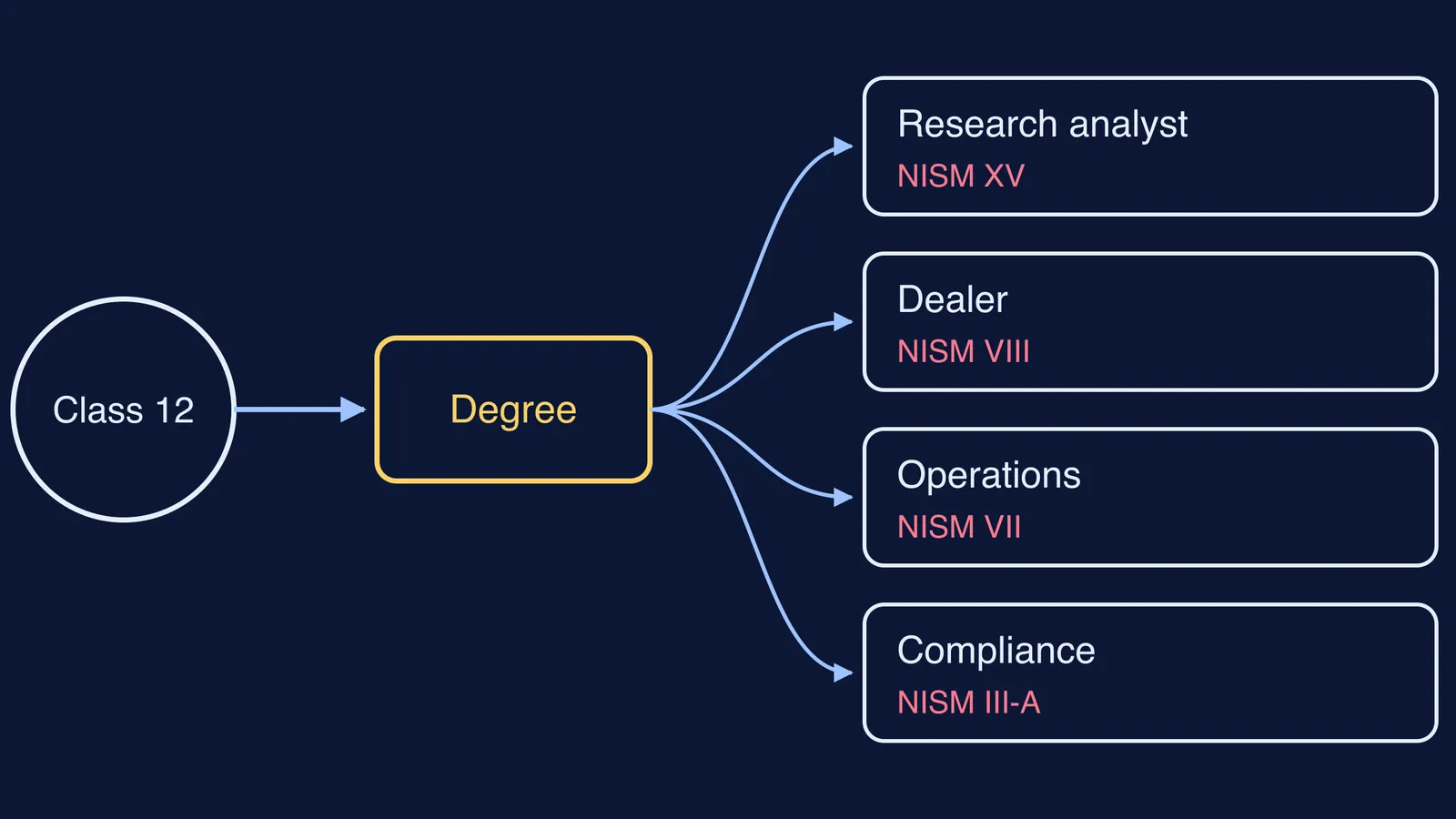
A "career in the stock market" usually brings to mind someone trading on a screen. The real jobs are wider, and most sit inside regulated firms such as brokers, research houses and mutual funds. The Securities and Exchange Board of India (SEBI) sets the rules for those firms, and many roles need a certificate from the National Institute of Securities Markets (NISM). Below are four common roles, the exam each needs, the degree that fits, and a plan to your first job.
Why do stock market jobs need NISM certification?
NISM offers mandatory certification exams for associated persons in securities market intermediaries, a function delegated to it under the SEBI (Certification of Associated Persons in Securities Markets) Regulations, 2007, according to the NISM certifications page. That page lists about 30 exam series. It also says a certificate can be re-validated for three years at a time, by passing the exam again or completing a NISM continuing education programme.
Each exam below has 100 questions in 120 minutes, a 3-year certificate and a fee of Rs 1,500 plus payment gateway charges, according to its NISM page, such as the research analyst exam page. Each page also says the passing certificate is issued only to candidates who have given their PAN. None of them names a degree as a condition for sitting the exam.
Which stock market jobs exist, and which NISM exam does each need?
Research analyst. A research analyst studies companies and writes reports with buy, sell or hold views and price targets. The NISM Series XV page says the exam is for people registered or employed as research analysts under the SEBI (Research Analysts) Regulations, 2014. It needs 60% to pass, and each wrong answer costs 25% of that question's marks. A revised version of the exam started on 20 January 2026.
SEBI has also moved to lower the entry bar for this role. A SEBI board memorandum from 2024 proposed cutting the minimum qualification for research analysts from a postgraduate or professional qualification to a graduate degree, in a field such as finance, accountancy or business management, and dropping the experience requirement, while still requiring NISM Series XV at registration. The same memo counted 1,380 registered research analysts on 31 August 2024, against more than 12 crore investors. Rules change, so check the current regulations on sebi.gov.in.
Dealer. A dealer places buy and sell orders for a broker's clients and explains products to them. The NISM Series VIII page says the Equity Derivatives exam is for associated persons "functioning as approved users and sales personnel" of trading members in equity derivatives. It also needs 60% to pass.
Operations and risk. Operations staff make sure client money and shares move correctly, handle complaints and watch for risk. The NISM Series VII page covers people at brokers and clearing members who handle client funds, investor grievances, internal control or risk management. Its pass mark is 50%.
Compliance. Compliance officers check that the firm follows SEBI's rules. The NISM Series III-A page says it is for "all persons engaged in the compliance function" at intermediaries such as brokers, depository participants and merchant bankers. It needs 60% to pass.
Which degree suits each stock market role?
Each role suits a different kind of study. This is our guide, not a rule:
Research analyst: BCom, BBA, or BA or BSc Economics. Comfort with algebra, percentages and statistics matters a lot. To register with SEBI as a research analyst yourself, check which degree fields the current rules accept.
Dealer: BCom, BBA or BMS. Communication and speed with numbers count most.
Operations and risk: BCom, BBA or BSc. Careful, process-minded people do well here.
Compliance: BCom or a law degree. A company secretary course can add to either.
Science students are not shut out: our piece on chartered accountancy for PCM students shows how maths students move into finance.
For research roles, the maths is the part people underestimate. If statistics feels shaky, the Fermi Concept Library has a lesson for each mathematics concept, so you can fill gaps before college.
What can you do right after 12th?
Here is a plan you can start this year:
Class 11 or 12: learn how markets work. Our explainer on stock market basics for school students and the Class 12 chapter on financial markets and SEBI are good starting points.
After board exams: take the free SEBI Investor Awareness Test. The NISM FAQ for this test says it has 25 questions in 60 minutes, a 40% pass mark, no negative marking, and no age or education requirement.
First year of college: choose your target role from the list above and read that NISM exam's syllabus.
Second or third year: pass the matching NISM exam before you apply for internships, so your CV shows it.
After graduating: apply for your first job, and keep track of when your certificate needs renewing.
Pick one role tonight and read its NISM syllabus to see whether the work suits you.