On this page
If your college says you have a "year back", it means you cannot move up to the next year with your batch. You stay back, clear the subjects you failed, and join the batch behind you. It often starts with one subject that stayed unclear all semester.
What is year back in engineering college?
Each university, and each autonomous college, writes its own promotion rule into its regulations (sometimes called an ordinance), so your limit may differ from a friend's.
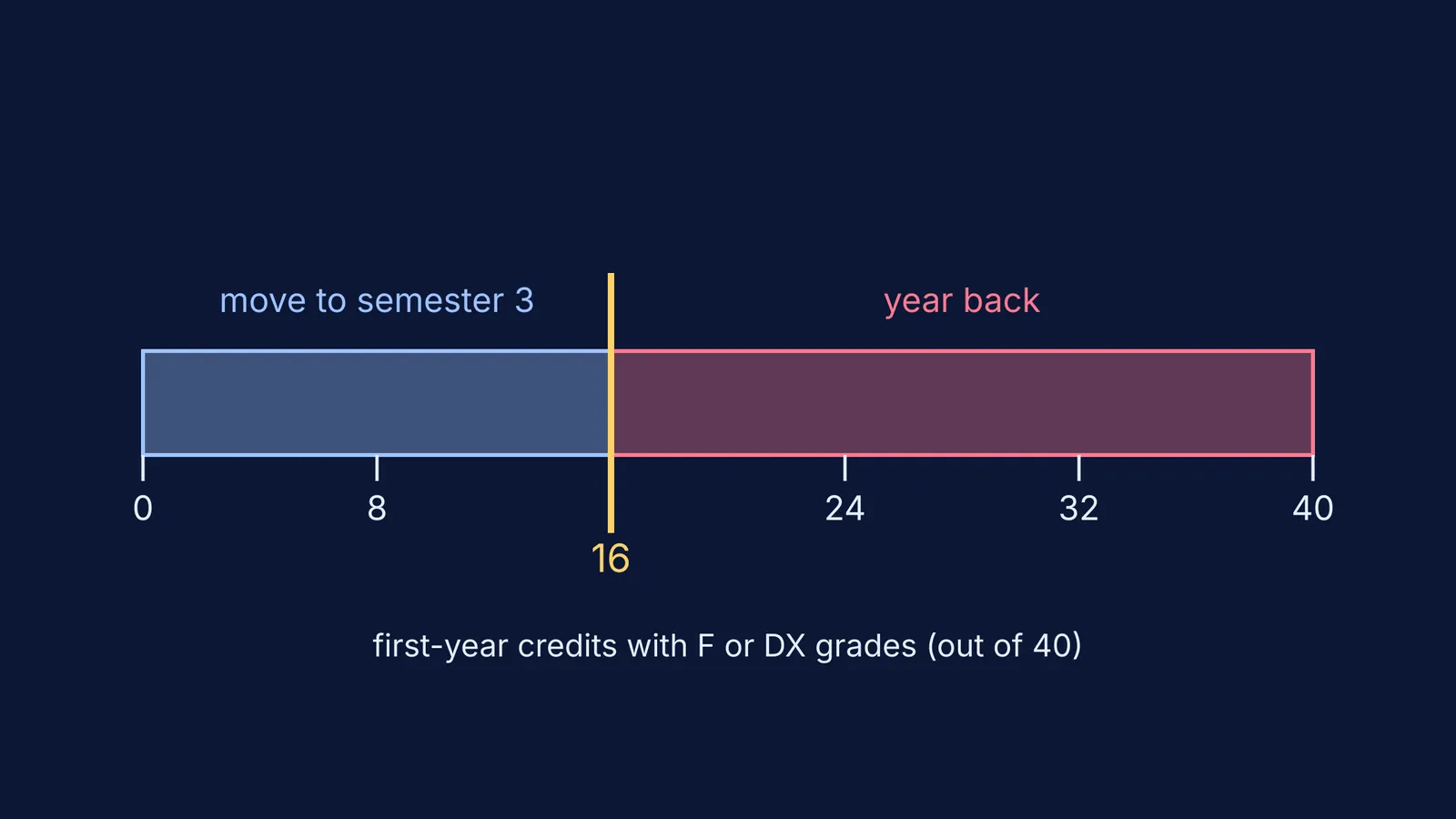
One real example: under VTU's B.E./B.Tech Regulations, 2022, first-year students whose F grades add up to more than 16 credits across semesters 1 and 2 cannot move to semester 3 (clause 22OB 6.4). The same regulations give the first year 40 credits, 20 per semester. Courses marked DX for an attendance shortage count towards those 16 credits.
From semester 3 onwards, the same VTU rules let you move forward even with several F grades. But you are admitted to semester 7 only after passing every course of semesters 1 and 2.
Other colleges count differently. The B.Tech rules of Noida Institute of Engineering and Technology, an autonomous college affiliated to AKTU (effective from 2020-21), put no restriction on moving from an odd semester to the next even one. To move up a year, though, you need 50% of the credits from the two preceding semesters.
If your college lets you carry subjects forward, read our explainer on what ATKT means and how it works. If you are unsure how credits add up, see how the college credit system works.
Why do students get a year back?
The VTU regulations show three routes:
Failed credits. An F grade means under 40% of a course's total marks, or under 35% in the semester-end exam.
Attendance. VTU asks for at least 85% in each course. The Vice Chancellor may condone a shortfall of up to 10% for documented reasons such as medical grounds or sports. Otherwise you cannot sit that course's semester-end exam.
Internal marks. You need at least 40% of the internal (CIE) marks to sit the semester-end exam.
They feed into each other: a subject you don't follow in week 3 becomes skipped classes and a weak internal test by week 8, then a DX or an F.
How close am I to a year back? A worked example
Suppose a first-year student under the VTU rules has these results (the credit values are for illustration; take yours from your grade card):
Semester 1: F in Mathematics (4 credits) and Physics (4 credits). Running total: 8.
Semester 2: F in Mathematics II (4 credits) and DX in a 3-credit course for low attendance. Running total: 15.
15 is not more than 16, so this student moves to semester 3, carrying four backlogs.
One more failed 2-credit course would make 17 and block the move.
Do the same sum for yourself: list every F, DX and incomplete course with its credits, add them, and compare with your university's limit. Every backlog you clear before promotion is decided lowers the total.
How do I avoid a year back? A semester checklist
Week 1: find the promotion (or "vertical progression") and attendance clauses in your university's current regulations, and write your limit in your notebook.
Every week: track attendance course by course, not overall. A healthy average can hide one course below the line.
Before each internal test: treat internal marks as the gate to the final exam, not a warm-up.
As soon as a subject stops making sense: ask the teacher or your mentor that same week. If the gap is a concept you never understood, the Fermi Concept Library has a lesson for every concept in physics, chemistry, biology, mathematics and computing.
Backlogs: register for every backlog exam. VTU's regulations let you register for up to 28 credits a semester, including backlog courses.
For a subject-by-subject method, see how to clear a backlog subject in engineering.
Already got a year back? How to recover
Get it in writing: which courses you must clear, and the next exam date for each.
Meet your mentor. Under VTU's rules, a mentor can advise a student who struggled in the first semester or year to take a lighter course load over several semesters.
Plan the year. You have fewer subjects and more time, so give each backlog a fixed weekly slot. Fermi's AI tutor works out what you already know and builds a plan for the session, so each study day starts with a clear next step.
Watch the clock. Under VTU's rules, a student still not eligible for semester 3 three academic years after admission must either leave the programme or be readmitted to semester 1.
A year back costs you a year; it does not have to end your degree. If the stress feels heavy, talk to someone you trust, or call Tele MANAS on 14416, the government's toll-free mental health helpline, which runs 24/7 according to PIB.