

On this page
In the Indian university system, failing a subject in the end-of-semester exams does not always mean you have to repeat the entire year. Thanks to the "Allowed To Keep Terms" (ATKT) provision, you can carry a limited number of failed subjects as backlogs and progress to the next year.
This system saves time, but the rules around how many subjects you can fail, and when they must be cleared, are strictly enforced. Here is how ATKT works across major universities, and what you need to do if you receive one.
What is ATKT in college exams?
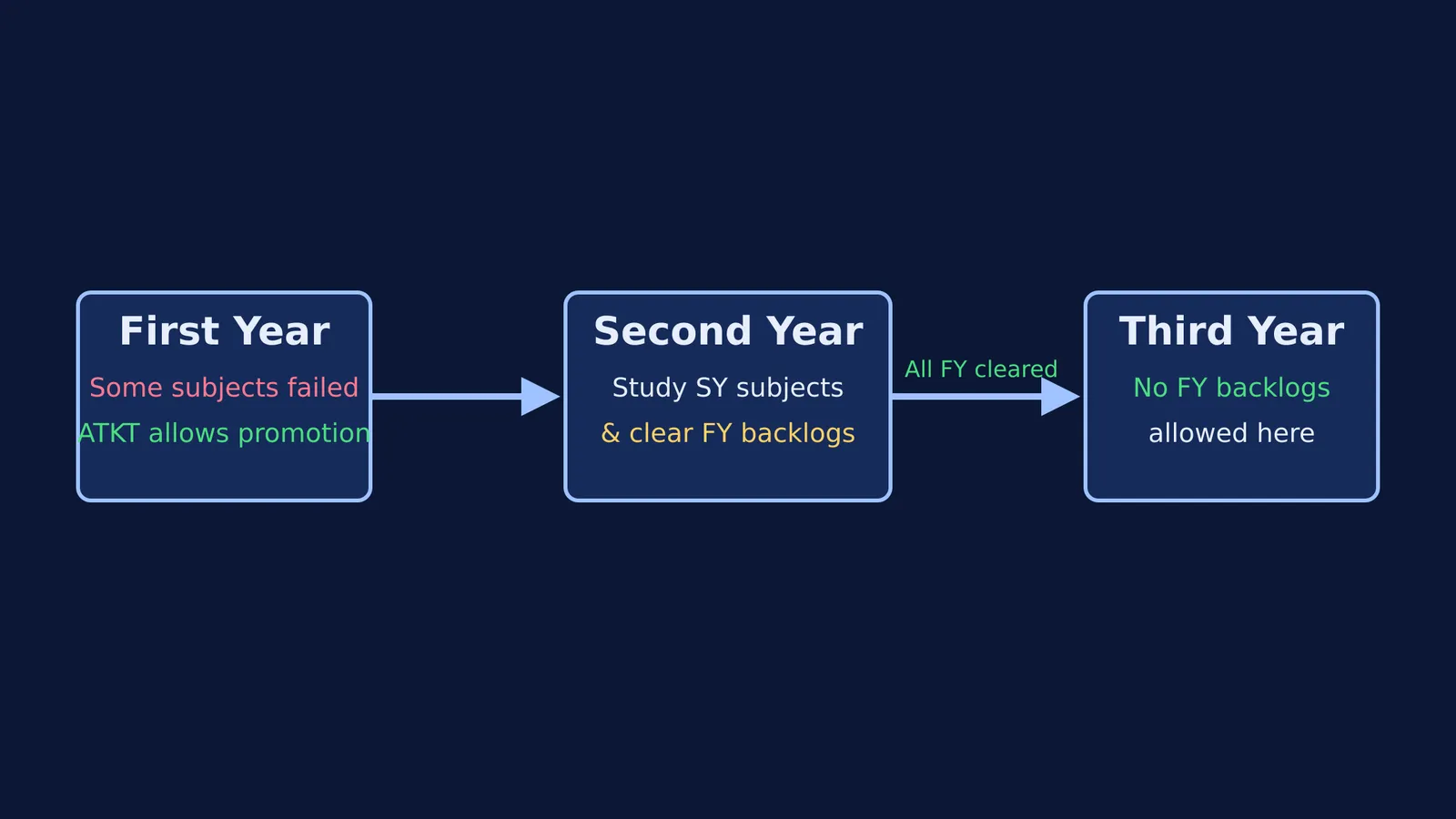
ATKT is a conditional promotion. If you do not meet the minimum passing criteria in one or more subjects, the university allows you to keep your academic terms and attend the next year's classes.
Instead of sitting out a year, you prepare for your current semester while simultaneously studying to clear the backlogs from previous terms. You must fill out a supplementary exam form and pay an ATKT exam fee for each subject you need to clear.
How many subjects can you carry forward?
The exact number of subjects you can fail without losing a year (known as a "year drop" or "year down") depends on your university and your degree programme.
Subject limits: Many standard undergraduate degrees allow you to keep terms if you fail in one to four subjects in total for the year.
Percentage of credits: Other institutions use a credit or heads-of-passing limit. For example, Savitribai Phule Pune University (SPPU) requires students to earn at least 50% of the total credits to move forward, while SNDT Women's University allows ATKT if a student fails in not more than 40% of the "heads of passing" (theory, practicals, and term work are counted separately).
If you are struggling with university physics or maths concepts, the Fermi Concept Library has a lesson for every concept to help you fill the gaps.
Do internal marks carry forward?
Yes. ATKT rules separate the "heads of passing". A single subject usually has two heads: an internal assessment (tests, assignments, term work) and an external university exam.
If you pass the internal assessment but fail the external written exam, your internal marks are carried forward. When you sit for the ATKT exam, you only need to take the external paper. However, if you fail the internal component, you may need to resubmit term work or retake unit tests in your college before you are allowed to sit for the final exam.
What happens if you do not clear your ATKT?
Failing an ATKT exam does not immediately result in a year drop, as long as you stay within your university's overall backlog limits. You can usually attempt the supplementary exam again in the next semester's exam cycle.
However, universities enforce a maximum time limit to complete your degree. For a standard three-year undergraduate programme, you generally have five to six years from the date of admission to clear all your subjects. If you repeatedly fail the ATKT exams and cross this maximum duration, your university registration may expire, and you will not be awarded a degree.
Furthermore, carrying backlogs into your final year can delay your graduation. Even if you pass all your third-year subjects, your final mark sheet and degree certificate will be withheld until every backlog is cleared. This can cause problems if you are applying for postgraduate studies or jobs, as most institutions and employers require a clean academic record.
How should you study for a backlog paper?
Balancing your current semester's syllabus with an ATKT subject requires strict time management. Do not treat the backlog as a secondary priority. Since you already struggled with the material once, you will need a new approach to master it.
First, analyse your previous performance. If you failed the external written paper, look at the syllabus and identify which chapters you completely skipped or misunderstood. Often, students fail because they rely on last-minute memorisation instead of understanding the core mechanisms or mathematical proofs.
Second, create a dedicated study slot for your backlog subject every week. Do not wait until the exam month to start revising. By dedicating just two hours a week to your ATKT subject from the start of the semester, you can comfortably cover the entire syllabus without overwhelming your current studies.
Finally, make sure you understand the format of the supplementary exam. It is usually identical to the regular end-of-semester paper, so past question papers are an excellent resource for practice. When you practice, write your answers fully and check if you are missing key steps. If you have failed a subject in your first semester, you must rebuild your foundation before moving forward.
Why should you clear backlogs before the third year?
A common trap for students is accumulating too many backlogs. While the ATKT rule lets you move from the first year to the second year, there is usually a hard block before the third year, often called the "Golden KT" rule.
At universities like SPPU, you must completely clear all first-year subjects before you are allowed to sit in a third-year classroom. Even if you pass every single second-year exam, a single pending backlog from semester one will result in a year drop. If you do face a year down, you will have to pause your degree progression and may need to convince your parents for a drop year to clear your pending subjects.
When studying for an ATKT exam, focus on understanding the core concepts rather than memorising past papers. If you need help untangling a difficult topic, Fermi's AI tutor works out what you know and builds a plan to teach you the steps, rather than just handing you an answer. Clear your backlogs at the earliest opportunity so you can graduate on time.


