

On this page
Failing a first-semester subject needs action, but colleges have a set process for it. You usually don't lose the year. You get a backlog: a course you still owe, shown as a fail grade until you clear it.
What do a backlog and a supplementary exam mean?
The names vary (backlog, arrear, back paper, re-exam), but the idea is the same: the college gives you a second attempt, either as a one-off exam or by letting you take the course again. Each college sets its own rules, so read yours, not a friend's. Two current examples:
At IIT Guwahati, a July 2026 notice says the supplementary exam is normally a single 3-hour test on the full syllabus, graded on that test alone, with no continuous-assessment marks carried over.
The same IIT Guwahati notice caps the grade from a supplementary exam at CC and lets you register for it in at most 3 failed courses. The exam is optional: you may repeat the course in a regular semester instead.
At NIT Calicut, Senate amendments dated 22 December 2025 say the highest grade for clearing a core theory course through re-examination is E.
So passing removes the fail, but the grade may be capped.
How do you register for a supplementary exam?
Treat registration as a hard deadline. In IIT Guwahati's notice, students registered online and paid a fee of Rs 500 per credit, and the notice said a registration was invalid without the fee. These steps fit most colleges:
Note the course code, credits and grade from your result.
Find the exam notice on the college website, or ask the exam cell when registration opens.
Ask whether you can choose between the exam and repeating the course.
Pay the fee and keep the receipt.
Check your hall ticket well before exam week.
Then message your course instructor:
"Sir/Ma'am, I failed [course code] in semester 1 and plan to take the supplementary exam. Could you tell me which topics cost me the most marks, and whether past papers are available? I want to start preparing this week."
How do you study for a backlog without hurting the next semester?
The bigger risk is not the backlog paper. It is letting the backlog eat into your current semester until you collect a second one. So protect the new semester first, and give the old course a small, fixed daily slot.
Use methods with strong evidence behind them. A 2013 review led by John Dunlosky rated practice testing and distributed practice (spreading study out over time) as high-utility techniques, and rated rereading and highlighting as low utility. In a 2006 study by Henry Roediger and Jeffrey Karpicke, students who took recall tests remembered more 2 days and 1 week later than students who reread the material, even though rereading made them feel more confident.
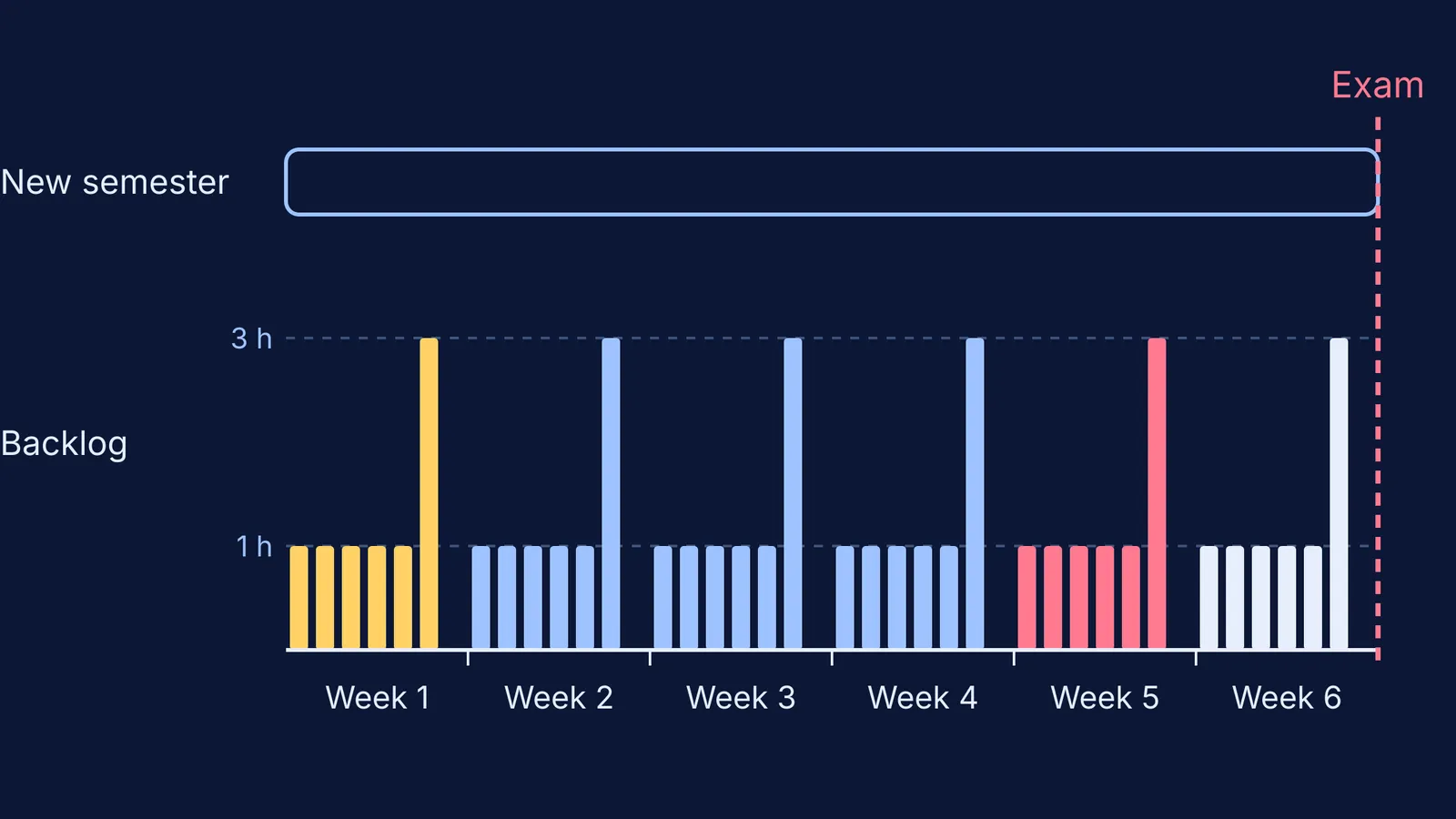
A six-week plan built on both methods:
Week 1, diagnose: collect the syllabus, your marks breakdown if your college shares it, and 3 to 5 past papers. Sort the topics into red (can't start), amber (start but get stuck) and green (can solve).
Weeks 2 to 4, rebuild: take one red or amber topic every two or three days. Each weekday hour: 10 minutes writing what you remember, 40 minutes solving problems without notes, 10 minutes logging mistakes. On Saturday, a 3-hour block of past-paper questions on covered topics.
Week 5, full papers: sit full past papers under exam timing and mark them strictly.
Week 6, repair: work only on the topics your mock papers exposed. Sleep normally the night before.
The arithmetic: five 1-hour weekday sessions plus a 3-hour Saturday block make 8 hours a week, or 48 hours in six weeks. Everything else goes to the current semester.
If a topic stays red because a basic idea never made sense, the Fermi Concept Library has a lesson for each concept in physics, chemistry, biology, mathematics and computing. If you know the idea but pick the wrong method, the Fermi Problem Library has worked problems with a step-by-step solver that explains the reasoning.
To space topics out, see our guide to building a spaced revision schedule. For the habits that prevent a second backlog, see settling into your first semester at college.
Will a backlog ruin your CGPA?
One capped grade pulls your average down, but every later semester adds credits to the average. Clearing the paper at the next attempt and keeping the coming semesters clean matters more than this one grade. Our post on how to improve your CGPA in college covers the longer climb.
Tell your parents early and show them the plan: the exam date, the fee and your six weeks.
If stress starts to affect your sleep, appetite or mood, talk to your college counsellor. You can also call Tele MANAS, India's free, 24x7 national mental-health helpline, on 14416 or 1800-891-4416, as listed on IIT Kanpur's counselling page.


