

On this page
A drop year means spending a year after Class 12 preparing to retake an entrance exam such as JEE Main or NEET-UG, instead of joining college straight away. Parents often worry about the money, a “lost” year and how you will cope; one written page answers all three better than a promise to work harder.
Can you take a drop year for JEE or NEET?
JEE Main: the JEE (Main) 2027 information bulletin sets no age limit and admits candidates who passed Class 12 in 2025 or 2026, or are appearing in 2027. Those who passed in 2024 or earlier are not eligible.
JEE Advanced: the official JEE (Advanced) 2026 eligibility page says a candidate can attempt it a maximum of two times in two consecutive years. If you sat it in Class 12, a drop-year attempt would be your second and last under these rules.
NEET-UG: the NEET (UG) 2026 information bulletin states, citing the National Medical Commission, that there is no upper age limit.
Rules change yearly; read the current bulletin together.
What should a drop-year plan include?
Fit it on one page under five headings.
Reasons. What went wrong, with evidence: which chapters you never finished and where your mock marks leaked. Our guide to reading your mock test data shows how.
Target. A score range and the colleges or courses it opens, checked against last year's official closing ranks.
Budget. Course or coaching, test series, books, hostel or PG if you would move, travel and exam fees. The JEE (Main) 2027 bulletin lists ₹1,000 per session for a general-category male candidate taking Paper 1 at a centre in India, and less for other categories.
Backup. Which other exams and degree courses you will apply to this year, decided now while everyone is calm.
Review points. Three dated check-ins, each with a number to hit and what happens if you miss it.
If coaching is on the list, ask for the written refund and exit policy before paying: the Ministry of Education's coaching guidelines, circulated to states in January 2024, say a centre should publish its fees, an easy exit policy and a fee refund policy on its website, according to a government reply in the Rajya Sabha in August 2026.
In a 2006 meta-analysis by Peter Gollwitzer and Paschal Sheeran38002-1), if-then plans had a medium-to-large effect on reaching goals across 94 independent tests. They also helped people step back from failing courses of action, which is what a review point is for.
What does a one-page drop-year plan look like?
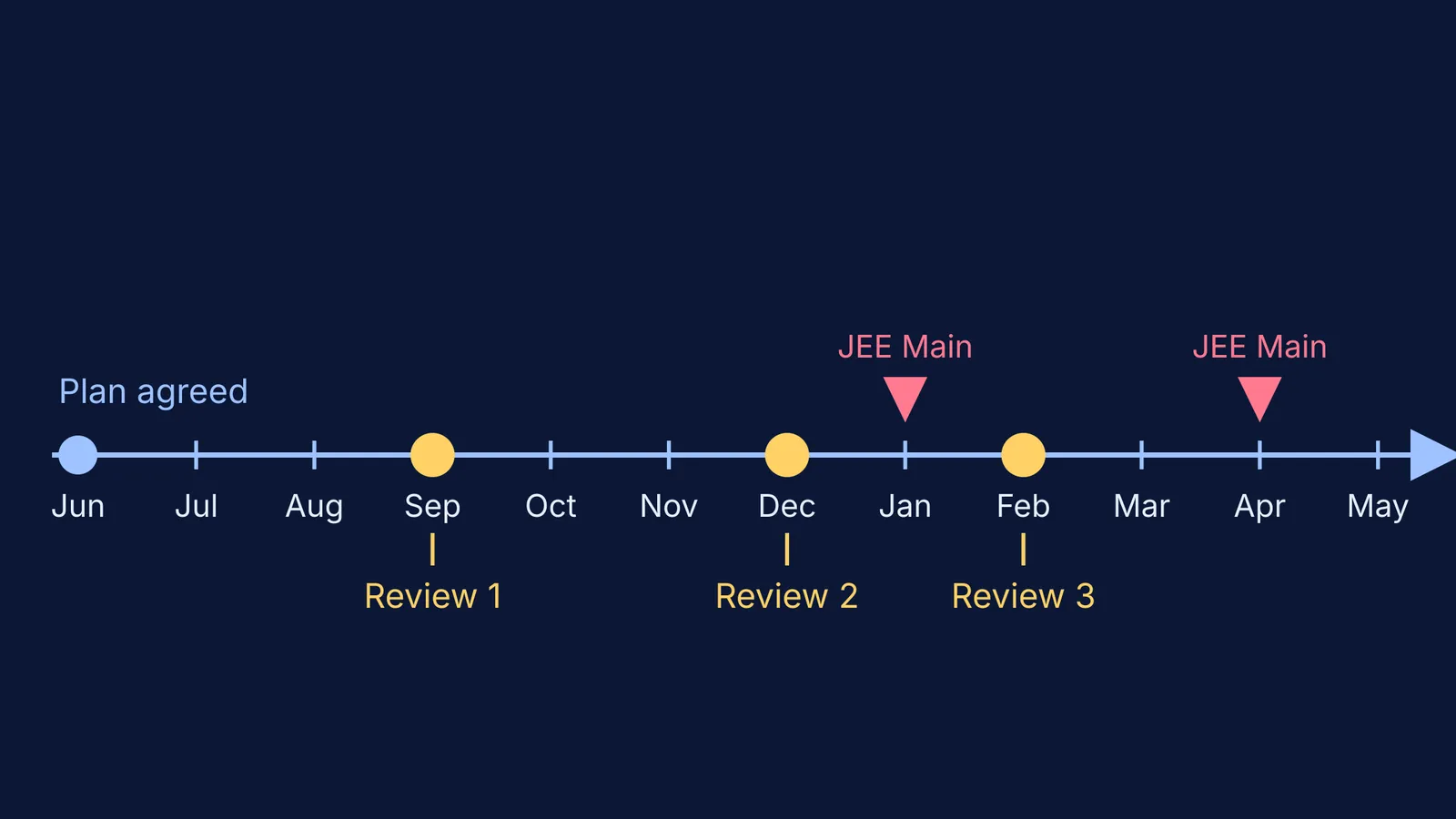
Here is one page for an imaginary JEE student, Aman. Session dates are from the JEE (Main) 2027 bulletin: January and April 2027.
Reasons: organic chemistry and rotational motion never finished; careless errors in the last hour of mocks.
Target: a JEE Main score that reaches the NIT branches on the family shortlist.
Budget: an online course and test series from home, not a move to a coaching city; fees for both sessions; a fixed monthly amount for books.
Backup: applications to the state engineering exam and to BSc physics courses, filed this year.
Review points: end of September (backlog chapters done); end of December (mock average inside the target band); after Session 1 (the result decides how much weight the backup gets).
If a backlog chapter stalls the plan, Fermi's AI tutor works out what you already know and builds a plan for the session.
What do you say to your parents?
Pick a quiet time, not results night. Hand over the page first, then talk. A script you can adapt:
“I want to talk about next year, and I've written a plan.”
“This is what went wrong, and here is the evidence.”
“This is what I'm aiming for, and what it would cost.”
“If it doesn't work, this is my backup, and I'm applying now.”
“Let's check progress on these three dates. If I miss the number, we follow the backup without a fight.”
“What worries you most?” Then listen, and add their worry to the page.
Don't argue on the spot; if they want time, agree on a day to talk again. Parents can read our guide on supporting a child through a JEE drop year.
What if the drop year gets hard?
Expect a flat stretch mid-year, when friends have left for college and scores stop rising; the review points let you compare numbers, not moods. When mocks keep showing the same wrong method, the Fermi Problem Library has a step-by-step solver that explains the reasoning rather than printing an answer.
Keep sleep, meals, time outdoors and friends in the plan. If low mood, worry or hopelessness lasts or crowds out daily life, tell a parent, teacher or doctor. Tele MANAS, the government's 24x7 tele-mental health service, is toll-free on 14416 (PIB), and our guide to exam stress and when to get help explains the warning signs.
Write your page tonight, and pick the first review date before you show anyone.


