
On this page
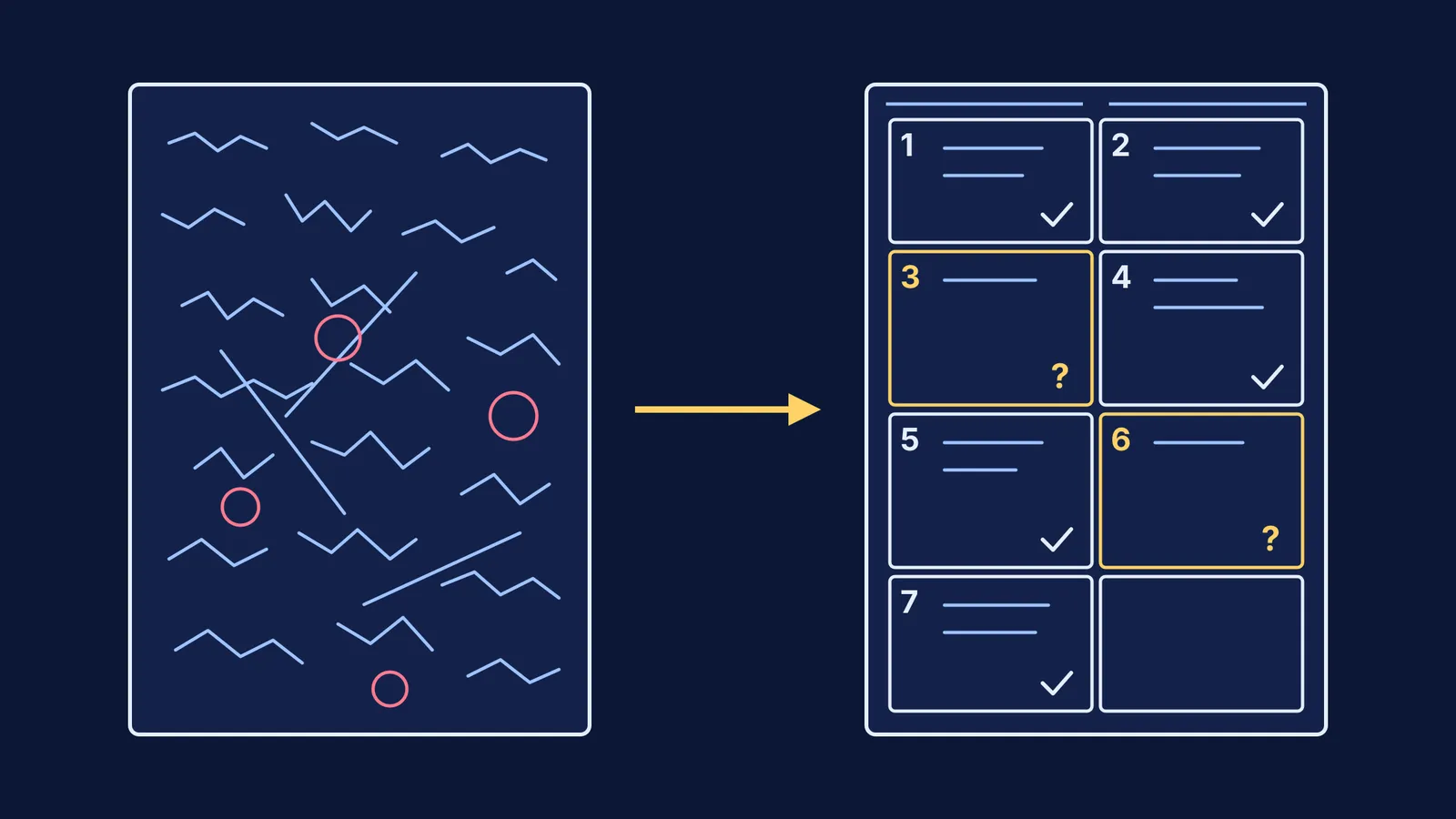
Picture the final stretch of a JEE Main paper. The screen shows a question you marked for review an hour ago. You worked it out somewhere, but the rough sheet is a storm of half-finished algebra. By the time you find the right lines, your checking time is gone.
The fix costs almost nothing: give every question its own numbered box.
What are the rough sheet rules in a computer-based exam?
Rules differ by exam, so read the current bulletin for yours. For JEE Main, the JEE (Main) 2027 Information Bulletin from the National Testing Agency (NTA) says rough sheets and a ballpoint pen are provided at the centre, and all calculations must be done only on those sheets.
The same bulletin says you must write your name and roll number at the top of each rough sheet and hand the sheets to the invigilator at the end. Swapping rough sheets is treated as unfair means, and you cannot bring your own paper, instruments or geometry box.
Paper 1 (B.E./B.Tech.) has 75 questions in 3 hours, with four marks for a correct answer and minus one for a wrong one, according to the NTA bulletin. A question marked for review with no answer selected scores zero.
Why do numbered boxes make rechecking faster?
Short-term memory is small: a review by psychologist Nelson Cowan brought together evidence that people can hold only about three to five chunks of information in mind at once (Cowan, 2001, Behavioral and Brain Sciences).
Writing your working down is a form of cognitive offloading, which Evan Risko and Sam Gilbert define as using physical action to change a task's information-processing demands so as to reduce cognitive demand (Risko and Gilbert, 2016, Trends in Cognitive Sciences).
A rough sheet already offloads your calculations; boxes add an index. When the screen shows question 14, you look at box 14 instead of trying to remember where you wrote it. We found no study testing numbered boxes on rough sheets specifically, so treat this as sensible bookkeeping built on those findings, not a tested way to raise scores.
How do you set up the boxes?
Write your name and roll number at the top of every sheet, as NTA requires.
When the test begins, fold each sheet in half lengthwise, then into four across. The creases give eight boxes per side without a ruler.
Number a box only when you start that question, using the number on screen, so skipped questions cost no space.
Work each question only inside its box. If it spills over, continue in the next free box headed "14 contd".
End every box with the answer circled: the option letter or the number you entered.
Add a tick when confident, and a "?" when you mark the question for review.
What does a worked example look like?
Say question 14 is a numerical-value question asking how much gravitational potential energy a 5 kg block loses as it falls 20 m. In box 14 you write the data and get 5 x 10 x 20 = 1000 J. Numerical answers are rounded to the nearest integer, and the NTA bulletin advises using the constants given in the question. You enter 1000, write "1000 ?", and mark it for review because you used g = 10 m/s² from habit.
In your final check, the review list sends you to question 14. Box 14 shows "g = 10" on its second line; the question gives g = 9.8 m/s². One line of redoing gives 5 x 9.8 x 20 = 980 J, and you correct the answer on screen.
What should you look for when you reopen a box?
Constants: did you use the values given in the question?
Copying: does the first line match the numbers on the screen?
Units and powers of ten.
Signs, especially in vectors, charges and energy changes.
The last step: does the option or number you entered match the circled answer?
How do you make the layout automatic before exam day?
A layout only helps under pressure if your hand already knows it, so use the same folded grid in every timed mock. Our guide to running a full-length mock as an exam-day rehearsal covers the rest of the setup, and keeping a time log for each question in mocks pairs well with boxes: note the minutes in each box's corner.
Keep your sheets after every mock; boxed work is easy to photograph and review, as in our piece on using photos of your handwritten rough work with an AI tutor.
For method problems, work a few similar questions in the Fermi Problem Library, where a step-by-step solver explains the reasoning rather than printing an answer.
At your next mock, fold the sheet as the test begins: eight boxes, numbered as you go.