On this page
Most olympiad certificates in a student's file are participation slips. A few lines in that file can change where you study. What separates them is the stage you reached, and how clearly you say so.
Which olympiad results count in Indian admissions?
According to HBCSE's page on the science olympiad stages, about 400 students per subject move from the National Standard Examination (NSE) to the Indian National Olympiad (INO). About 40 per subject go on to the Orientation-cum-Selection Camp (OCSC), and 4 to 5 per subject represent India at the international olympiad. Maths follows its own five-stage process under the National Board for Higher Mathematics.
The olympiad-based admission routes below reward the later stages:
IIT SCOPE. For 2026-27, IIT Madras, IIT Kharagpur and IIT Mandi offer extra (supernumerary) seats through Science Olympiad Excellence admission, according to the SCOPE business rules. You must have attended the maths training camp (IMOTC), an HBCSE OCSC or the informatics camp (IOITC) in the last four years, have first appeared for Class XII in 2025 or 2026, and have scored at least 75% in Class XII (65% for SC/ST/PwD) or be in your board's top 20 percentile.
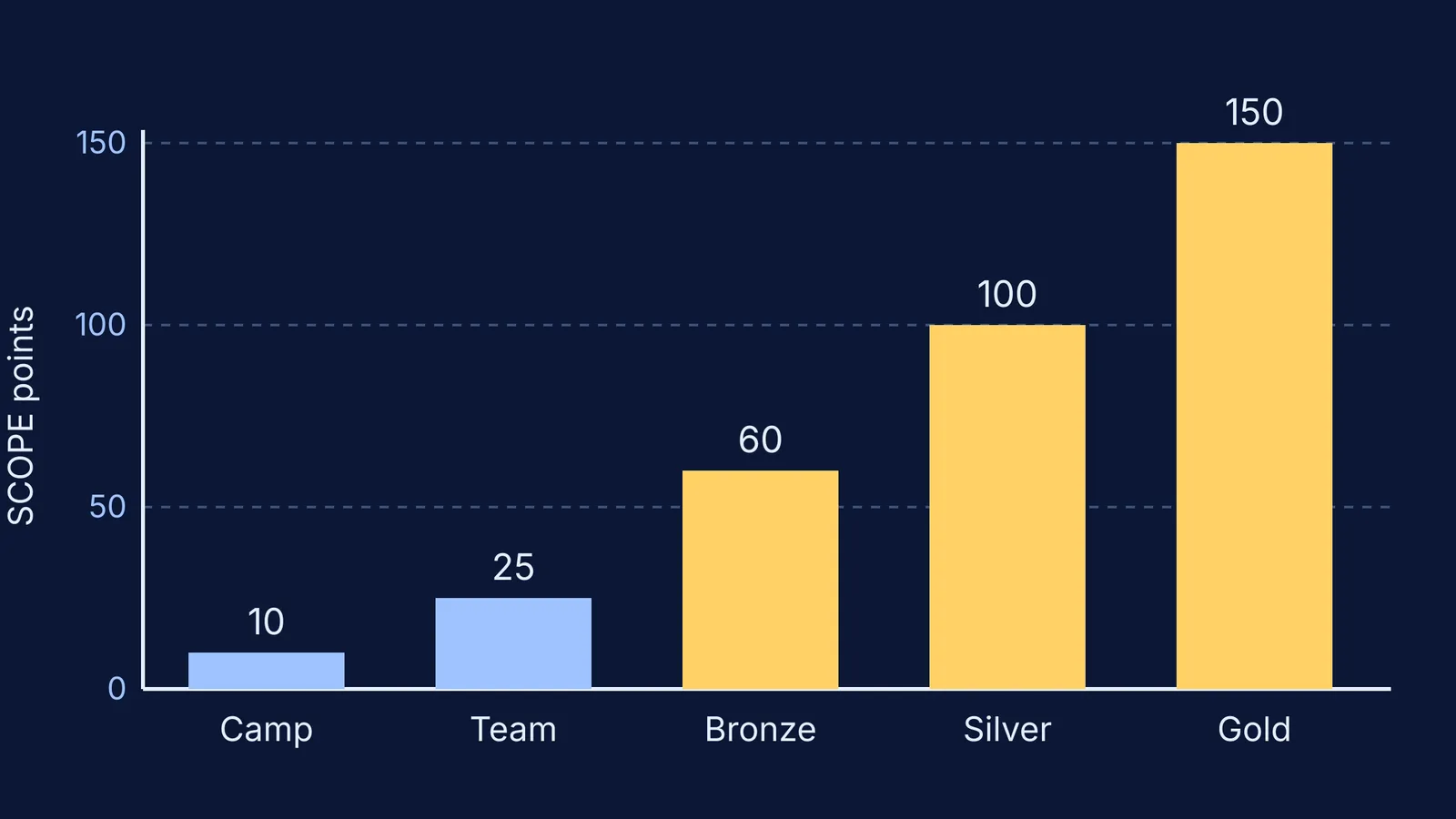
SCOPE points. The same rules give 10 points for attending a camp, 25 for competing in the Indian team without a medal, and 60, 100 or 150 for an international bronze, silver or gold. Each programme counts only the olympiad subjects it lists.
CMI. The Chennai Mathematical Institute admissions page exempts students from its BS entrance exam if, in Class 11 or 12, they qualified for IMOTC or EGMOTC, the physics OCSC or IOITC, or won gold or silver at INOI.
A first-stage certificate alone does not open these doors, but it still shows interest you can use in an essay or activities list. If you reach a camp, read what happens at the olympiad selection camp. Weighing routes? Compare CMI, ISI and IIT for maths lovers.
The 2026 SCOPE application window ran from 6 to 28 May 2026. Rules can change yearly, so check the current brochure first.
How do you list olympiad results on the Common App?
The Common App's checklist for applicants says you can list up to 5 academic honors, each with its title, when you received it and the level of recognition. You can also enter up to 10 activities, and the Common App guide to the Activities section allows 150 characters for activity details, honors won and accomplishments.
Put the result in Honors and the work behind it in Activities. A worked example for a student who cleared the physics NSE and wrote the INO in Class 11:
Honor title: Qualified for Indian National Olympiad in Physics (stage 2 of 5)
Grade: 11. Level: National
Activity details: Prepared for physics NSE and INO from past papers; ran a weekly problem session for 8 Class 10 students; reached INO in Class 11.
The honor states only what the certificate proves; the activity shows the effort. For the rest of the form, see our guide to filling the Common App as an Indian student.
What does presenting olympiad results honestly look like?
Some admission routes verify every document. Under SCOPE, the business rules say every certificate is checked by document verification officers, and wrong or forged documents lead to denial of admission with no appeal. Write every line so it would survive that check.
Use the exact name of the exam and stage: "cleared NSE in physics, wrote INO", not "national physics olympiad finalist".
Say what the certificate is: participation, merit, qualifier, camp or medal. A participation certificate is not an award.
Give the year and your class.
Describe the level by who ran that stage: school, regional, national or international.
Don't round up. Claim a rank or percentile only if the certificate or official list states it.
How do you talk about an olympiad in an interview?
Your rank is already on paper; in an interview or essay, what you add is how you think. Pick one problem from your preparation and practise explaining it from scratch in three minutes. A simple script:
"I cleared the physics NSE in Class 11 and wrote the INO. I didn't make the camp."
"The problem I remember best: I first tried this method, it failed because of this, so I switched to that."
Admitting you missed the camp is fine; it leads to the interesting part. To rehearse, explain a solved problem aloud step by step; the Fermi Problem Library has worked problems with a step-by-step solver that explains the reasoning, so you can check your explanation against it.
What should you gather before applications open?
Every certificate, score card and official results link, scanned or saved and named by year and stage.
A one-page list: exam, stage reached, year, class and level.
The current brochure for each route you are aiming for, with the deadline marked.
Start the folder this week. The line you write next year is only as strong as the paper behind it.