On this page
"Net zero" turns up constantly in climate news, and it is easy to misread. Here is what it means, what India has promised, and how to test a net-zero claim yourself.
What does net zero mean?
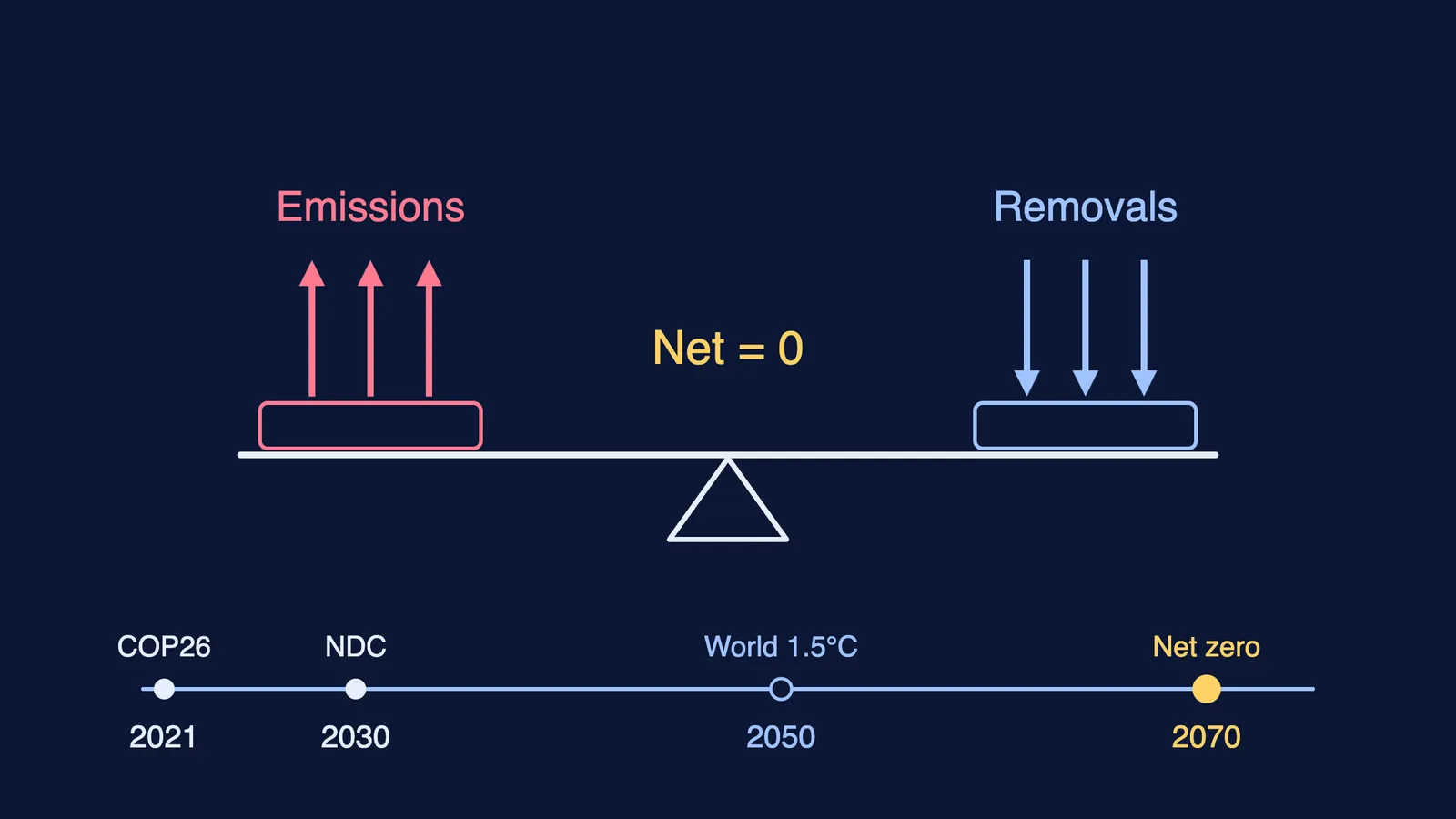
The IPCC, the UN's climate science panel, defines net zero CO2 emissions as the condition in which human-caused carbon dioxide emissions are balanced by human-caused CO2 removals over a specified period (IPCC AR6 Synthesis Report glossary).
Think of it as a bank account for the atmosphere. Emissions are deposits: burning coal, petrol and gas, making cement, clearing forests. Removals are withdrawals: growing forests, storing carbon in soils, or machines that capture CO2 and lock it away underground. Net zero is when deposits minus withdrawals comes to zero over the period.
A wider version, net zero greenhouse gas emissions, also counts gases such as methane, converted into one common unit; the glossary notes the result depends on the metric chosen.
Is net zero the same as zero emissions?
No. The UN puts it simply: net zero means cutting carbon emissions to a small amount of residual emissions that can be absorbed and durably stored by nature and other carbon dioxide removal measures (United Nations, Net Zero Coalition). That is why durability matters: a new forest does not cancel a coal plant if the trees burn twenty years later.
The same UN page says that to keep warming to 1.5°C, as the Paris Agreement calls for, emissions need to be reduced by 45% by 2030 and reach net zero by 2050 (United Nations). That is a global path; each country picks its own date. Our guide to the Paris Agreement and how COP summits work explains how those national pledges fit together.
What is India's 2070 net zero target?
On 1 November 2021, at the COP26 summit in Glasgow, Prime Minister Narendra Modi presented five commitments he called the "Panchamrit". In the government's English translation of his Hindi remarks, the fifth was: "by the year 2070, India will achieve the target of Net Zero" (PIB, National Statement at COP26).
In the same speech he said India has 17 percent of the world's population but its responsibility in emissions has been only 5 percent (PIB). He used that contrast to argue that India was still doing its part.
The speech did not say whether 2070 covers carbon dioxide alone or all greenhouse gases. Notice which one a writer assumes.
What has India promised before 2070?
On 3 August 2022 the Union Cabinet approved India's updated Nationally Determined Contribution (NDC), its formal pledge under the Paris Agreement (PIB, Cabinet approves updated NDC).
India's updated NDC commits it to cut the emissions intensity of its GDP by 45 percent by 2030 from the 2005 level, and to reach about 50 percent cumulative electric power installed capacity from non-fossil fuel-based energy resources by 2030 (PIB). The same release calls this a step towards net zero by 2070.
Two phrases are worth reading slowly:
Intensity, not total. Emissions intensity is emissions per rupee of GDP. If the economy doubles while intensity falls 45%, total emissions become 2 × 0.55 = 1.1 times the starting level. They still rise, just far more slowly than the economy.
Capacity, not energy. Installed capacity counts the power plants that could run, not the electricity they actually make. Solar panels make nothing at night, so half of capacity is not half of electricity.
If combustion, photosynthesis or the carbon cycle behind all this feels shaky, the Fermi Concept Library has a lesson for every concept in chemistry and biology, each with its place in the map.
How can you check a net-zero claim yourself?
Use the IPCC definition as a checklist. When a company, city or country says it will be "net zero by 20XX", ask:
Which gases: carbon dioxide only, or all greenhouse gases?
Which emissions: only its own chimneys and vehicles, or also the electricity it buys and the products it sells?
How much is cut, and how much is removed or offset? A plan built mostly on offsets is weaker than one built on cuts. Our explainer on how carbon credits work, and their catch shows where offsets go wrong.
How long do the removals last? Trees can burn; carbon stored in rock stays far longer.
What happens by 2030? A distant date with no near-term target is a promise, not a plan.
Here is a made-up worked example. Say your school's yearly emissions add up to 100 units, from electricity, buses and canteen gas. It puts solar panels on the roof (cutting 40 units), switches to electric buses (cutting 30) and plants a grove that absorbs 5 units a year. It still emits 100 − 40 − 30 = 30 units and removes 5, so its net is 25, not zero. To claim net zero it must cut those 25 units or pay for removals that last.
To run the same sum for your family, start with our guide to calculating your carbon footprint as a student in India. Next time you read "net zero by 2070", ask: net of what, and removed how?