On this page
Your carbon footprint is the greenhouse gas your activities release, usually written in kilograms of carbon dioxide equivalent (kg CO2e). You can estimate it with one formula and three records: the electricity bill, your travel and the month's groceries.
How do I calculate my carbon footprint?
Use the same rule for every activity:
emissions (kg CO2e) = activity × emission factor
The activity is something you can count: kilowatt-hours (kWh) on the bill, kilometres travelled, kilograms of food. The emission factor says how much greenhouse gas one unit of that activity releases. Work out each part for one month, add them, and multiply by 12 for a year.
Electricity: your share of the household's kWh × the grid factor.
Travel: kilometres by each mode × that mode's factor.
Food: kilograms of each main food × its factor.
Add the three and see which one is largest.
Which emission factors should I use in India?
Use Indian numbers where they exist, because India's power stations, vehicles and farms differ from those behind many online calculators.
For electricity, India's grid emitted 0.675 kg of CO2 per kWh in 2025-26, according to the Central Electricity Authority's CO2 Baseline Database, Version 22.0. That is an average over all grid-connected power stations, weighted by how much each generated, renewables included. Find the units consumed on your bill (one unit is one kWh) and divide by the number of people at home to get your share. Our explainer on electricity bill slab rates shows how to read the bill.
For travel, the India GHG Program's road transport emission factors, a 2015 version released for stakeholder consultation, give these values:
City bus: 0.0152 kg CO2 per passenger-km.
Scooter under 110 cc: 0.0334 kg CO2 per km.
Motorcycle under 125 cc: 0.029 kg CO2 per km.
CNG auto-rickshaw: 0.108 kg CO2 per km.
Petrol hatchback under 1000 cc: 0.117 kg CO2 per km.
The bus figure is already shared among passengers, and it is for buses within a city, not intercity coaches. The others are per vehicle, so count the whole trip if the vehicle went only for you, and divide by three if you shared an auto with two friends. Walking and cycling count as zero.
For food, a study led by Sylvia Vetter estimated farm-level emissions for Indian foods, published in Agriculture, Ecosystems & Environment in 2017 (free full text). Its country averages, in kg CO2e per kg of product:
Rice (paddy): 5.65
Wheat: 0.34
Pulses such as tur, moong and urad: 0.75
Tomato: 0.15
Milk: 2.42
Chicken: 2.59
Mutton: 45.54
The rice value is per kilogram of paddy, the grain before husking and polishing, so using it for the rice you buy is an approximation.
A worked example: one month for a Class 11 student
Ananya (an invented student) lives in Pune with three family members. Her month, using the CEA grid factor, the India GHG Program transport factors and the Vetter food values:
Electricity: the household used 250 kWh, so her share is 62.5 kWh. 62.5 × 0.675 = 42.2 kg.
Bus to coaching: 12 km a day for 24 days is 288 passenger-km. 288 × 0.0152 = 4.4 kg.
Scooter drop to school: 10 km a day for 24 days is 240 km, on trips made only for her. 240 × 0.0334 = 8.0 kg.
Rice: 4 kg × 5.65 = 22.6 kg.
Wheat (as atta): 5 kg × 0.34 = 1.7 kg.
Pulses: 1.5 kg × 0.75 = 1.1 kg.
Milk: 300 ml a day, about 9 kg a month. 9 × 2.42 = 21.8 kg.
Vegetables: 8 kg × 0.15 = 1.2 kg, using tomato as a stand-in.
Chicken: 1 kg × 2.59 = 2.6 kg.
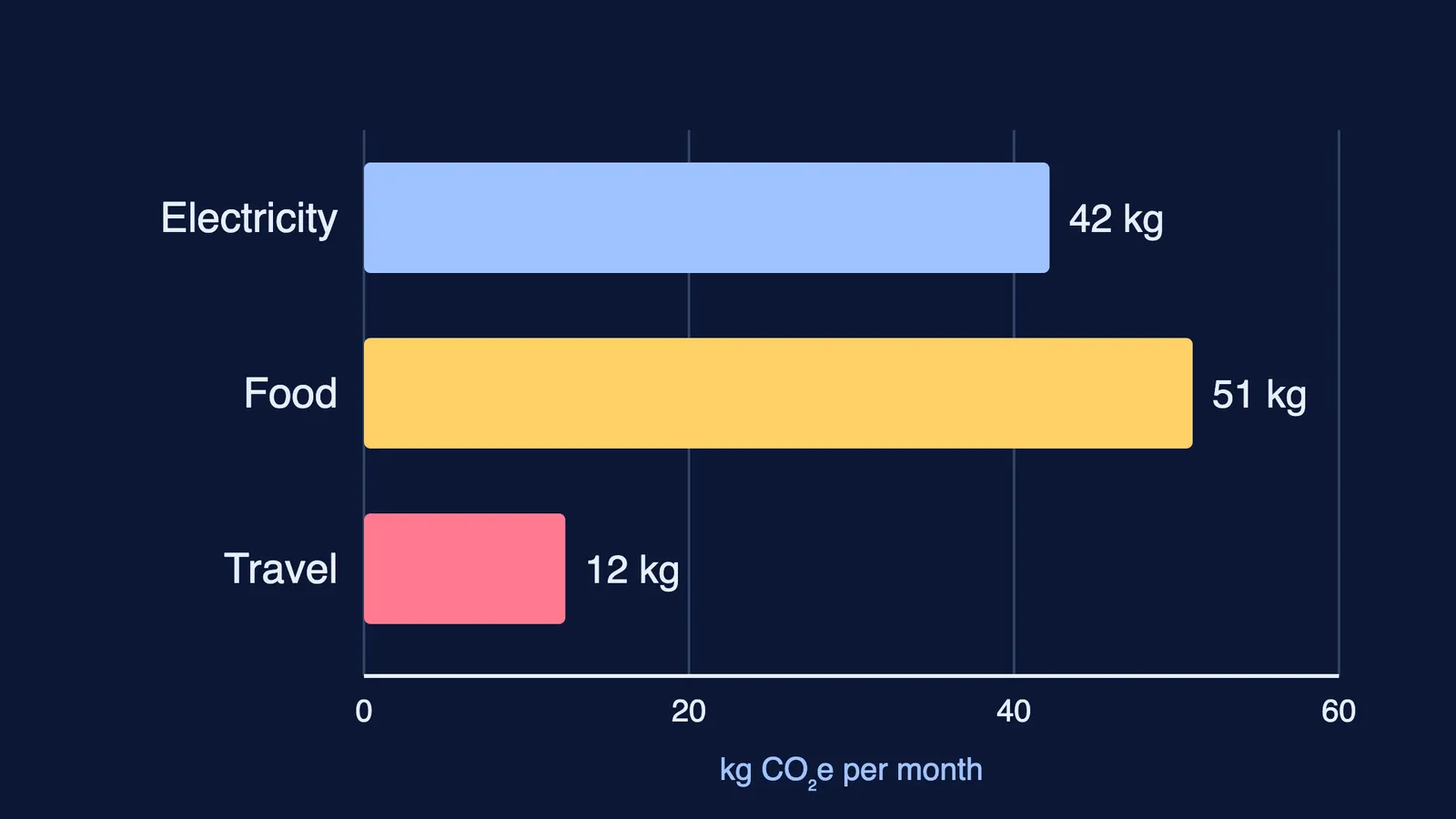
Her total is 42.2 kg (electricity) + 12.4 kg (travel) + 51.0 kg (food) = 105.6 kg CO2e a month, or about 1.27 tonnes a year from these three areas.
What makes the biggest difference?
Try one swap at a time with the same transport, food and electricity factors:
If Ananya's 288 km to coaching were in a petrol hatchback driven only for her instead of the bus, that trip would rise from 4.4 kg to 33.7 kg (288 × 0.117).
Replacing her 1 kg of chicken with 1 kg of mutton would add about 43 kg, close to doubling her food total.
Cutting 20 kWh from the household bill saves 13.5 kg for the whole household. Our posts on setting the AC at 24 °C and whether an idle charger uses power show where household kWh go.
If the step from watts to kWh feels shaky, the Fermi Concept Library has its own lesson for every concept in physics, chemistry, biology, mathematics and computing. For practice with unit-heavy sums like these, the Fermi Problem Library has worked problems with a step-by-step solver that explains the reasoning.
What does this calculation leave out?
It leaves out cooking gas, clothes, phones, flights and the energy used to process, pack and carry food to your kitchen, because the Vetter figures stop at the farm. The grid and transport factors count CO2 only, while the food factors include other greenhouse gases, so the total is a rough estimate. The transport factors are from 2015 and the grid factor changes every year, so check the CEA's latest version before you redo the sum.
Start with this month's electricity bill: it takes two minutes and gives you your first number.