On this page
Since 1 January 2020, every star-labelled room AC sold in India must come with a default setting of 24 °C, under a Ministry of Power notification announced by PIB. You can still turn it down. Whether you should is a question the thermodynamics chapter of Class 11 physics answers neatly.
Does setting the AC at 24 °C really save electricity?
Yes. The Bureau of Energy Efficiency (BEE) estimates that raising the room temperature by 1 °C saves about 6% of electricity, according to its FAQ on AC temperature settings, published by PIB in June 2018. The same FAQ says that moving from a typical 20 °C to 24 °C saves about 24% of the AC's electricity.
The FAQ also clears up a common myth: setting 18 °C does not cool the room faster. The thermostat only decides when the compressor stops, so a lower setting just keeps the compressor running longer.
Why does a smaller temperature gap mean less compressor work?
An AC is a refrigerator for your room: it pumps heat from the room to the hotter air outside, and that pumping costs electrical work. Two things get worse as the gap between outside and inside grows.
More heat leaks in. Heat conducts through walls and windows at a rate proportional to the temperature difference, P = kA(Th − Tc)/d, as OpenStax University Physics explains. A colder room pulls heat in faster, and the AC has to pump all of it back out.
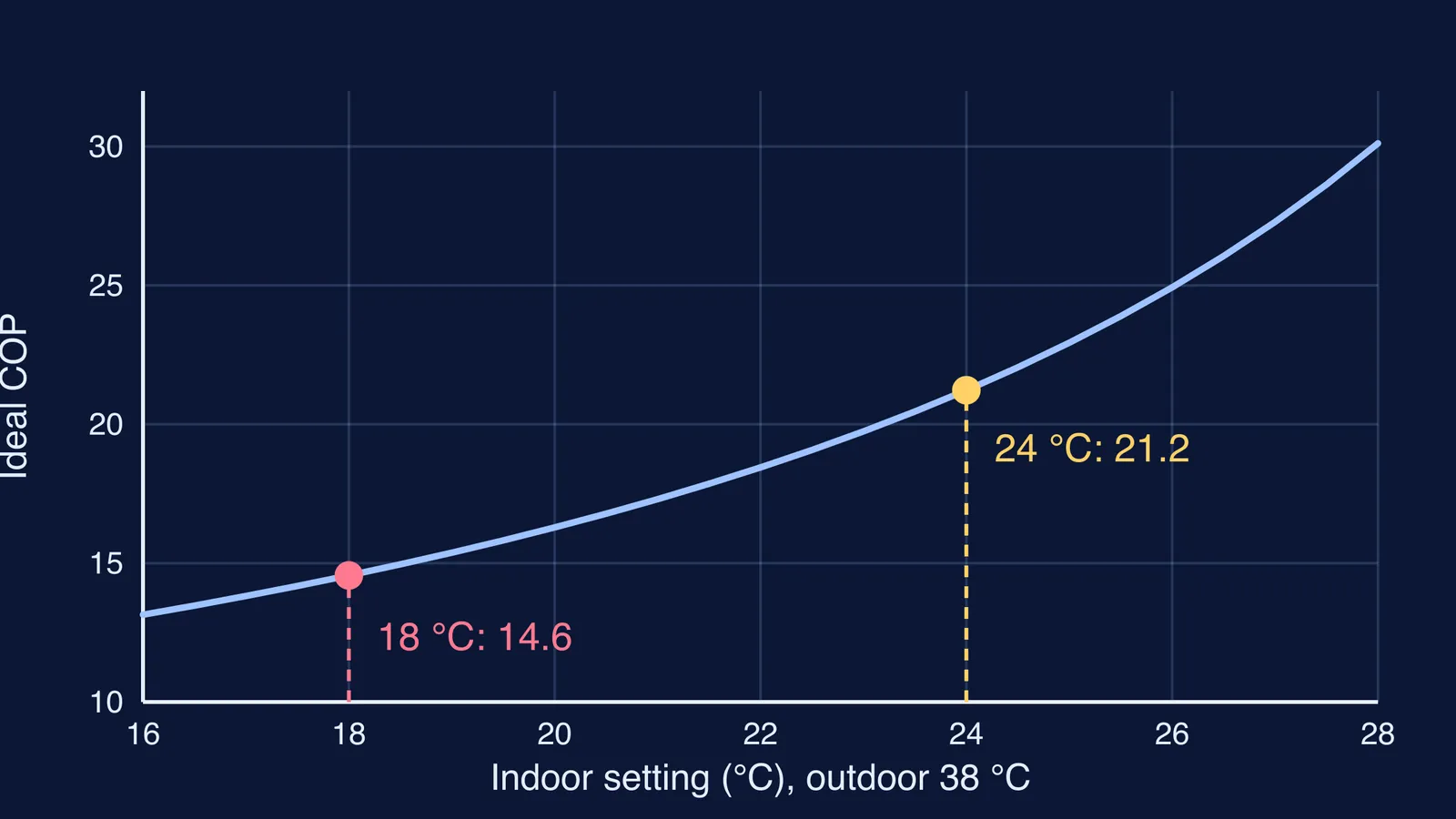
Each joule costs more to pump. The coefficient of performance (COP) of a refrigerator is the heat removed from the cold side divided by the work done, K = Qc/W (OpenStax). For an ideal Carnot refrigerator, K = Tc/(Th − Tc) with temperatures in kelvin (OpenStax), so the bigger the gap, the lower the COP.
We worked through the fridge version of this idea in why a refrigerator works harder in summer.
Worked example: 18 °C or 24 °C on a 38 °C afternoon?
Take outdoor air at 38 °C, which is 311.15 K. Use the ideal Carnot formula from OpenStax, K = Tc/(Th − Tc).
At 24 °C (297.15 K): K = 297.15 ÷ 14 ≈ 21.2.
At 18 °C (291.15 K): K = 291.15 ÷ 20 ≈ 14.6.
So each joule you remove costs about 1.46 times as much work at 18 °C. On top of that, the gap is 20 degrees instead of 14, so about 1.43 times as much heat leaks in through the walls. Multiply the two and this idealised model says the compressor does roughly twice the work at 18 °C.
For a sense of scale, the standards notified in October 2019 set seasonal efficiency ratings (ISEER) of 3.30 to 5.00 for split ACs from January 2021, according to PIB. ISEER is a seasonal average, not a single-temperature COP, but it sits far below the ideal 21.2.
If the jump from K = Qc/W to K = Tc/(Th − Tc) feels shaky, the Fermi Concept Library has its own lesson for every concept in physics. To practise COP numericals, the Fermi Problem Library has worked problems with a step-by-step solver that explains the reasoning rather than printing an answer.
Why did BEE choose 24 °C as the default?
Comfort, as well as savings. BEE's FAQ notes that normal body temperature is 36-37 °C, and that by the comfort chart, temperatures up to 25 °C are comfortable with suitable humidity and air movement. It adds that technical analysis puts the setting for comfort at steady state at 24-25 °C, and that Japan introduced a default of 28 °C.
When the campaign launched on 22 June 2018, the then Power Minister R.K. Singh said many commercial establishments, hotels and offices kept rooms at around 18-21 °C, forcing people into warm clothing, which he called a waste of energy (PIB). Manufacturers were advised to label the optimum setting in the range of 24-26 °C, and the ministry estimated that if all consumers adopted it, India would save 20 billion units of electricity in a year.
How should you set your AC this summer?
A short checklist for your home, based on BEE's FAQ and the physics above:
Leave it at the 24 °C default, then try 25 °C or 26 °C for a few nights. By BEE's estimate, each degree up saves about 6%.
Do not drop to 18 °C to cool the room faster. It will not; the compressor just runs longer.
Run the ceiling fan with the AC. Air movement is part of what makes 24-25 °C feel comfortable.
Shut doors and windows, and draw curtains on sun-facing glass. Less heat coming in is less heat to pump out.
When you buy, read the star label. Our guides to what BEE star ratings mean and how an inverter AC saves power explain what to look for.
Try the worked example with your own city's afternoon temperature.