

On this page
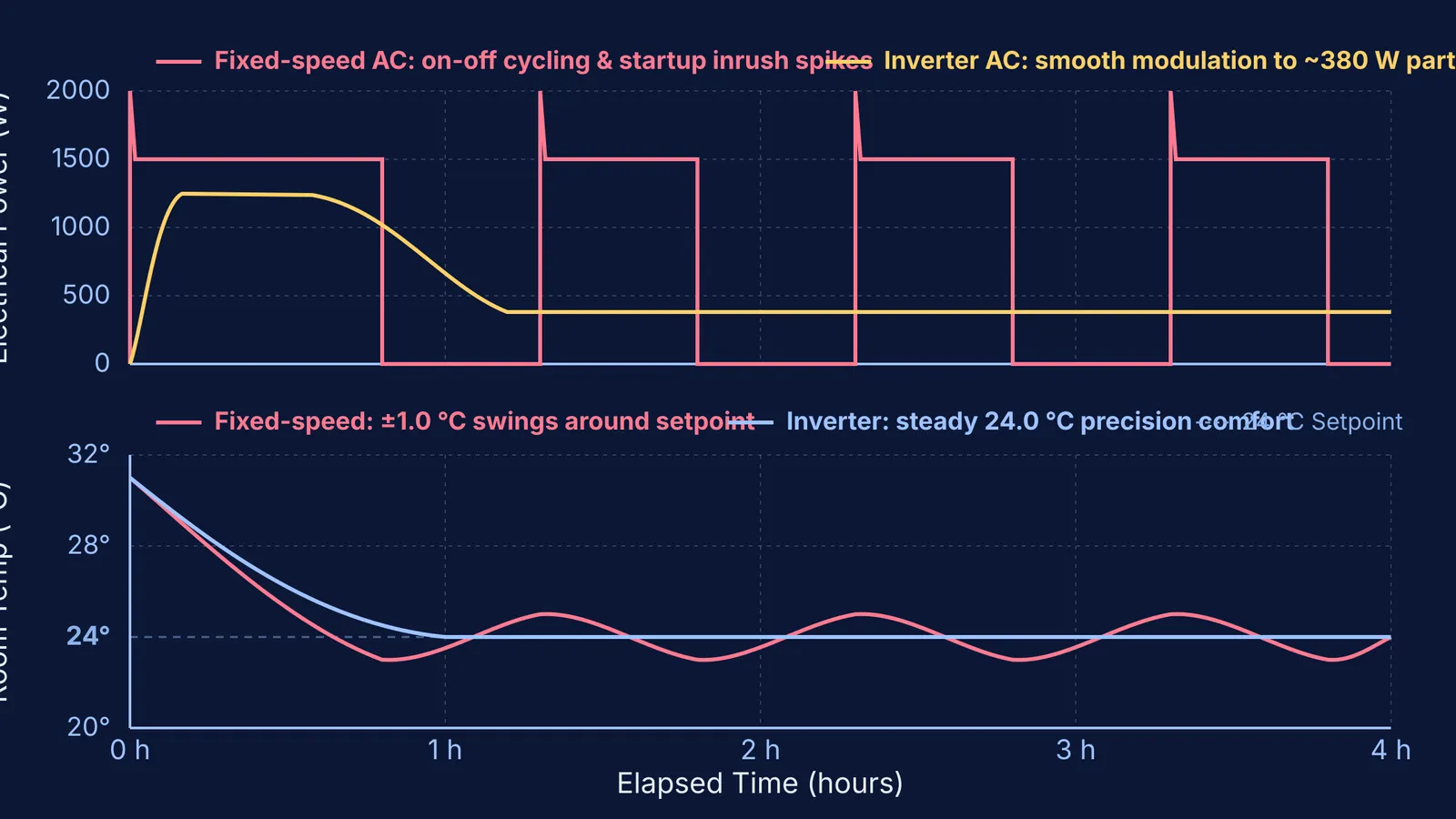
When you set a traditional, non-inverter air conditioner to 24 °C, its compressor motor operates like a simple on-off switch. Connected directly to the standard 230 V, 50 Hz electrical mains, the compressor runs at full mechanical speed—typically around 2,900 revolutions per minute for a two-pole induction motor—until the room drops slightly below the setpoint. Once cooled, the thermostat cuts power completely. As heat enters through walls and windows, the room warms up, prompting the thermostat to switch the motor back on at full blast.
An inverter air conditioner replaces this binary cycling with a variable-frequency drive (VFD). Incoming alternating current is converted to direct current by a solid-state rectifier, and an inverter synthesizes variable-frequency alternating current to power a brushless DC or permanent magnet synchronous motor. Because synchronous motor speed follows the relation N = 120f / P, where f is the electrical frequency in hertz and P is the pole count, modulating f across a wide frequency band lets the compressor vary its speed smoothly from low maintenance output to maximum capacity (Shao et al., 2004).
Connecting motor rotation to electrical waveforms is central to studying alternating current and RMS power. The Fermi Simulation Lab provides interactive simulations for the ideas that are easier to see than to read, helping students visualize how variable-frequency waveforms govern mechanical drive systems.
Why does variable compressor speed consume less power?
Running a compressor continuously at lower speed draws significantly less total electrical energy than stop-and-go cycling (Khatri & Joshi, 2017).
First, an inverter eliminates motor restart surges. When a conventional induction motor starts from rest, it draws a locked-rotor inrush current 3 to 5 times its normal operating current, dissipating energy as waste heat under the heating effect of current across the motor windings and wiring. An inverter executes an electronic soft start, ramping up frequency smoothly with negligible surge.
Second, part-load operation dramatically improves thermodynamic efficiency. Under the second law of thermodynamics, a refrigeration cycle's Coefficient of Performance (COP)—the ratio of heat removed to electrical work expended—increases when the temperature gap between refrigerant coils and the surrounding air shrinks. In a split AC, the coil surface area is fixed. When the inverter throttles compressor speed, refrigerant flow drops, so the same coil area operates across a smaller temperature difference. The compressor pumps heat against a lower pressure ratio, expending less mechanical work per joule of cooling. It also avoids pressure equilibration losses, where high-pressure refrigerant bleeds away uselessly whenever a fixed-speed compressor cuts off.
How much electricity does an inverter AC actually save?
Real-world measurements confirm these efficiency gains. In a 108-day continuous field experiment published in *Energy Transitions*, researchers monitored identical 1.5-ton split units under real operating conditions (Almogbel et al., 2020). The inverter model consumed 3,471 kWh over the evaluation year compared to 6,230 kWh for the fixed-speed unit—a measured 44% reduction in electricity consumption and a 49% reduction in carbon emissions.
To see the financial impact during an 8-hour summer night in an Indian bedroom cooling from 34 °C down to 24 °C:
Fixed-speed AC: Cycling at a 50% duty cycle on a 1,500 W draw, plus restart and pressure losses, averages ~800 W, consuming 6.4 kWh per night. At ₹8 per kWh, that costs ₹51.20 per night, or ₹1,536 monthly.
5-Star Inverter AC: Pulling 1,200 W for 45 minutes during initial pull-down (0.9 kWh) and 360 W for the remaining 7.25 hours (2.61 kWh) totals ~3.51 kWh per night. This costs ₹28.08 per night, or ₹842 monthly.
The inverter saves ~₹694 each month, recovering its purchase premium within two to three summer seasons.
How do BEE star ratings and ISEER measure cooling efficiency?
In India, the Bureau of Energy Efficiency (BEE) rates air conditioners using the Indian Seasonal Energy Efficiency Ratio (ISEER), a standard notified by the Ministry of Power. ISEER measures the ratio of total annual heat removed (Cooling Seasonal Total Load) to total energy consumed (Cooling Seasonal Energy Consumption) over 1,600 operating hours.
Unlike older tests conducted at a single 35 °C temperature, ISEER tests across outdoor bins between 24 °C and 43 °C based on weather data from 54 Indian cities. Because over 65% of annual cooling hours occur at moderate temperatures below 31 °C, ISEER directly reflects the part-load advantages of inverter compressors. Split units achieving an ISEER of 5.00 or higher earn a 5-star rating, while 1-star units sit around 3.30. Additionally, the Ministry of Power mandates a default 24 °C factory setting for all room ACs up to 10,465 W cooling capacity, noting that every 1 °C increase in thermostat setting saves roughly 6% of electricity.
For students connecting electrical theory with thermal physics, the Fermi Concept Library covers every concept in physics, chemistry, biology, mathematics and computing, each with its own lesson and its place in the map.


