

On this page
Every major appliance in Indian showrooms carries a red-and-white sticker featuring one to five stars. Managed by the Bureau of Energy Efficiency (BEE) under the Energy Conservation Act, 2001, this Standards and Labeling programme translates thermodynamic performance into an intuitive rating. More stars signify higher efficiency: delivering the same cooling or storage while drawing fewer kilowatt-hours. Because BEE tightens benchmarks every two to three years, every label displays an active validity period—such as 2026 to 2028. Comparing two models is only valid when both carry labels from the same regulatory cycle.
What do the stars on a BEE label actually measure?
A star label measures energy efficiency relative to a government baseline rather than gross power draw. To ensure authenticity, the Bureau of Energy Efficiency requires testing in accredited laboratories and conducts random market surveillance tests on retail units. The label displays four standardised values:
Star rating: Relative efficiency from 1 to 5 stars against competing models of equal size.
Annual energy consumption: Estimated yearly electricity use in kilowatt-hours (kWh or units) under standardised test conditions.
Capacity: Measured cooling output for air conditioners (in watts) or storage volume for refrigerators (in litres).
Label period: The active calendar years for the rating criteria.
Why can you not compare stars across different appliance sizes?
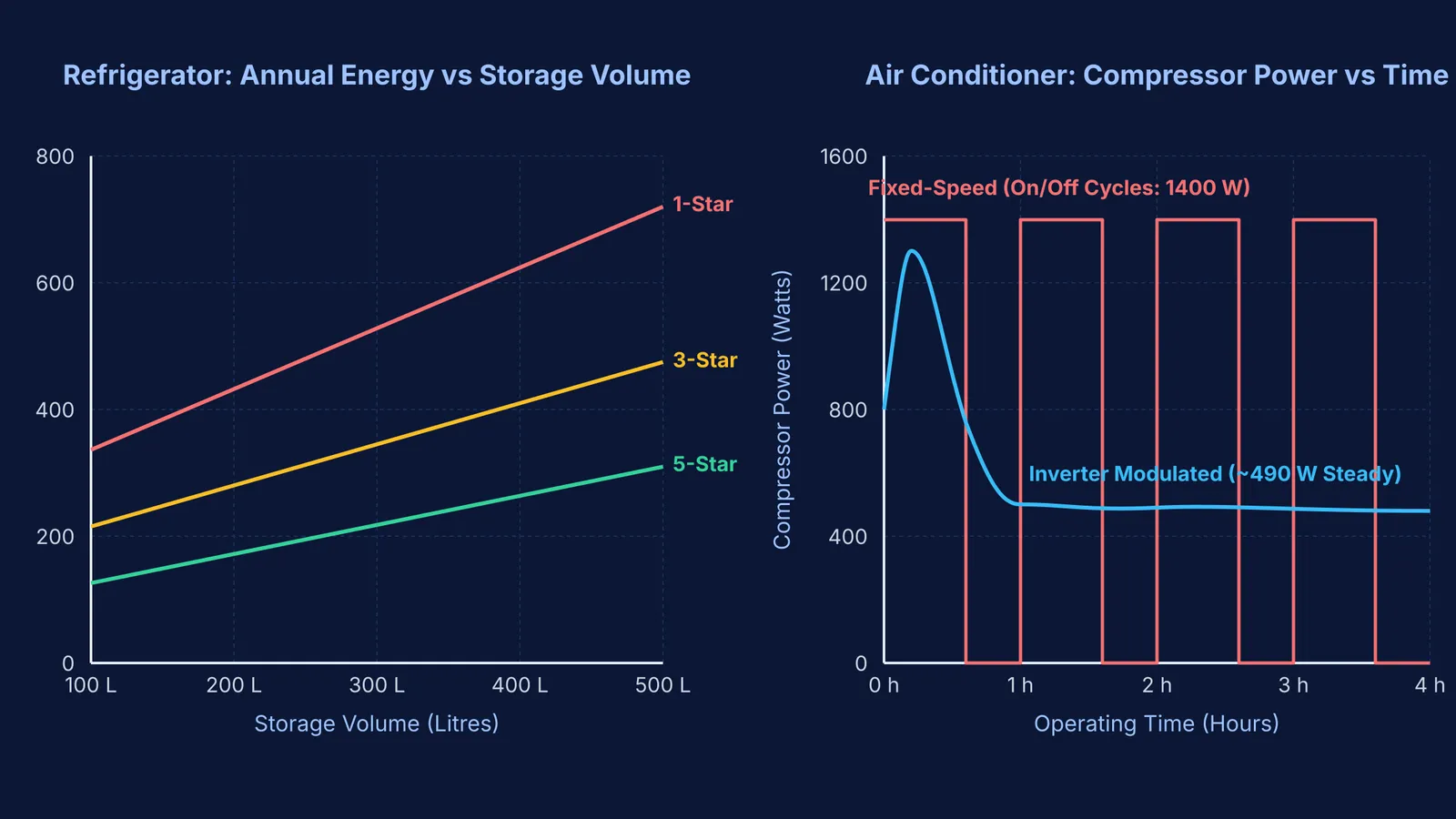
Star ratings compare efficiency within a specific capacity class, not absolute electricity consumption. A large appliance requires more physical work than a small one, regardless of design quality. Under Bureau of Energy Efficiency testing standards, refrigerators are judged using an adjusted storage volume. Because cooling a freezer to −15 °C demands far more thermodynamic work than maintaining fresh food at +3 °C, freezer volume is multiplied by an adjustment factor of roughly 1.62. Consequently, a 5-star 500-litre refrigerator often consumes 320 kilowatt-hours annually, whereas a 2-star 180-litre model consumes only 240 kilowatt-hours. Learn how thermodynamic cycles pump heat against temperature gradients in our guide on refrigerator and heat pump thermodynamic efficiency.
How do watts, kilowatt-hours, and your electricity bill connect?
Electric power, measured in watts (W) or kilowatts (kW), is the instantaneous rate of energy transfer. Energy, measured in kilowatt-hours (kWh), is the total electricity consumed over time: Energy = Power × Time. In India, electricity utilities bill in 'units', where one unit equals one kilowatt-hour (3.6 × 10⁶ joules).
Unlike constant-wattage heaters, compressors in refrigerators and air conditioners cycle or modulate. Under Bureau of Energy Efficiency testing protocols, a refrigerator remains plugged in for all 8,760 hours of the year, but its compressor draws power only when cabinet temperatures rise. That is why nameplate wattage cannot predict your bill; you must read the annual energy consumption in kWh/year on the label. For electrical circuit theory, review our explainer on Class 10 electric power and Ohm's law and our guide on the heating effect of current and household electricity billing.
How do air conditioner ISEER ratings calculate yearly power?
Air conditioners are rated using the Indian Seasonal Energy Efficiency Ratio (ISEER), defined by the Bureau of Energy Efficiency as Cooling Seasonal Total Load divided by Cooling Seasonal Energy Consumption. Testing assumes 1,600 operating hours annually across outdoor temperatures from 24 °C to 43 °C, reflecting the climate of 54 Indian cities. A higher ISEER indicates more heat extracted per watt-hour consumed. Under the regulatory norms, a 1-star split AC starts near an ISEER of 3.5, while a 5-star inverter model exceeds 5.6.
Inverter units achieve high ISEER values through variable-speed compressors. Running continuously at partial load reduces thermal resistance across heat exchangers, lowering approach temperature differences and cutting throttling losses. When students struggle to visualise how temperature differences drive heat flow or how compressor work transfers thermal energy against a gradient, interactive simulations in the Fermi Simulation Lab provide visual models for ideas that are easier to see than to read, letting students observe energy transfer across thermal reservoirs in real time.
How can you calculate whether a 5-star appliance is worth the extra price?
A 5-star appliance carries a higher retail price, but lower running costs offset the premium. According to Bureau of Energy Efficiency guidelines, you can calculate the payback period in four steps:
Find annual units: A 1.5-ton 3-star AC consumes roughly 1,000 units/year, while a 1.5-ton 5-star AC consumes roughly 740 units/year.
Calculate unit savings: 1,000 − 740 = 260 kWh saved per year.
Multiply by tariff: At ₹8 per unit, annual savings equal 260 × ₹8 = ₹2,080.
Compute payback: If the 5-star model costs ₹6,000 more upfront, dividing ₹6,000 by ₹2,080 yields a payback period of 2.9 years over an 8- to 10-year lifespan.
For practice calculating household energy budgets from wattage ratings, the Fermi Problem Library provides worked problems with a step-by-step solver that explains the reasoning rather than printing an answer.
Before buying, check the validity period on the label, match capacity to room size, and consider your actual daily runtime. If your AC runs 10 hours daily through summer, your annual runtime exceeds the standardised 1,600 hours, cutting the payback time in half.


