On this page
If an airline has offered to "offset" your flight, you have met carbon credits. Here is what they are, a worked example you can do on paper, and the criticisms to know before you trust a "carbon neutral" label.
What are carbon credits?
One tradable carbon credit equals one tonne of carbon dioxide, or the equivalent amount of another greenhouse gas, reduced, sequestered or avoided, according to the UN Development Programme.
Gases such as methane trap heat at different strengths, so they are converted into tonnes of CO2 equivalent (CO2e) to sit on one scale. Our post on how the greenhouse effect works explains the physics.
UNDP describes two types of market. Compliance markets are created by national, regional or international policy or regulation. Voluntary markets are where credits are bought and sold by choice, such as a company that wants a carbon-neutral label. UNDP adds that once a credit is used to cancel out emissions, it becomes an offset and can no longer be traded.
How does a carbon credit work?
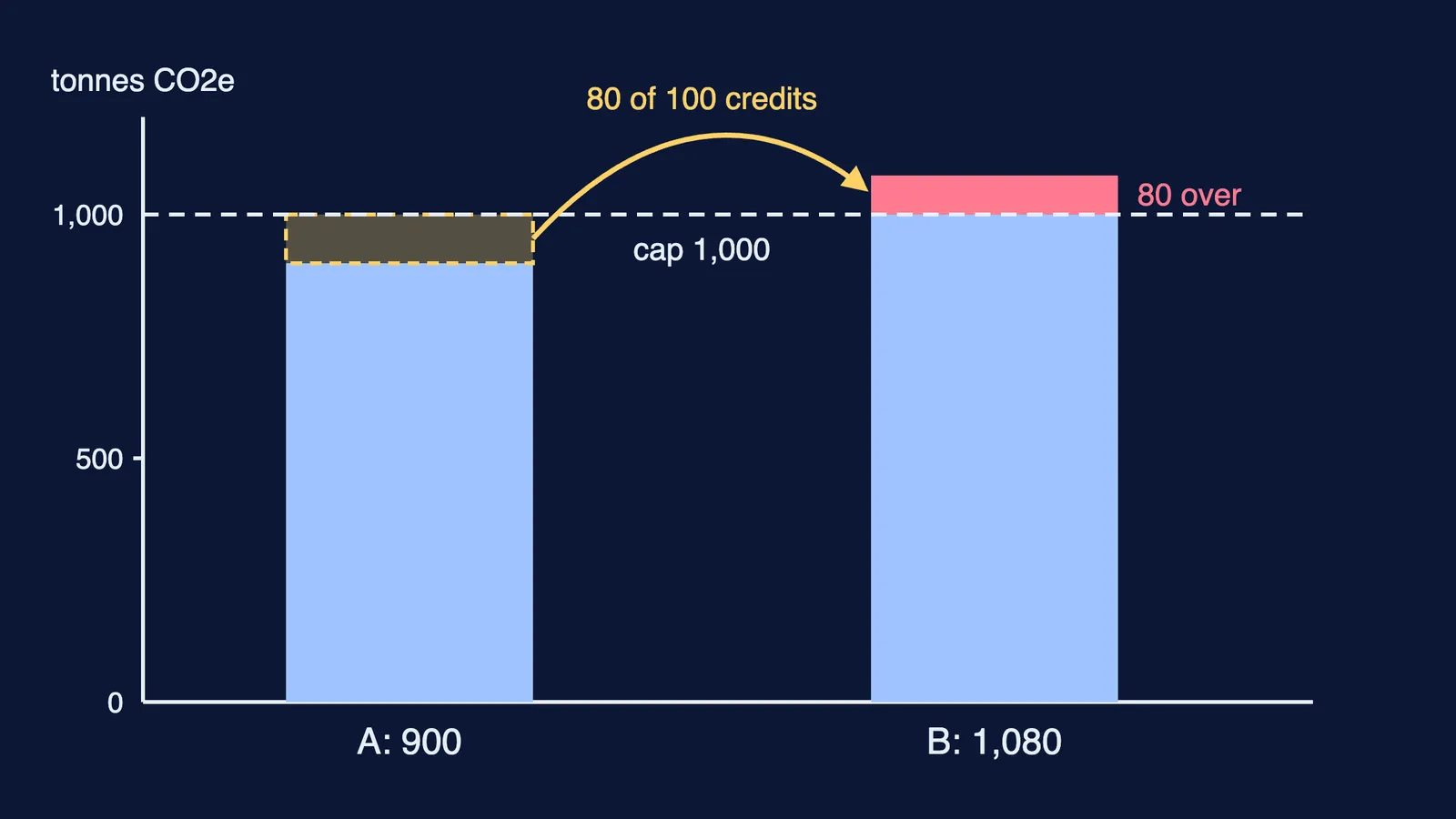
Here is a worked example: an imaginary compliance market with round numbers. The regulator sets a cap: each of two factories may emit 1,000 tonnes of CO2e.
Factory A installs efficient furnaces and emits 900 tonnes. It is 100 tonnes under its cap, so it earns 100 credits.
Factory B runs an old boiler and emits 1,080 tonnes. It is 80 tonnes over its cap.
B buys 80 credits from A. B is now within the rules, and A keeps 20 credits to sell later.
Check the total: 900 + 1,080 = 1,980 tonnes, under the combined cap of 2,000 tonnes.
The cap does the climate work; trading decides who cuts. The factory that can cut cheaply cuts more and gets paid. Lower the cap next year and credits become scarcer.
An offset is different. Imagine a company that emits 1,000 tonnes buys 1,000 credits from a cookstove project and announces it is net zero. There is no cap. The claim holds only if every credit stands for a tonne that would otherwise have reached the air.
Does India have a carbon market?
Yes. On 28 June 2023 the Ministry of Power brought in the Carbon Credit Trading Scheme, which the International Energy Agency's policy database says is set to take effect by 2025-2026. It has two parts: a compliance mechanism, in which the Ministry of Environment, Forest and Climate Change notifies emission reduction targets for businesses on the Ministry of Power's recommendation, and an offset mechanism. A business that cuts emissions below its target is entitled to a Carbon Credit Certificate, like Factory A; one that falls short must buy certificates, like Factory B.
What are the criticisms of carbon offsets?
Additionality: would the cut have happened anyway? Protecting a forest nobody planned to fell earns credits without changing the atmosphere.
Permanence: carbon stored in trees returns to the air if the forest burns.
Baselines: a project estimates what would have happened without it, and a generous estimate inflates the credits.
A 2023 study in Science by Thales West and colleagues examined 26 avoided-deforestation project sites in six countries and found that most had not significantly reduced deforestation, while those that had did so by much less than claimed (West et al., 2023). The authors traced the gap to the baselines the projects used.
A 2024 review in Nature Communications by Benedict Probst and colleagues synthesised 14 studies covering 2,346 crediting projects, about one-fifth of the credit volume issued to date, almost 1 billion tonnes of CO2e (Probst et al., 2024). It estimated that fewer than 16% of those projects' credits were real emission reductions: 11% for cookstoves, 25% for avoided deforestation and 68% for destroying the gas HFC-23, with no statistically significant reductions from wind power or improved forest management projects.
Apply the review's 11% cookstove figure to the offset example: 1,000 credits might stand for about 110 real tonnes (1,000 x 0.11), leaving the net-zero company roughly 890 tonnes short. That is an average, not a verdict on any single project.
How can you judge a carbon-neutral claim?
Ask these four questions when a brand, airline or app says it is carbon neutral:
Did it cut its own emissions first, or only buy credits?
What kind of project are the credits from? Quality varies a lot by project type.
Is there a cap behind the credits (compliance) or only a promise (voluntary)?
Could the stored carbon come back, as it can with forests?
To see where your own tonnes come from, start with our guide to calculating your carbon footprint as a student in India. If CO2 equivalents or the greenhouse effect are the sticking point, the Fermi Concept Library covers every concept in physics, chemistry, biology, mathematics and computing, each with its own lesson, and the Fermi Simulation Lab has interactive simulations for ideas that are easier to see than to read.
If measuring carbon honestly sounds like work you would enjoy, read how to become a climate scientist in India.