On this page
The Paris Agreement turns up in geography, current-affairs quizzes and school debates. Here is what it says, what COP meetings do and what India has promised.
What is the Paris Agreement in simple words?
It is a treaty in which countries agreed to limit global warming and to publish their plans for doing it. World leaders reached the deal at the UN Climate Change Conference (COP21) in Paris on 12 December 2015, and it entered into force on 4 November 2016, according to the United Nations.
The agreement does not hand each country a fixed number. Instead, every five years each country is expected to submit an updated national climate action plan, called a Nationally Determined Contribution or NDC (UN).
What do the 1.5 and 2 degree goals mean?
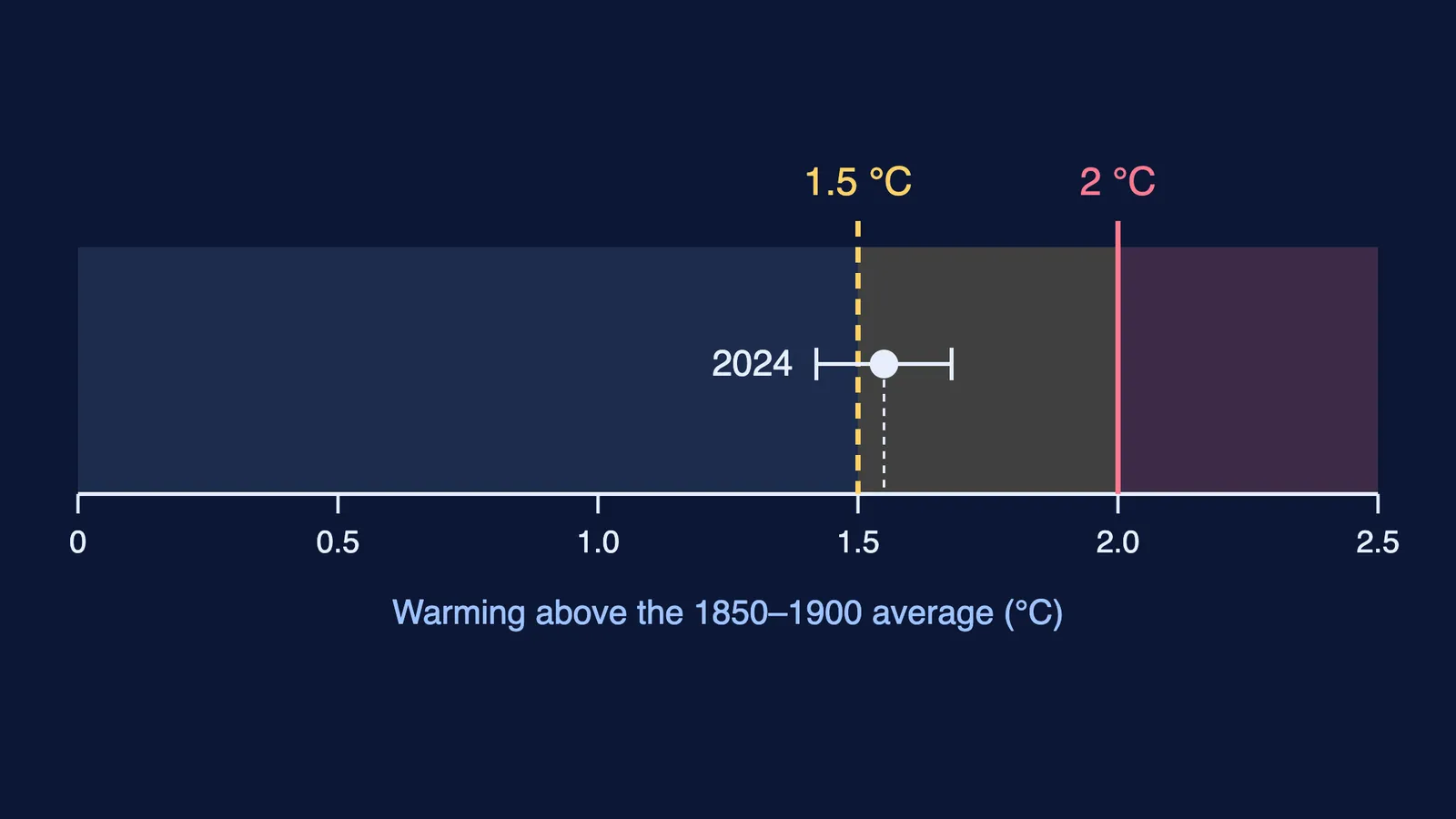
The goal is to "hold global temperature increase to well below 2°C above pre-industrial levels and pursue efforts to limit it to 1.5°C above pre-industrial levels" (UN). So 2°C is the outer limit, and 1.5°C is the safer target countries agreed to try for.
In practice, scientists measure warming against the 1850–1900 average. The World Meteorological Organization found that 2024 was 1.55°C above that average, with an uncertainty of ±0.13°C (WMO).
Has the goal been missed? Not on its own: WMO explains that one or more years above 1.5°C does not mean that, because the goal refers to an extended period, typically decades.
If the physics of how greenhouse gases trap heat still feels fuzzy, start with our explainer on how the greenhouse effect works, with five predictions to test. The Fermi Simulation Lab has interactive simulations for ideas that are easier to see than to read.
What is a COP?
COP stands for Conference of the Parties: the meeting of the countries that belong to the UN climate convention.
At COP30 in Belém, Brazil, in November 2025, the adopted text called for mobilising at least $1.3 trillion a year by 2035 for climate action and for tripling adaptation finance by 2035, UN News reported. Adaptation means preparing for the heat, floods and droughts that are already happening. The same report notes that the outcome did not include a clear commitment to move away from fossil fuels.
COP31, the thirty-first session, is being held in Antalya, Türkiye, from 9 to 20 November 2026 (Nature4Climate event listing).
What has India promised under the Paris Agreement?
India's plan has a few numbers worth knowing. The Union Cabinet approved the 2030 targets on 3 August 2022, as reported by The Tribune:
Cut the emissions intensity of GDP by 45% by 2030, from the 2005 level.
Get about 50% of cumulative installed electric power capacity from non-fossil sources by 2030.
Reach net zero by 2070, India's long-term goal.
In March 2026 the Cabinet approved new targets for 2035, according to News On AIR:
Cut emissions intensity of GDP by 47% by 2035, from 2005 levels.
Raise the non-fossil share of installed power capacity to 60% by 2035.
The same report says India reached 52.57% non-fossil capacity by February 2026, meeting the target five years ahead of schedule. Note the word installed: a solar plant produces nothing at night, so its share of capacity is larger than its share of the electricity actually generated.
Worked example: what does a 47% intensity cut mean?
India's 2035 target is a 47% cut in the "emissions intensity of its GDP" (News On AIR). Emissions intensity is emissions divided by GDP: how much greenhouse gas a country releases for each rupee of economic output. It is a ratio, not a total.
Call India's 2005 intensity 100 units.
A 47% cut means the 2035 intensity is 100 × (1 − 0.47) = 53 units.
Suppose, only for this example, that the economy in 2035 is 3 times its 2005 size.
Total emissions = intensity × size of economy, so 53 × 3 = 159, against 100 × 1 = 100 in 2005.
In this made-up case, each rupee of output is about half as polluting, yet total emissions are 59% higher than in 2005. Totals would fall only if the economy grew less than 100 ÷ 53, or about 1.9 times. So never compare an intensity target with a total-emissions target as if they were the same thing.
If ratios and percentage changes like this trip you up, the Fermi Problem Library has worked problems with a step-by-step solver that explains the reasoning rather than printing an answer.
How do you read a climate headline correctly?
Use this four-question check on any story about COP31:
Which temperature: a single year, or the long-term average the Paris goal is about?
Total or intensity: is the target about all emissions, or emissions per unit of GDP?
Capacity or generation: does a clean-energy figure count power plants built, or electricity produced?
Promise or result: is it a pledge in an NDC, a decision at a COP, or something already measured?
To put the ideas to work, try calculating your own carbon footprint as a student in India, or read how to become a climate scientist in India.