On this page
Your first timetable at an NEP-based university can look like a page of codes: DSC-1, GE-1, AEC, SEC, VAC. Each code tells you what kind of course it is, how many credits it carries and whether you get to choose it. The rules come from the University Grants Commission's Curriculum and Credit Framework for Undergraduate Programmes, issued in December 2022. Each university then turns it into its own scheme, so labels differ between colleges.
What do DSC, DSE, GE, AEC, SEC and VAC stand for?
The University of Delhi's draft Undergraduate Curriculum Framework 2022 defines the codes like this:
DSC (Discipline Specific Core): compulsory core courses of your subject, such as Physics for a BSc (Honours) Physics student.
DSE (Discipline Specific Elective): electives you pick from a pool within your own subject.
GE (Generic Elective): courses from other disciplines, meant to make your degree multidisciplinary.
AEC (Ability Enhancement Course): at DU, language and literature courses plus Environmental Science and Sustainable Development, which is mandatory for every discipline.
SEC (Skill Enhancement Course): skill-based courses that give hands-on training.
VAC (Value Addition Course): courses on ethics, culture, constitutional values, soft skills and sports.
The UGC framework describes AEC as Modern Indian Language and English courses focused on language and communication skills. Its value-added courses cover understanding India, environmental education, digital and technological solutions, and health, yoga and sports. If your AEC is the EVS paper, our guide to the compulsory EVS course in college covers the syllabus and field project.
How are major and minor different from DSC and DSE?
UGC defines the major as the subject your degree is awarded in, earning about 50% of your total credits through core courses. Its framework gives the example of a Physics student who needs at least 60 of 120 credits in Physics for a single-major BSc. A minor gives you breadth: an Economics student with at least 12 credits in Statistics gets a BA in Economics with a Minor in Statistics.
At DU, the major is the discipline where you earn at least half your credits through DSCs and DSEs. In a single-discipline Honours programme, you can earn a minor by taking at least 28 credits from seven GE courses of one discipline, according to DU's draft UGCF 2022. UGC's closest category to GE is "Multidisciplinary", or courses from other disciplines.
How many credits does each course type need?
Table 2 of the UGC framework sets the minimum credits for a 3-year degree and a 4-year degree:
Major (core): 60 and 80
Minor stream: 24 and 32
Multidisciplinary: 9 and 9
AEC: 8 and 8
SEC: 9 and 9
VAC: 6-8 and 6-8
Summer internship: 2-4 and 2-4
Research project or dissertation: none and 12 (Honours students not doing research take three courses for 12 credits instead)
Total: 120 and 160
The same document suggests 4 credits per major or minor course, 3 for multidisciplinary, AEC and SEC courses, and 2 for value-added courses and internships, but calls these numbers suggestive. One lecture credit means one hour of class a week over a semester of at least 15 weeks, and one practicum credit means two hours a week. Our explainer on how credits, SGPA and CGPA work shows how these credits turn into your grades.
What does a real NEP semester look like?
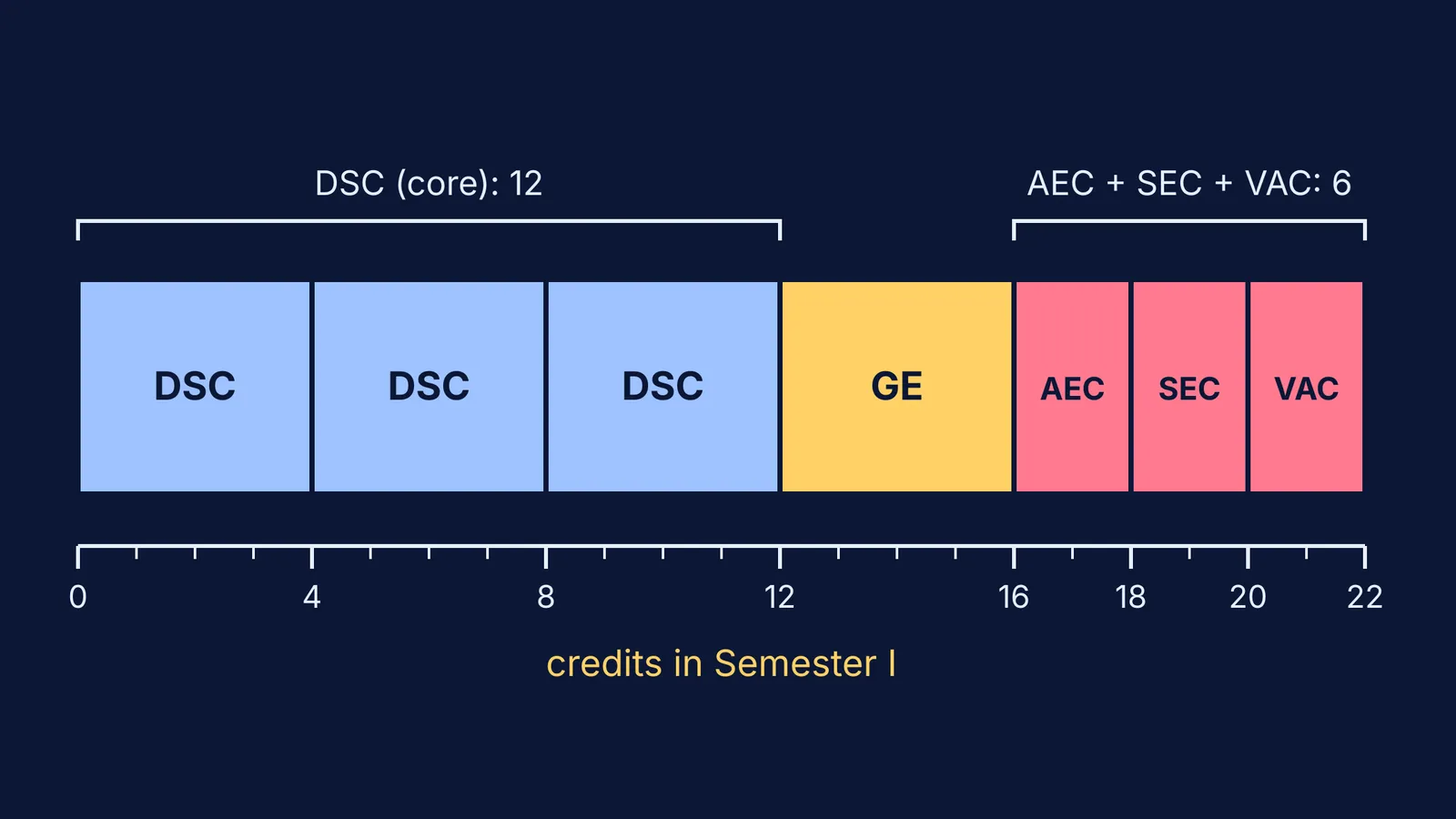
Here is Semester I of BSc (Honours) Computer Science from the University of Delhi's model curricula under UGCF%20CS-10June22.pdf) (June 2022):
DSC-1, Programming using Python: 4 credits
DSC-2, Computer System Architecture: 4 credits
DSC-3, Mathematics for Computing: 4 credits
GE-1, chosen from a pool: 4 credits
AEC, chosen from a pool: 2 credits
SEC, chosen from a pool: 2 credits
VAC, chosen from a pool: 2 credits
That adds up to 22 credits, and the same document says two such semesters give the 44 credits needed for an Undergraduate Certificate if you exit after Semester II. Notice that DU's AEC and SEC carry 2 credits, not the 3 UGC suggests, so always check your own university's scheme.
How do you check your own timetable?
Download your programme's scheme of studies from your department's website.
Write each course on your timetable next to its category and credits.
Add the credits and match the semester total in the scheme.
Mark every pool course (GE or minor, SEC, VAC) and note the date its choice closes.
Keep a running total against the exit points. UGC's framework lets students request a change of major within the broad discipline at the end of the first year, and our guide to multiple entry and exit under NEP explains the certificate and diploma routes.
If a core course such as Mathematics for Computing leans on Class 12 topics you never fully understood, the Fermi Concept Library has a lesson for every concept in mathematics, physics and computing, so you can patch the gap before the first internal test.
Run the five-step check this week, before elective choices close.