On this page
You will find it on your first-semester timetable as EVS, AECC or Environment Education, whether you study BCom, BTech, BA or BSc. The course goes back to a Supreme Court case, and it is short enough that a little planning goes a long way.
Why is environmental studies compulsory in college?
On 22 November 1991, in M.C. Mehta v. Union of India, the Supreme Court directed the University Grants Commission to consider the feasibility of making environment a compulsory subject at every level in college education (InforMEA case summary). The court returned to the issue in later years, and implementation is still uneven across the country (Down To Earth).
The preface to UGC's 2023 guidelines on environment education says UGC issued a core module syllabus in 2003, following the Supreme Court's directives. In 2017 came an 8-unit Ability Enhancement Compulsory Course (AECC) in Environmental Studies under the Choice Based Credit System. The 2023 guidelines are the NEP 2020 version, and in September 2024 UGC asked colleges and universities to put them into practice (Careers360 report).
Which version you get depends on your university and when you joined, so check your programme's syllabus PDF for AECC or "value-added course".
What does the EVS syllabus cover?
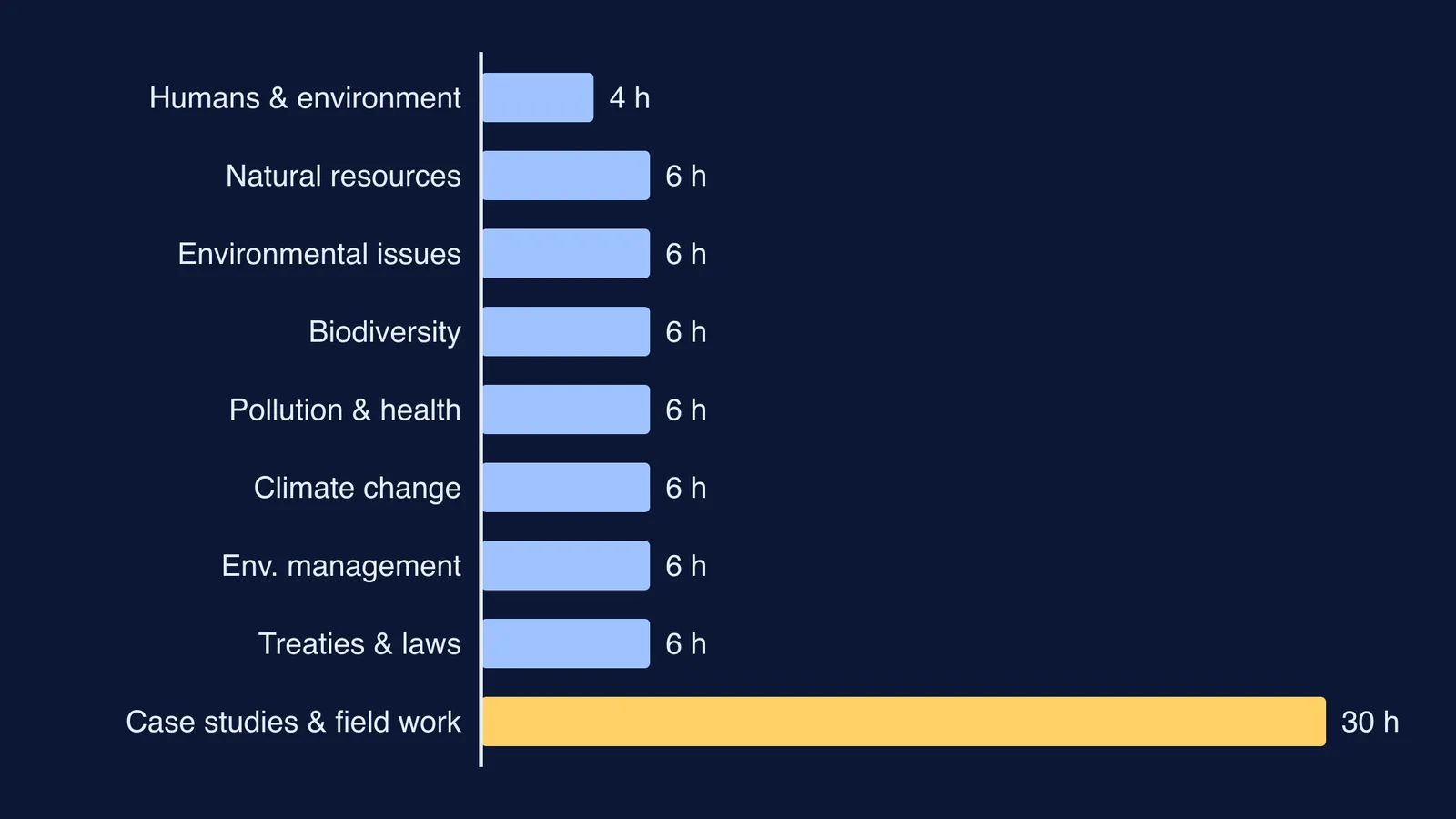
The 2023 UGC framework is a 4-credit course in nine units (UGC guidelines):
Humans and the environment (4 hours)
Natural resources and sustainable development (6 hours)
Environmental issues: local, regional and global (6 hours)
Conservation of biodiversity and ecosystems (6 hours)
Environmental pollution and health (6 hours)
Climate change: impacts, adaptation and mitigation (6 hours)
Environmental management (6 hours)
Environmental treaties and legislation (6 hours)
Case studies and field work (30 hours)
Look closely at the last line. Case studies and field work get 30 hours, five times as much as any other unit.
The older AECC syllabus, which many universities still use, has eight units adding up to 50 lectures, with field work counted as equal to 5 lectures (UGC AECC syllabus). It leans on Indian examples you should be able to name: the Chipko movement, Silent Valley, the Bishnois of Rajasthan and CNG vehicles in Delhi. It also covers laws such as the Environment Protection Act and the Wildlife Protection Act.
The 2023 guidelines say the credits and their distribution are only suggestions and each institution may decide them. So your university, not UGC, sets how marks are split between the written exam and the field report.
How do you prepare for the EVS exam?
Vague answers say little: "pollution is harmful to humans" shows no real understanding. Strong answers have three parts: a clear definition, a named Indian example and one relevant law or treaty.
A four-week plan that fits around your main subjects:
Week 1: List every unit in your own syllabus. For each one, write a definition and one Indian case. For biodiversity, our guide to India's four biodiversity hotspots gives you ready examples.
Week 2: Make a one-page sheet of the laws and treaties in your syllabus, with the year from your textbook and what each one controls.
Week 3: Practise the diagrams that come up again and again: a food chain, a food web, energy flow through trophic levels and a flowchart of solid waste management.
Week 4: Do two of your university's past papers under timed conditions. Mark each answer against the three-part rule.
If the science underneath trips you up, such as why oxygen falls in a polluted river, our explainer on BOD and dissolved oxygen walks through it. The Fermi Concept Library has a lesson on every biology and chemistry concept, so you can fill the gap before the paper.
How do you write the EVS field project report?
UGC's list of field work includes field visits to spot local environmental issues, with data collection and a short report. It also suggests documenting campus biodiversity, plantation drives and nature camps, and campus work on solid waste, water and sewage (UGC guidelines).
Here is a worked example: a one-week waste audit of your hostel floor.
Question: How much of one hostel floor's waste could be recycled or composted?
Method: With the warden's permission, weigh the bins for five days, sorting into wet, dry recyclable and other. Note date, time and who weighed.
Data: Daily weights in kilograms in a table, plus one bar chart.
Analysis: Work out each type's share and compare it with your pollution unit.
Recommendation: One specific change the hostel could make.
Evidence: Your own captioned photos, and a source for every outside figure.
Watch for the usual weak spots: missing dates, copied text and no data of your own. Keep a field notebook from day one, and ask your teacher early about format, word limit, deadline and any viva. If you are juggling internals in several subjects, our guide to college mid-sems and internals helps you plan the term.
Start your field notebook this week. The exam gets easier once you have seen the problems for yourself.