On this page
The National Education Policy (NEP) 2020 introduced a major shift for Indian college students: the multiple entry and exit system. Instead of the rigid structure where leaving college early meant dropping out with nothing to show for it, the University Grants Commission (UGC) established guidelines to provide flexible learning pathways. If you need to step away from your studies for financial, personal, or professional reasons, you can now do so with a formal qualification and return later. This reduces the stigma of being a dropout and supports lifelong learning by allowing students to complete their degrees at their own pace.
What is multiple entry and exit in college under nep?
The multiple entry and exit system allows college students to leave a degree early with a recognized qualification, as detailed in the National Education Policy 2020. For every year of study you complete, you earn a specific number of credits and a corresponding certificate or diploma. This completely changes how higher education works in India. Instead of losing all your progress if you cannot complete a full three-year or four-year program uninterrupted, you become a student who has completed a specific stage of learning and is simply taking a break.
The framework is built around academic credits. Each semester, you accumulate credits for the courses you pass. These credits act as the currency that allows you to move between different institutions and stages of your education without starting over from the beginning.
What certificates do you get at each exit point?
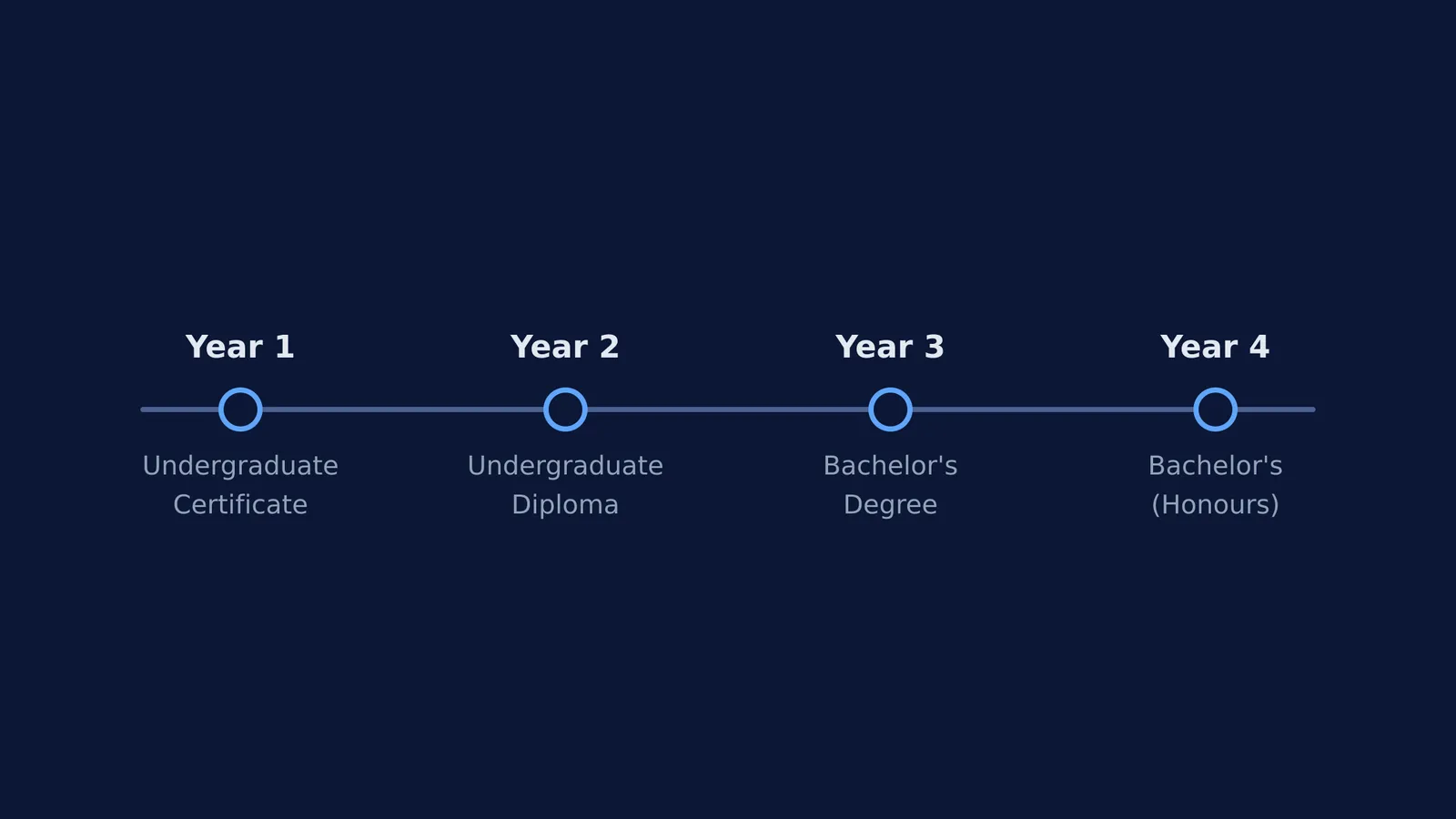
Under the National Education Policy guidelines, a typical four-year undergraduate program offers specific qualifications at each exit point.
After 1 Year: You receive an Undergraduate Certificate after completing two semesters. To qualify, you must also complete an additional vocational or skill-enhancement course during the summer vacation.
After 2 Years: You receive an Undergraduate Diploma after four semesters. This exit point also requires a summer internship or vocational course.
After 3 Years: You receive a Bachelor's Degree after six semesters.
After 4 Years: You receive a Bachelor's Degree with Honours or Research after eight semesters.
How does the Academic Bank of Credits work?
To make this flexibility possible, the government created the Academic Bank of Credits (ABC). Think of it as a digital bank account for your education. When you pass a course at a registered Higher Education Institution, the credits are deposited into your ABC account.
If you decide to exit your program, your credits remain safely stored in this national repository. When you are ready to resume your education, you can redeem these credits toward your degree, even if you transfer to a different university, provided the new institution maps and recognizes them. Earned credits generally have a set validity period, ensuring your previous academic progress is not lost when you return.
What are the rules for re-entry?
Re-entering the system is designed to be straightforward, but there are a few rules to keep in mind when planning your return:
Timing: Lateral entry is typically permitted at the beginning of an odd semester, such as the third, fifth, or seventh semester.
Validity: You must re-enter and use your stored credits within their validity period.
Availability: Admission for re-entry depends on seat availability and meeting the specific entry requirements of the institution you are applying to.
If you are taking a break from college but want to keep your fundamental skills sharp for when you re-enter, Fermi's AI tutor can work out what you already know and build a plan for the session, so you sit down to a clear next step.
A checklist for planning an exit
If you are considering stepping away from your degree, follow this plan to ensure your hard work is recognized and securely banked for the future:
Check your credits: Log into your ABC portal and verify that all your completed credits are accurately recorded.
Complete summer requirements: If you are exiting after year one or two, ensure you enroll in and complete the required summer vocational course or internship.
Get your certificate: Apply for your Undergraduate Certificate or Diploma before you formally leave the institution.
Plan your return window: Note the exact date your earliest credits expire so you can plan your re-entry well in advance.
While you are deciding your next steps, reading about the experiences of others can be helpful. You might want to review what changes during your first semester at science or engineering college, or look into research internships for science undergraduates in India to see if a short-term project fits your goals. If you choose to stay, here is a guide on how to improve your CGPA using a semester plan backed by research.