On this page
If biology is your strong subject, physics is often what holds your NEET score back. This plan treats physics the way you already treat biology: secure the learnable chapters, keep every formula on one page, and practise a little every day, mixed.
How much is NEET physics worth?
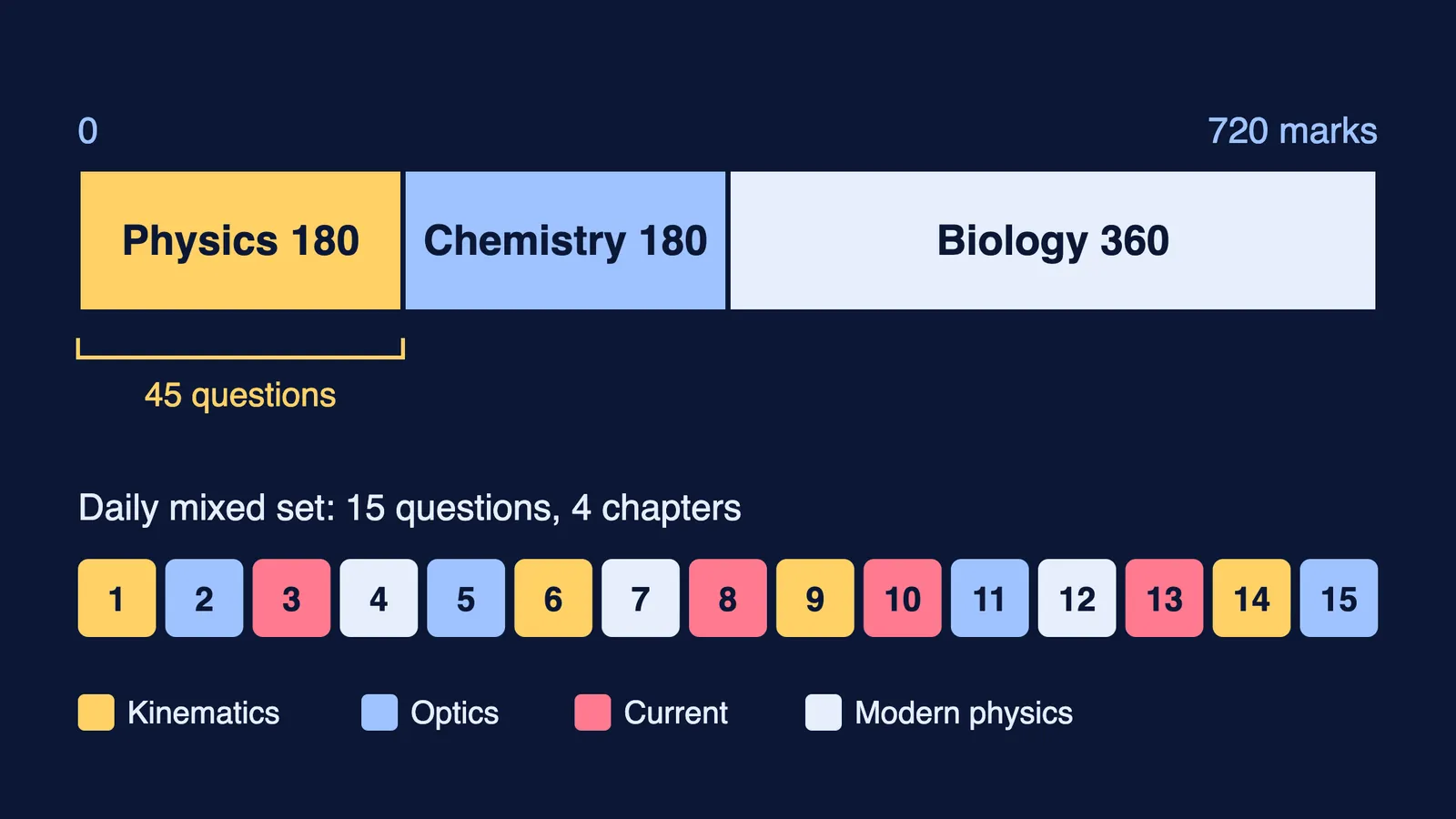
Physics carries 45 of the 180 questions and 180 of the 720 marks, according to the NTA Information Bulletin for NEET (UG)-2026. The same bulletin sets the marking: +4 for a correct answer, -1 for a wrong one, 0 for a blank. All 180 questions are compulsory four-option multiple choice, answered in 180 minutes.
The bulletin breaks ties in total marks by Biology marks first, then Chemistry, then Physics, so your strength already helps. But physics is a quarter of the paper, and a weak physics score caps your total however good your biology is. The pattern can change; check the next bulletin on the official NEET (UG) site when NTA releases it.
Which NEET physics chapters should you secure first?
The NEET (UG)-2026 syllabus issued by the National Medical Commission lists 20 physics units, from Physics and Measurement to Experimental Skills. Neither it nor the NTA bulletin gives chapter-wise marks, so distrust any "official weightage" table. Order chapters by what they cost you to learn.
Tools first: Physics and Measurement (units, dimensions, significant figures), Kinematics, Laws of Motion, and Work, Energy and Power. Later chapters borrow from these.
Chapters that read like biology: Dual Nature of Matter and Radiation, Atoms and Nuclei, Electronic Devices (diodes and logic gates), Electromagnetic Waves, and Experimental Skills. Mostly definitions, named experiments and short formulas: learn them the way you learn the nephron.
One formula, many questions: Optics (mirror and lens formulas, Young's double-slit fringe width), Current Electricity, Gravitation, Properties of Solids and Liquids, Thermodynamics, Kinetic Theory of Gases, and Oscillations and Waves.
Heavy calculation last: Rotational Motion, Electrostatics, Magnetic Effects of Current and Magnetism, and Electromagnetic Induction and Alternating Currents. Build them once groups 1 to 3 feel safe; do not skip them.
Starting from a very low score? Our formula ladder and weekly plan for weak NEET physics goes step by step.
What should a NEET physics formula sheet look like?
A formula sheet is not a list of equations. For each formula, write four lines: the formula, each symbol with its SI unit, when it applies, and the trap that cost you marks. Keep one handwritten page per unit.
One entry, for the power of a lens:
Formula: P = 1/f
Symbols: P in dioptres (D); f is the focal length in metres
When it applies: a thin lens; f is positive for a convex lens and negative for a concave lens
Trap: f given in centimetres. A convex lens with f = 25 cm has f = 0.25 m, so P = 1/0.25 = +4 D, not +0.04 D.
Use the sheet for recall, not rereading: cover all but the formula and say the rest aloud before you check.
How should you practise NEET physics every day?
Textbook exercises come in blocks, so you never practise choosing a formula, and choosing is exactly what NEET asks. Mixed, or interleaved, practice fixes that. In a randomized trial across 54 seventh-grade mathematics classes, Doug Rohrer and colleagues found that students who had practised with interleaved assignments scored 61% on an unannounced test a month later, against 38% for students who had practised in blocks. That was maths, not physics, but the skill trained, picking the method for an unlabelled problem, is the one NEET physics tests.
A 2013 review of ten study techniques by John Dunlosky and colleagues rated practice testing and spaced (distributed) practice as high utility, and interleaved practice as moderate because the evidence was still limited. Our one-week experiment comparing rereading with practice testing lets you check this on your own syllabus.
A daily plan of about 50 minutes:
5 minutes: recall one formula page.
30 minutes: 15 questions shuffled from three or more finished chapters, unlabelled.
15 minutes: mark them, then log each mistake as concept, formula condition, or calculation.
The log tells you the fix. For a concept gap, go back to NCERT or that idea's lesson in the Fermi Concept Library. For a wrong method, work a similar problem slowly in the Fermi Problem Library, where the step-by-step solver explains the reasoning rather than printing an answer. For calculation slips, write one more line of working.
Once a week, sit 45 physics questions in one timed block and review them; before redoing an old paper, read should you reattempt an old mock test.
Should you guess in NEET physics?
With +4 and -1, as the NTA bulletin sets out, a blind guess among four options gives 0.25 x 4 - 0.75 x 1 = +0.25 marks on average, barely above a blank. If you can rule out two options, it becomes 0.5 x 4 - 0.5 x 1 = +1.5 marks. So attempt questions where you can eliminate options and leave those you cannot start; daily mixed practice turns the second kind into the first.
Start tomorrow with one formula page and 15 mixed questions.