On this page
If you are starting NEET (UG) preparation with about six months left, you are not too late to prepare properly, but you are too late to waste weeks. This plan is honest about both. It will not promise a score or a rank; nobody can. It gives you an order of work, a weekly cycle and a way to set targets from your own results.
Can you crack NEET in 6 months?
Six months is enough to read the syllabus once with care, revise it, and sit a run of full mock tests. Whether that turns into a seat depends on where you start, how many hours you can really study, and the competition in your year, none of which a plan controls.
What you can control is where your hours go. The NTA's NEET (UG) 2026 information bulletin sets out the paper: 180 compulsory multiple-choice questions in 180 minutes, worth 720 marks.
Physics: 45 questions, 180 marks.
Chemistry: 45 questions, 180 marks.
Biology (Botany and Zoology): 90 questions, 360 marks.
Biology is half the paper. The same bulletin says ties are broken first by Biology marks, then Chemistry, then Physics. The syllabus itself is notified by the National Medical Commission, so check every chapter you plan against it.
Why should biology and NCERT come first?
Biology rewards careful reading of a fixed text, so steady daily reading pays off even for a late starter. Use your NCERT Class 11 and 12 textbooks as the base, line by line, with diagrams and tables. If the volume of lines feels crushing, this guide to a calmer way through NCERT biology lines breaks it down.
Chemistry comes second: much of inorganic and organic chemistry is also text-based. For most students, physics needs the most practice per mark, so keep it in every week from day one rather than leaving it to the end. If physics is your weak subject, start with a formula ladder and weekly plan for NEET physics.
What does the six-month plan look like?
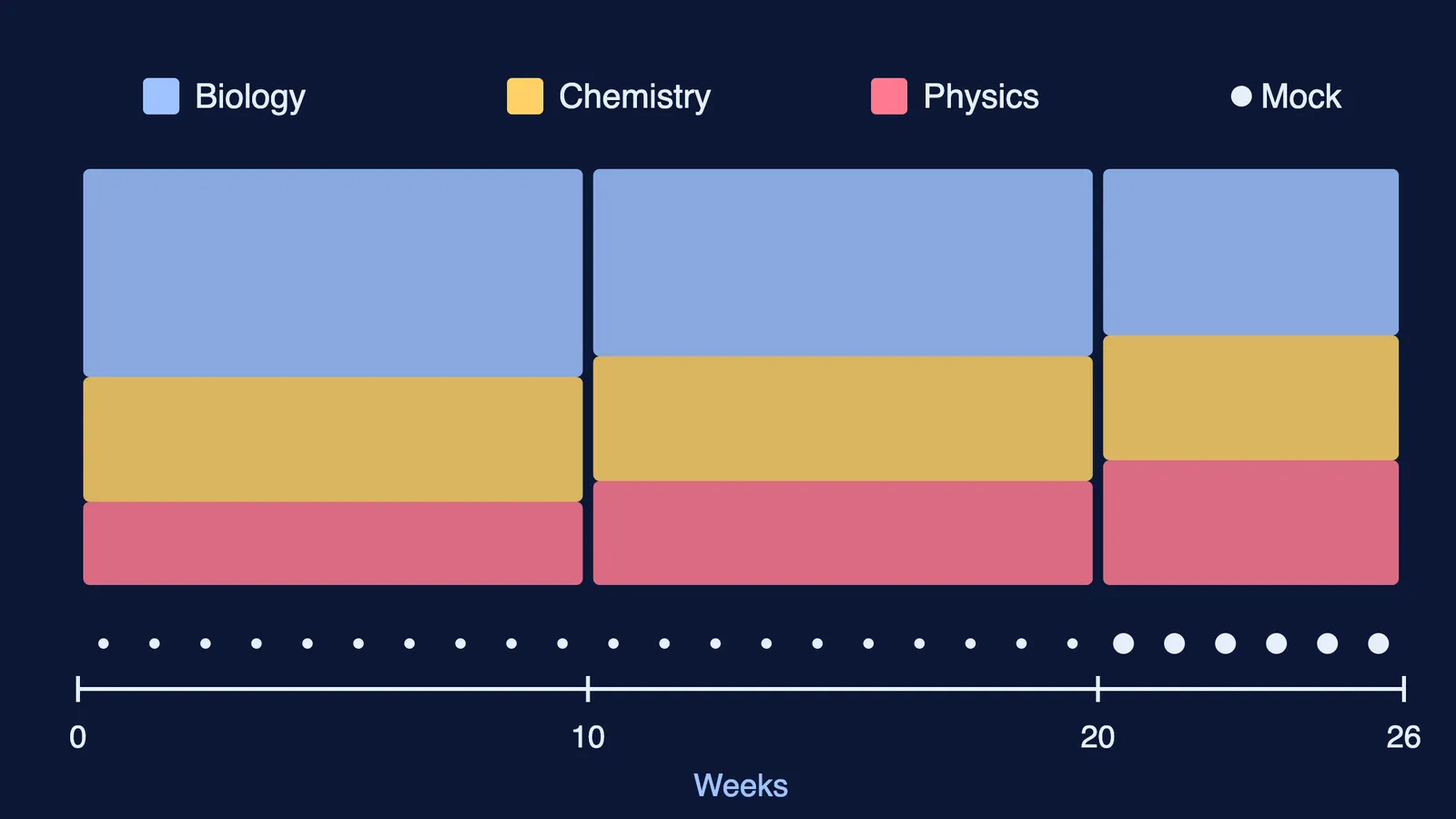
The hero diagram shows the split: a larger share for biology early, more physics later, and a test every week.
Weeks 1 to 10, first pass. Cover each biology chapter from NCERT, with chemistry and physics alongside. End every chapter with a short self-test.
Weeks 11 to 20, second pass. Revise chapters from the first pass and take timed tests that mix old and new chapters.
Weeks 21 to 26, full mocks. One full 180-question, 180-minute mock a week under exam conditions, then two days fixing what it exposed. For the last stretch, follow this four-week NEET revision schedule.
Each week follows the same cycle:
Days 1 to 5: new or revision chapters. Biology first while you are fresh, then chemistry, then physics problems.
Day 6: a mixed test on this week's chapters plus some from earlier weeks.
Day 7: go through your error log, redo every wrong question, and rest.
The cycle rests on two findings. A 2013 review by Dunlosky and colleagues rated practice testing and distributed practice as high-utility techniques, and rated rereading and highlighting as low utility. In Roediger and Karpicke's 2006 experiments, students who took recall tests remembered more a week later than students who restudied, even though restudying made them feel more confident. A 2008 study of spacing by Cepeda and colleagues found that the most effective gap between first study and review grows as the test gets further away, which is why the plan keeps returning to old chapters.
How do you set realistic targets?
Use the marking scheme in the NTA bulletin: four marks for a correct answer, minus one for a wrong answer, zero for a question left blank.
A worked example: in a mock you attempt 150 questions, get 120 right and 30 wrong. That is 120 x 4 = 480, minus 30, which gives 450. If 20 of those wrong answers were guesses you could have skipped, leaving them blank would have scored 470.
So set targets on things you control: chapters covered by week 10, accuracy on attempted questions, and fewer repeat mistakes in your error log. Compare each mock with your previous one, not with toppers' scores.
When a wrong answer comes from a gap in the idea itself, look the concept up in the Fermi Concept Library, which has a lesson for each concept in physics, chemistry and biology. When you knew the concept but used the wrong method, the Fermi Problem Library has worked problems with a step-by-step solver that explains the reasoning rather than printing an answer.
If the pressure gets heavy, talk to someone you trust. Tele MANAS, the government's free 24x7 mental health helpline, is on 14416.
Six months is a real amount of time. Start with today's biology chapter and this week's first test.