On this page
Two scholarships can sit side by side on the National Scholarship Portal and still judge you on different things. A merit scholarship asks how your marks compare with everyone else's. A need-based scholarship asks what your family earns. Knowing which is which tells you what to prepare, and whether you can hold both.
What is the difference between need-based and merit-based scholarships?
A merit-based scholarship is awarded for academic performance, such as a Class 12 board result or an entrance-exam rank. A need-based scholarship is awarded for financial need, usually proven with an income certificate. The National Scholarship Portal (NSP) calls these two groups "merit-based" and "welfare-based" schemes.
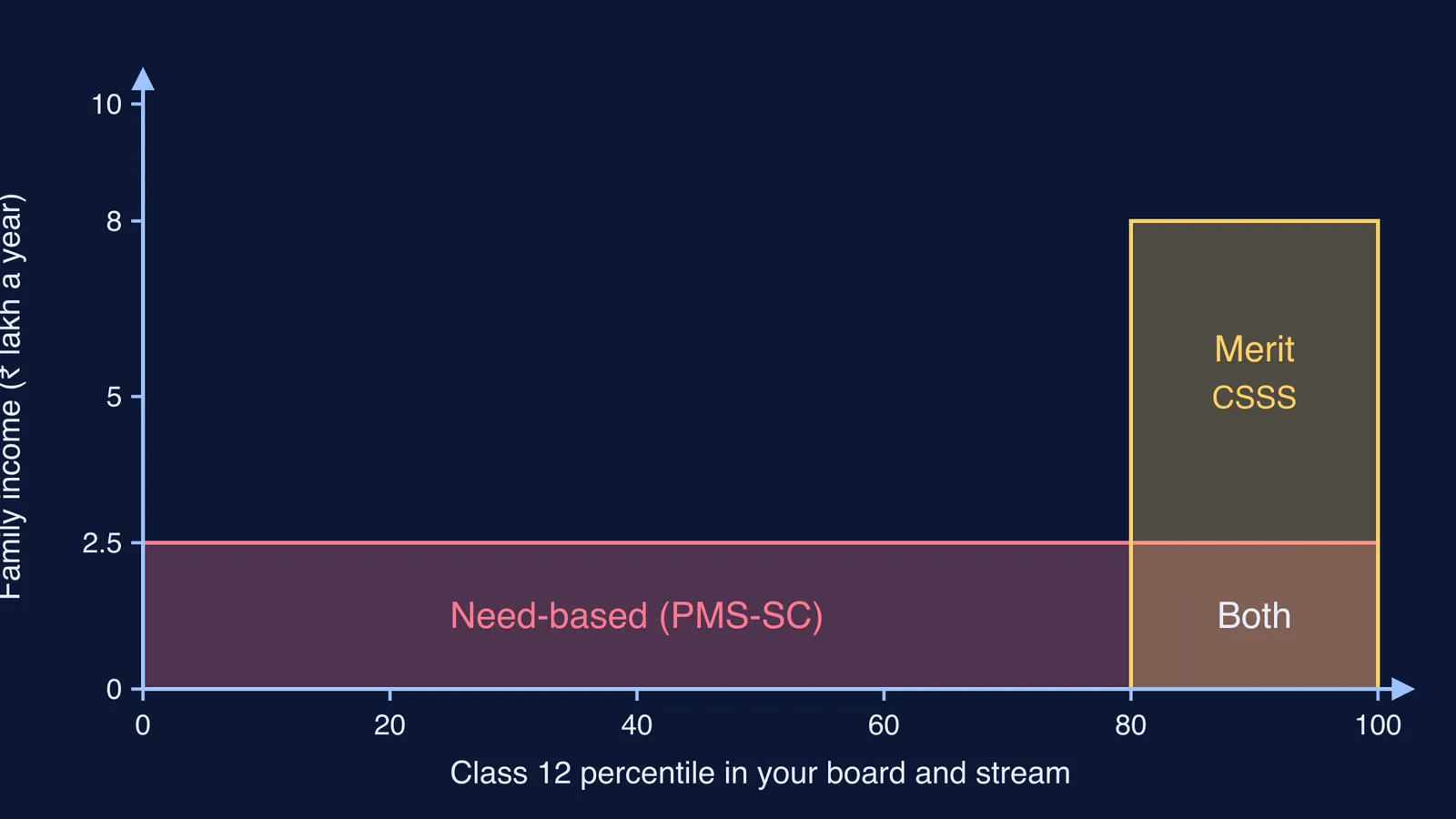
The Central Sector Scheme of Scholarship (CSSS) guidelines open that merit scheme to students above the 80th percentile of successful candidates in their stream and board in Class 12. The Post Matric Scholarship for Scheduled Castes (PMS-SC) guidelines, written for 2020-21 to 2025-26, instead require parents' income from all sources of no more than ₹2.5 lakh in the last financial year, with no percentile cut-off.
Some schemes mix the two. CSSS is labelled merit-based on NSP, yet its 2019 guidelines also set a parental income ceiling of less than ₹8 lakh a year. Check the current figure on the scheme's NSP page before you apply.
How does each kind judge your application?
Merit schemes rank you against others. Under the 2019 CSSS guidelines, 82,000 fresh scholarships a year are shared among boards, split 3:2:1 across Science, Commerce and Humanities, with half earmarked for girls. Your rank inside your own board and stream is what counts.
Need schemes check you against a line. Under the PMS-SC guidelines, if your family income is under the limit and your caste certificate is valid, you are eligible; states are asked to focus on the poorest households.
Both check you again every year. CSSS renewal needs 50% marks in the previous exam and 75% attendance. PMS-SC continues to the end of the course subject to satisfactory academic performance and 75% attendance.
For a merit scheme, your marksheet does most of the work. For a need scheme, your documents do: an income certificate from the right authority, a caste certificate where relevant, and an Aadhaar-seeded bank account.
Can you apply for both a merit and a need-based scholarship?
Yes, within limits. The NSP announcements say students may apply for one merit-based scholarship scheme and one or more welfare-based schemes from the 2026-27 academic year, as per scheme eligibility criteria.
That is a real change. The 2019 CSSS guidelines limited the scheme to students "not availing benefit of any other scholarship scheme including State run scholarship schemes/Fee waiver". The PMS-SC guidelines told a student awarded two scholarships to pick the more beneficial one. So apply to one merit scheme at a time, and read each scheme's current NSP guidelines, not an old PDF, to see whether you can hold it alongside another award.
Which should you apply for? A worked example
Take two hypothetical science students.
Meera's board list puts her above the 80th percentile in Science. Her family earns ₹2.2 lakh a year and she holds an SC certificate. She meets the CSSS cut-off and the PMS-SC income limit, so she applies to both: PMS-SC when she takes admission, since those guidelines expect the application on admission day, and CSSS on NSP before its deadline. If both come through, she checks whether current rules let her keep both.
Arjun is at the 70th percentile, his family earns ₹6 lakh, and he is not in a PMS-SC category. He qualifies for neither. His next stop is state schemes and college awards that weigh marks and income together; our guide to how merit-cum-means scholarships pick students walks through them.
A checklist to apply for both without conflicts
List every scheme you might qualify for and label it merit or welfare. NSP prints the label in the scheme name, for example "(Merit Based Scheme)" after CSSS.
Keep only one merit scheme. If you qualify for two, compare the amount and how many years each pays.
Get your income certificate before the portal opens; our guide to getting an income certificate for a scholarship lists the steps.
Use the same name, Aadhaar number and bank account on every form.
Declare every scholarship you already receive.
Note each scheme's renewal rule (marks, attendance) on one page.
After submitting, follow up with your institute nodal officer until verification is done. Our step-by-step NSP application guide shows where to check status.
Renewal is where a merit scholarship can slip away. If keeping one depends on clearing a tough first-year paper, Fermi's AI tutor can work out what you already know and build a plan for the session, so revision starts where you are weakest.
If you already hold CSSS, note the NSP notice: renewal applications close on 31 October 2026, with institute verification due by 15 November 2026.