

On this page
Many IITs and NITs run a scholarship you apply for on campus, not on a national portal: the institute's merit-cum-means (MCM) scholarship. Its notice usually arrives by institute email or portal, so it is easy to miss.
What is a merit-cum-means scholarship in an engineering college?
It is an institute-run award that weighs two things at once: your academic record (entrance rank, later CGPA) and your family's income. Rules differ by institute, so read your own college's notice. Three official documents show the range:
IIT Goa's scholarship manual, approved by its Senate in November 2024, awards MCM to at most 25% of the sanctioned undergraduate intake, for non-SC/ST students whose gross parental income for the previous financial year does not exceed ₹4,50,000. The benefit is a monthly stipend plus a tuition fee waiver.
NIT Karnataka, Surathkal's 2025-26 scholarship circular gives first-year MCM to the top 50 students by JEE (Main) All India Rank whose parents earn under ₹4.5 lakh and who scored at least 70% in Class 12.
IIT Hyderabad's scholarship page opens MCM to GEN, GEN-EWS and OBC students with parental gross income up to ₹4.5 lakh and an SGPA or CGPA of 7.0 or above with no active backlogs, paying ₹1,000 a month.
MCM is separate from IIT tuition remission: IIT Goa's manual lists full remission below ₹1 lakh a year and two-thirds from ₹1 lakh to ₹5 lakh; see our guide to the IIT fee waiver for low-income families.
How do colleges decide who gets it?
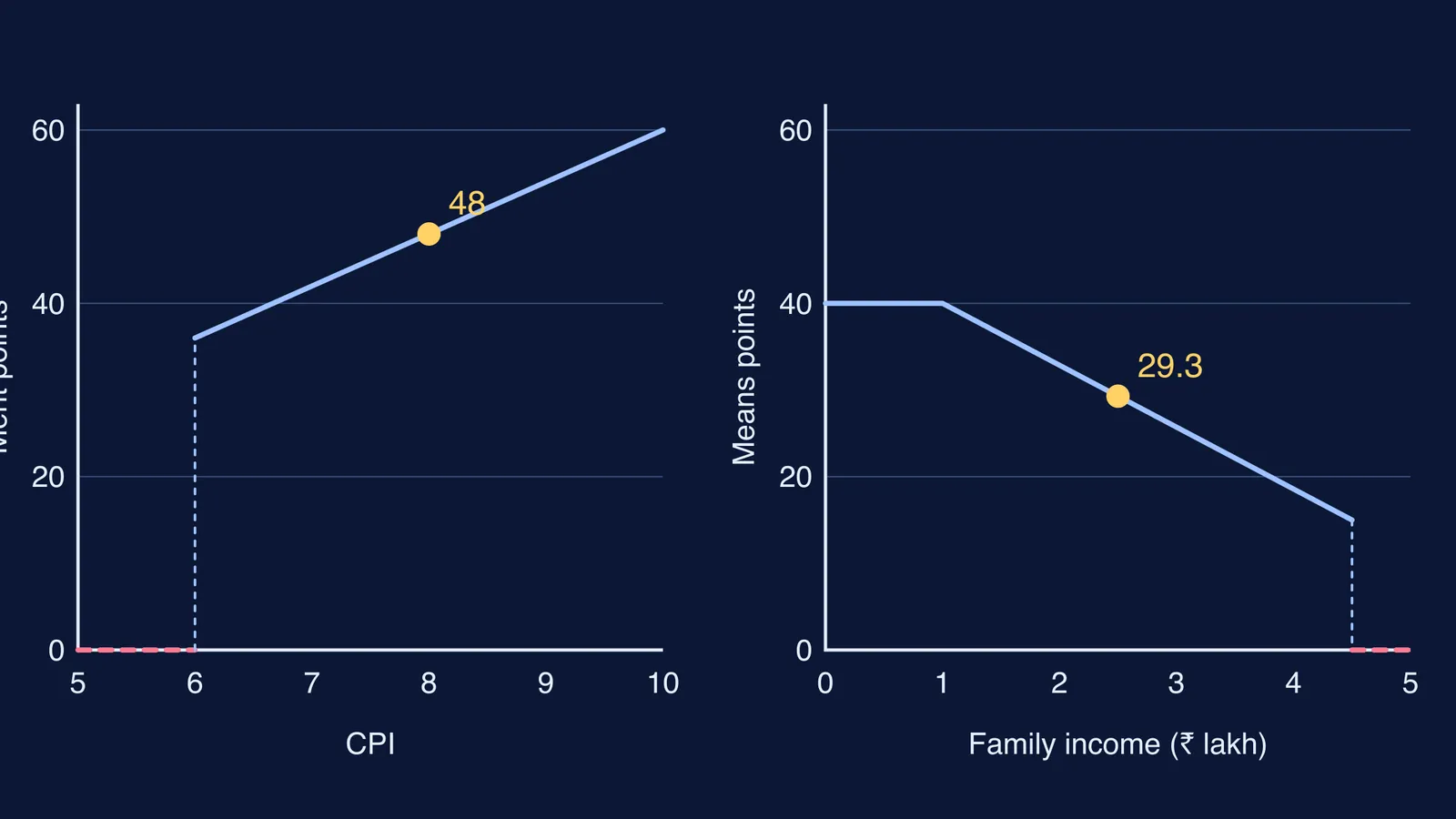
IIT Goa publishes its formula, which makes the trade-off visible: merit is worth up to 60 points and means up to 40, according to its scholarship manual.
Merit after the first semester: 60 × (CPI × 10 / 100), so a CPI of 8.0 earns 48 points. You need a CPI of at least 6.0. In the first semester, your JEE (Advanced) rank is used instead.
Means: 40 points below ₹1 lakh. Above that, 40 minus up to 25 points, scaled by where your income sits between the lowest and highest applicant incomes up to ₹4.5 lakh.
The top 25% of applicants by total score are considered.
Worked example. Assume this year's applicants in that band run from ₹1 lakh to ₹4.5 lakh.
Asha: CPI 8.0, family income ₹2.5 lakh. Merit 48. Means 40 − 25 × (1.5 / 3.5) = 29.3. Total 77.3.
Rohan: CPI 9.0, family income ₹4.0 lakh. Merit 54. Means 40 − 25 × (3.0 / 3.5) = 18.6. Total 72.6.
Asha ranks higher despite the lower CPI. Under this formula, one point of CPI is worth 6 merit points; with this income band, each lakh of income costs about 7 means points.
How do you apply for MCM after admission?
The window can be short. NITK's 2025-26 form was open from 25 February to 6 March 2026, with no extensions, and took one submission only, from the student's official institute email ID, according to its circular. IIT Goa usually announces MCM in the Autumn semester.
A checklist for your first month:
Find the scholarship section on your institute website and the office that runs it. Save its email address.
Check which income proof your institute wants. NITK asks for an income certificate for a scholarship. IIT Hyderabad wants both parents' Income Tax Returns with acknowledgement for 2026-27, even if income is zero, not a certificate.
Keep clear scans of your Class 12 marks card, JEE score card and caste certificate if you have one. IIT Hyderabad also lists your Aadhaar card.
Open a bank account in your own name. NITK will not pay into a parent's account.
Ask whether MCM can be combined with another scholarship. IIT Goa's manual may allow external scholarships, subject to conditions; IIT Hyderabad allows only one per academic year.
Check every upload before you submit. NITK does not let you replace documents afterwards.
If your application then sits at pending, see what to do when a scholarship is stuck at institute verification.
How do you keep the scholarship after first year?
NITK's circular requires a CGPA of 7.0 or more each year and income still under ₹4.5 lakh. Miss it and the scholarship is suspended for a year, a concession allowed only once. An FA grade ends it.
IIT Goa needs a CPI of at least 6.0, and cuts 50% of the monthly stipend for an academic warning letter and 100% for a grade or mark penalty.
Write your college's renewal CGPA on the first page of your notebook and check each SGPA against it. If a first-year maths or physics course is pulling you towards that line, fix the method early: the Fermi Problem Library has worked problems with a step-by-step solver that explains the reasoning rather than printing an answer.
Open your institute email tonight and search for scholarship; the notice may already be there.


