

On this page
A student formula team is a group of college students who design, build and race a small single-seat car, then explain every decision to a panel of judges. The rules are strict about who does the work: the car must be “conceived, designed and maintained by the student team members” and professionals “must not make design decisions or drawings” (Formula Student Rules 2027, section A 2.1). Nobody hands you the answer, which is why these teams teach so much.
What does a student formula team actually build?
A new car every season. Under the Formula Student rules, a vehicle may compete for only one year, and to count as new it must have a newly manufactured chassis (FS Rules 2027, A 2.2). Teams enter either a combustion (CV) or an electric (EV) class.
India has two main events. The 10th edition of Formula Bharat, held at Kari Motor Speedway in Coimbatore, concluded in early February 2026 with over 60 student teams; Camber Racing from SRM Institute of Science and Technology won the combustion category and Veloce Racing from Vishwakarma Institute of Technology, Pune, won the electric one (Autocar India). The 13th SUPRA SAEINDIA was scheduled for 2 to 5 September 2026 at the Buddh International Circuit, with 66 teams: 52 combustion and 14 electric (Autocar Professional). The Formula Bharat website lists Formula Bharat 2027 as its next event.
How is a formula student car scored?
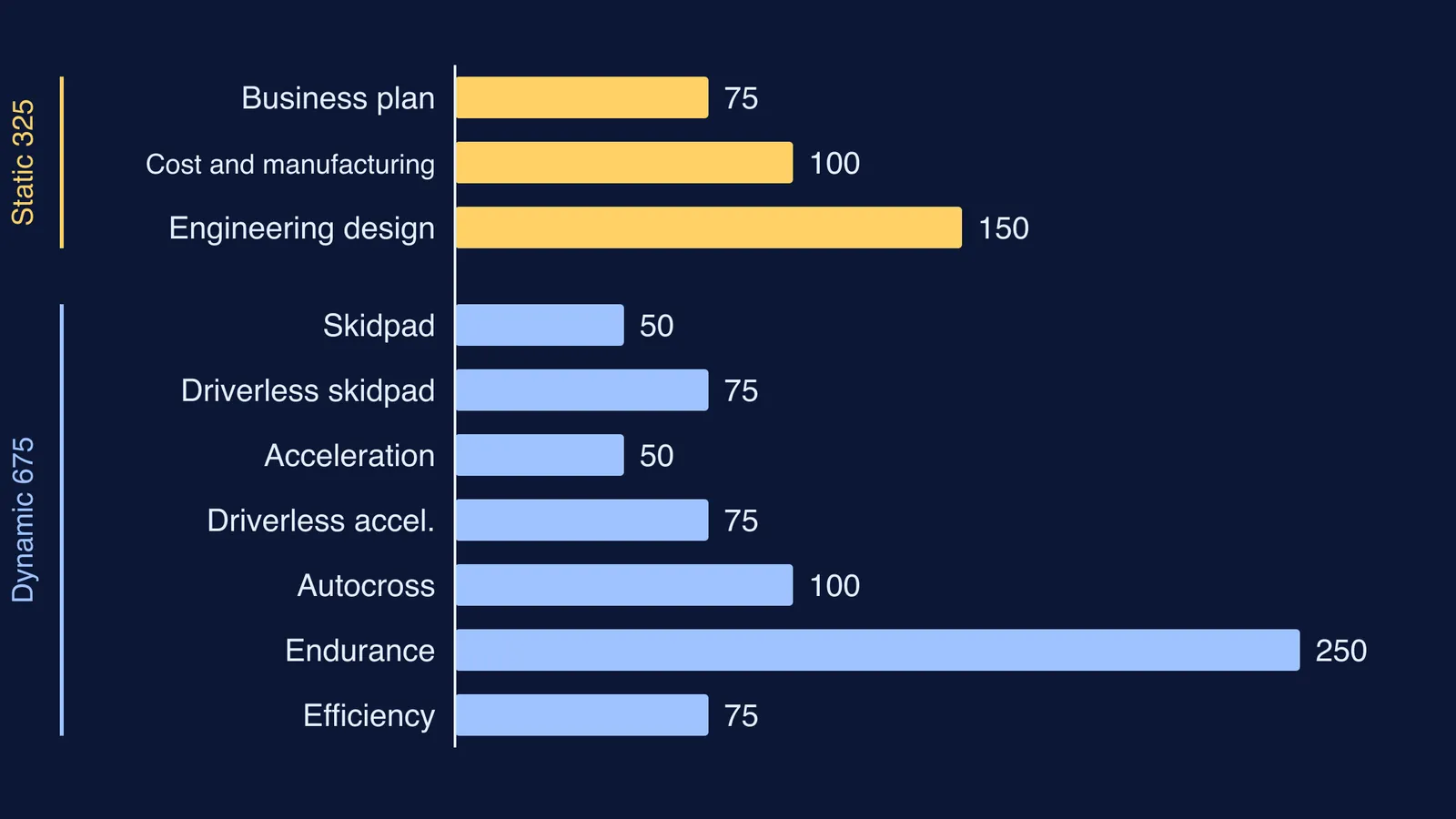
Out of 1,000 points, 325 come from three static events: Engineering Design (150), Cost and Manufacturing (100) and Business Plan Presentation (75) (FS Rules 2027, Table 1). The largest single event is Endurance, worth 250 points. Formula Student Germany says the car should also be “offered at a very reasonable cost and be reliable and dependable” (Formula Student Germany).
What roles are there on a formula student team?
More than most students expect. IIT Bombay Racing, for example, has added 17 technical and 4 non-technical subsystems over the years, from suspension, chassis and aerodynamics to accumulator management and data acquisition, plus marketing, creatives and finance (IIT Techambit). Roughly, the work splits like this:
Mechanical: chassis, suspension, wheel assembly, aerodynamics, powertrain.
Electrical: battery (accumulator) management, control unit, wiring, data logging.
Business: sponsorship, finance, the cost report and the business plan pitch.
Roles named in the rules: a team captain, drivers with a valid government driving licence, and, for electric cars, one to four Electrical System Officers, the only people in the team who may declare the car electrically safe (FS Rules 2027, A 4.2 and A 4.3).
That last rule is a teamwork lesson: nobody works on the car until a named teammate says it is electrically safe, so clear hand-offs matter as much as skill.
Who can join a student formula racing team?
The rules say team members must be enrolled undergraduate or graduate degree students, at least 18 years old, and PhD students cannot take part (FS Rules 2027, A 4.2). Each event also sets its own details in an Event Handbook (A 1.3.3), so check the rules of the event a team enters. In Class 11 or 12, the real step is choosing a college that runs a team: check Formula Bharat and SUPRA results lists, then each team's website.
Once in college, expect a ladder. At IIT Bombay Racing, freshers take a recruitment test in three sections (mechanical, electrical and organisational), sophomores become junior design engineers or assistant managers, and fourth-years form the core team (Insight, IIT Bombay). The same report says that by the time members leave, they have experience of design, modelling and simulation software, and dealing with vendors and industry experts. Still choosing a branch? Our guide to automobile vs mechanical engineering helps, and whether to join a technical team in first year covers the time trade-off.
How do you prepare for the recruitment test?
A four-week plan before recruitment opens:
Week 1: Read Table 1 and the rulebook chapter for your area.
Week 2: Revise the physics a car runs on: friction, circular motion, torque, work and energy, current electricity.
Week 3: Learn one tool: CAD for mechanical, basic circuits or coding for electrical, a spreadsheet for business.
Week 4: Build something small and write one page on what went wrong and what you changed.
For week 2, the Fermi Concept Library has a lesson for each concept, and the Fermi Simulation Lab has interactive simulations for the ideas that are easier to see than to read.
For the interview, try a script like this: “I chose electrical because I enjoyed current electricity. I read the rule on Electrical System Officers and wondered how you check the car is safe. Here is a small circuit I built, and the mistake I fixed.” It shows you read the rules and can own a mistake.
If the electric side appeals to you, read our guide to careers in the electric vehicle industry next.


