

On this page
The International Energy Agency's Global EV Outlook 2025 reports that electric car sales passed 17 million worldwide in 2024, more than 20% of all new cars sold. India matters most in two- and three-wheelers: the same report finds that China, India and Southeast Asia made up around 80% of global two- and three-wheeler sales in 2024, and that these vehicles are the main way people get around privately in India.
The government is putting money behind this too. The Union Cabinet approved the PM E-DRIVE scheme with an outlay of Rs 10,900 crore over two years, including money for electric buses, fast chargers and vehicle testing agencies, according to a PIB release of 11 September 2024. A separate production-linked incentive for battery cells, worth Rs 18,100 crore, allotted 50 GWh a year of cell-making capacity to four companies, as PIB reported in March 2022.
The 2024 release says the scheme will create jobs along the EV value chain. The harder question is which branch leads to them.
Which engineering branch is best for a career in electric vehicles?
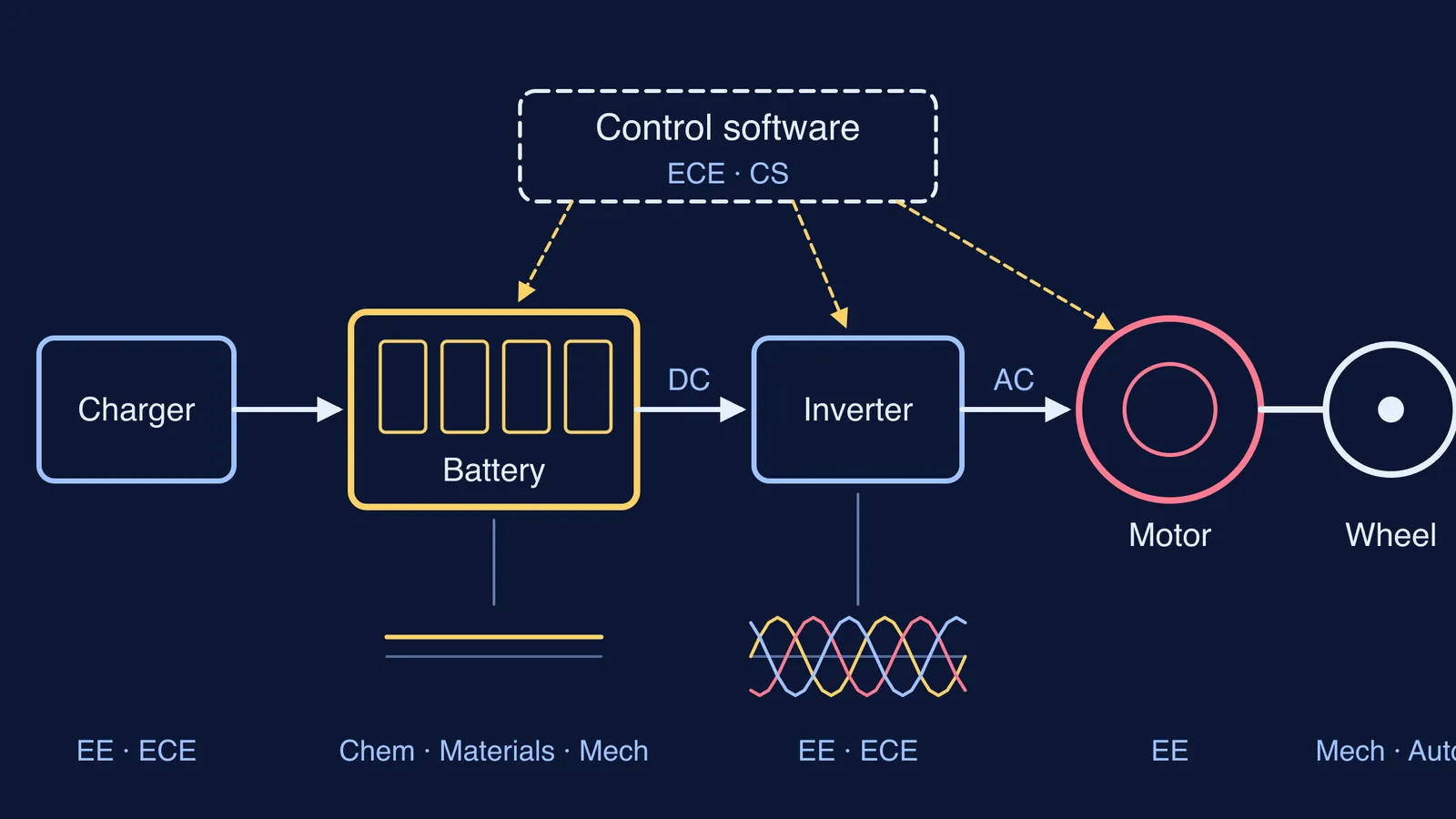
There is no single 'EV branch'. An electric vehicle is a chain of parts: a charger fills a battery, an inverter turns the battery's direct current into alternating current, a motor turns that current into torque, and software controls all of it. Each part draws on a different branch.
The IIT Guwahati course on NPTEL, Introduction to Hybrid and Electric Vehicles, lists four prerequisites: control systems, two courses on electrical machines, and power electronics. NPTEL files it under electrical engineering, which tells you where the core of the drivetrain sits. But the battery cell itself is chemistry and materials, the body and cooling are mechanical, and the code is computer science and electronics.
Which part of an EV matches which branch?
Battery cells (chemistry and materials): chemical engineering, metallurgy and materials engineering. You work on electrode materials, cell manufacturing and safety testing.
Battery packs and thermal management: mechanical engineering for cooling and structure; electrical engineering for the battery management system that monitors every cell.
Power electronics (inverter, charger, DC-DC converter): electrical engineering, or electronics and communication engineering (ECE). See our guide to choosing a power electronics specialisation.
Motors and drives: electrical engineering. The IIT Delhi NPTEL course EV: Vehicle Dynamics and Electric Motor Drives spends most of its 12 weeks on DC, induction, PMSM, switched reluctance and BLDC motor drives and their control.
Vehicle dynamics, chassis and testing: mechanical or automobile engineering. Our post on whether automobile engineering is worth choosing covers that route.
Embedded software, controls and data: ECE, electrical, or computer science. Firmware runs the battery management system and the motor controller; data teams study how batteries age.
Which Class 11 and 12 topics matter most for EV work?
The physics and chemistry you study for boards and JEE Main are the starting point for the ideas EV engineers use.
Current electricity and electrochemistry: EMF, internal resistance, cells in series and parallel, and the Nernst equation. A battery pack is all of these at once. Our explainer on battery technology careers goes deeper.
Electromagnetic induction and alternating current: Faraday's law, AC circuits and phasors are the base for how motors and inverters work. If these feel abstract, the Fermi Simulation Lab has interactive simulations for ideas that are easier to see than to read.
Thermodynamics and heat transfer: batteries lose energy as heat, so cooling design matters.
Calculus and trigonometry: sine waves, rates of change and integrals show up in control and power calculations.
If one of these chapters has a gap, the Fermi Concept Library gives each concept in physics, chemistry and mathematics its own lesson, so you can repair it before you build on it.
What can you do before college to test your interest?
Try this four-week plan alongside school. It takes about two hours a week.
Week 1: Take any electric scooter or e-rickshaw you can see on the road. Write down every part you can name, then sort them into the six groups above.
Week 2: Work out how far a battery could move a vehicle, using pack voltage, capacity in ampere-hours and a guess for energy used per kilometre.
Week 3: Read the syllabus of one NPTEL EV course linked above, then find its first lectures on the NPTEL site. Note which topics you enjoyed and which felt like a chore.
Week 4: Write one paragraph: 'The part I want to work on is ___, so the branches I will shortlist are ___ and ___.'
Your answer from week 4 is a better guide than an EV label on a brochure. Take it into counselling, and keep the branch decision about what you want to learn for four years.


