

On this page
Electric vehicles, smart grids, and renewable energy are changing the engineering landscape. The foundation behind these shifts is a specific branch of electrical engineering that handles the rigorous demands of high voltages and massive currents. For students considering their long-term path, understanding this discipline is the first step toward a secure and impactful career.
What is power electronics?
Power electronics is the application of solid-state electronics for the control and conversion of electric power. It sits squarely at the intersection of heavy power engineering, diode circuit problems, and digital control systems.
While a traditional electronics engineer might work with microchips processing mere milliwatts of power for computing, a power electronics engineer designs robust circuits that handle kilowatts or even megawatts of power. Their primary goal is to efficiently convert electrical energy from one form to another—such as changing Alternating Current (AC) from the grid to Direct Current (DC) for a battery, or stepping up voltage levels for long-distance transmission.
Because these systems handle so much energy, even a tiny percentage of energy lost as heat can melt components or drain a battery prematurely. When you dive into power and efficiency problems in physics, you are touching the core metrics that define this discipline. Engineers in this field are obsessed with achieving extremely high conversion efficiency.
Why consider a power electronics career for electrical students?
The global shift away from fossil fuels has transitioned this field from a niche specialty to a crucial technical discipline. The U.S. Bureau of Labor Statistics projects an 8% job growth for electrical and electronics engineers through 2035, which is much faster than the average for all occupations (source).
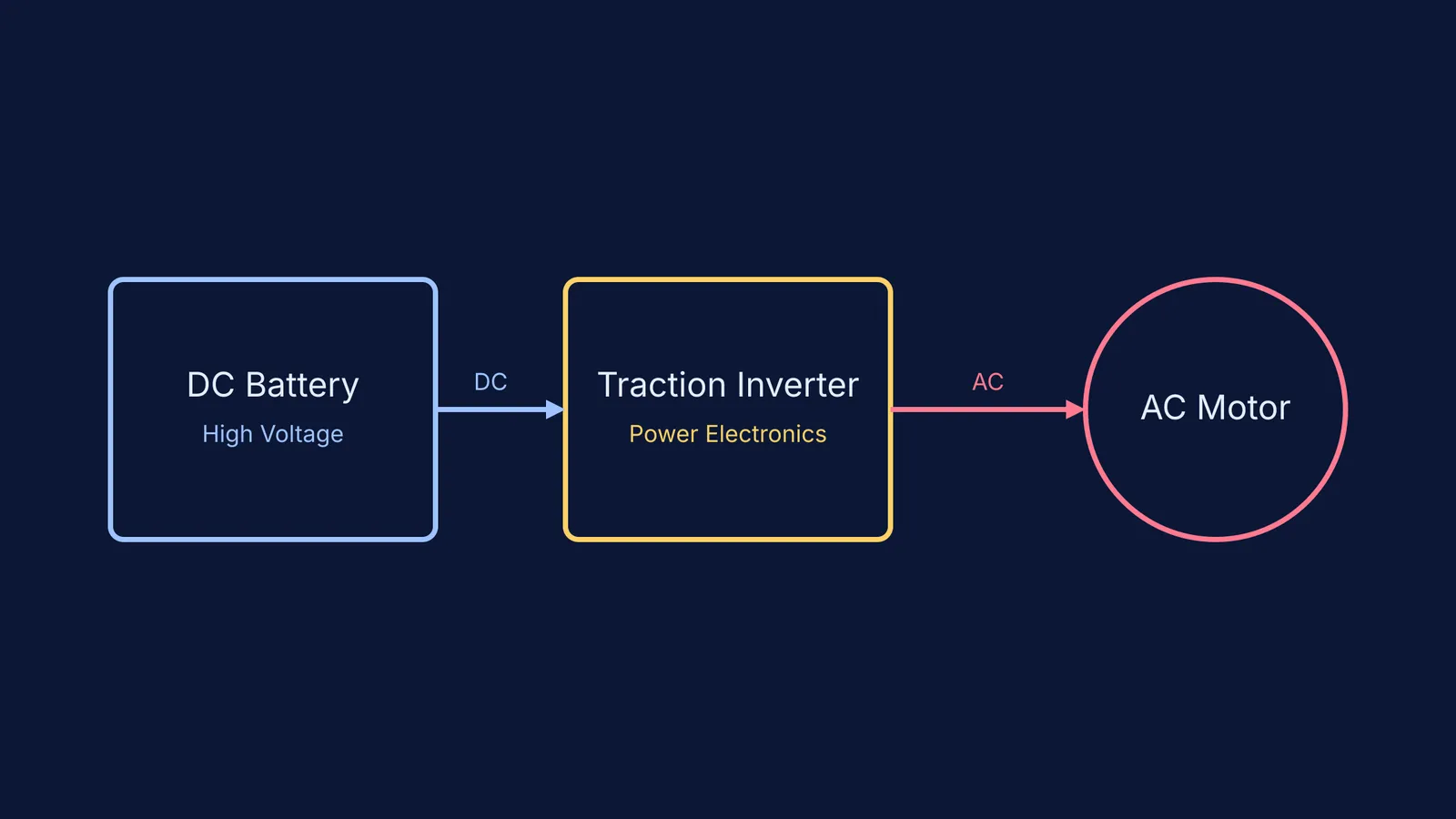
Within this broader engineering growth, the electrification of transport is the primary accelerator. Modern EVs rely entirely on highly efficient inverters and converters to manage the massive flow of energy between the battery and the electric motor. A recent report by IDTechEx projects that the global market for power electronics in electric vehicles alone will exceed $42 billion by 2036 (source). This translates directly into strong hiring demand, competitive salaries, and long-term job security for graduates who understand power systems.
Where do power electronics engineers work?
As a power electronics engineer, your skills are highly transferable and needed across several high-growth industries:
Electric Vehicles (EVs): Automotive companies need engineers to design the traction inverters that drive the motor, the on-board chargers (OBC) that replenish the battery from a wall socket, and the battery management systems (BMS) that keep the cells balanced and safe.
Renewable Energy and Smart Grids: The green energy transition requires massive solar inverters that convert the DC power generated by photovoltaic panels into the AC power used by the electrical grid. Engineers also design High-Voltage Direct Current (HVDC) transmission systems to move wind power across entire continents with minimal loss.
Consumer Electronics: Every laptop, smartphone, and television requires a compact, efficient power supply to step down wall voltage.
Data Centres: The growth of artificial intelligence has created a need for thermal management and highly efficient power delivery to run gigantic server farms.
What skills do you need to specialise?
To thrive in this field, you will need to build a strong theoretical foundation during your first semester at engineering college and carry it through to your final year.
Converter Topologies: You must understand how basic circuits like Buck (step-down) and Boost (step-up) converters operate, eventually moving to complex Dual Active Bridge (DAB) designs.
Semiconductor Physics: Knowing how modern switches like Insulated-Gate Bipolar Transistors (IGBTs) and MOSFETs behave under thermal and electrical stress is essential.
Control Theory: Power systems are rarely static. They require precise, real-time digital control loops to manage voltage fluctuations, load changes, and motor speeds safely.
Simulation and Software: Before building expensive and potentially dangerous high-voltage hardware, engineers rigorously simulate their circuits using software.
If you are learning the fundamentals of these circuits, you can build and test them in the Fermi Simulation Lab to see how current flows and voltages change before you ever touch a physical breadboard. When the heavy mathematics behind closed-loop control or semiconductor physics becomes confusing, Fermi's AI tutor can work out what you already know and build a plan for the session, so you sit down to a clear next step rather than feeling overwhelmed. If you just need a quick refresher on a specific principle, the Fermi Concept Library holds the core ideas behind electromagnetic induction and solid-state physics.
How to start your journey?
The biggest differentiator for students entering this field is hands-on hardware experience. Employers highly value engineering graduates who have moved beyond textbook theory and actually built physical systems that work.
Start small with hardware: Build a bench-scale prototype, such as a low-power DC-DC converter. Testing real hardware teaches you about parasitic inductance and heat—things that equations often hide.
Join a student design team: Participate in student competitions like Formula SAE Electric or solar car challenges. These teams task you with designing actual power systems under strict constraints.
Master PCB layout: Learn how to design a Printed Circuit Board (PCB), paying close attention to heat dissipation, trace widths for high current, and mitigating electromagnetic interference (EMI).
A career in power electronics demands rigorous mathematical analysis, a deep understanding of physics, and careful lab practices. In return, it places you at the very forefront of the clean energy transition, giving you the tools to build the systems that will power the future.


