On this page
Your first university exam in MBBS comes at the end of Phase I, and it has its own rules on who may sit it and who passes. The National Medical Commission sets them in its Competency Based Medical Education (CBME) Guidelines 2024, which apply from the MBBS batch of 2024-25 onwards. Here is what they say, one worked mark sheet, and a plan for the year.
What is the first professional MBBS exam?
Under the NMC CBME Guidelines 2024, Phase I lasts 12 months, including a two-week Foundation Course and the university exams. The Phase I university exam is held in the 12th month of training, in Anatomy, Physiology and Biochemistry.
Each of these subjects has two theory papers of 100 marks each and a practical of 100 marks, so 300 marks per subject. The suggested theory paper runs 3 hours and mixes scenario-based MCQs, a long essay, reasoning questions and short notes, including one from the AETCOM (Attitude, Ethics and Communication) module. Universities may design their own blueprint within these principles, so check yours.
Who is eligible to sit the university exam?
The NMC guidelines set three gates:
Attendance: at least 75% in theory and 80% in practical in each subject, plus 75% in AETCOM and 80% in family visits under the Family Adoption Programme.
Internal assessment (IA): at least 50% of IA marks with theory and practical combined, and at least 40% in each separately. IA is marked out of 100 for theory and 100 for practical.
Competencies and log book: the certifiable competencies for the phase completed and the log book submitted.
IA comes from at least three theory and practical internal exams per subject, including a pre-university exam, and the log book carries 10-20% of IA. IA marks are not added to your university marks: they sit in a separate column on your marks card and decide whether you may sit the exam.
What marks do you need to pass first year MBBS?
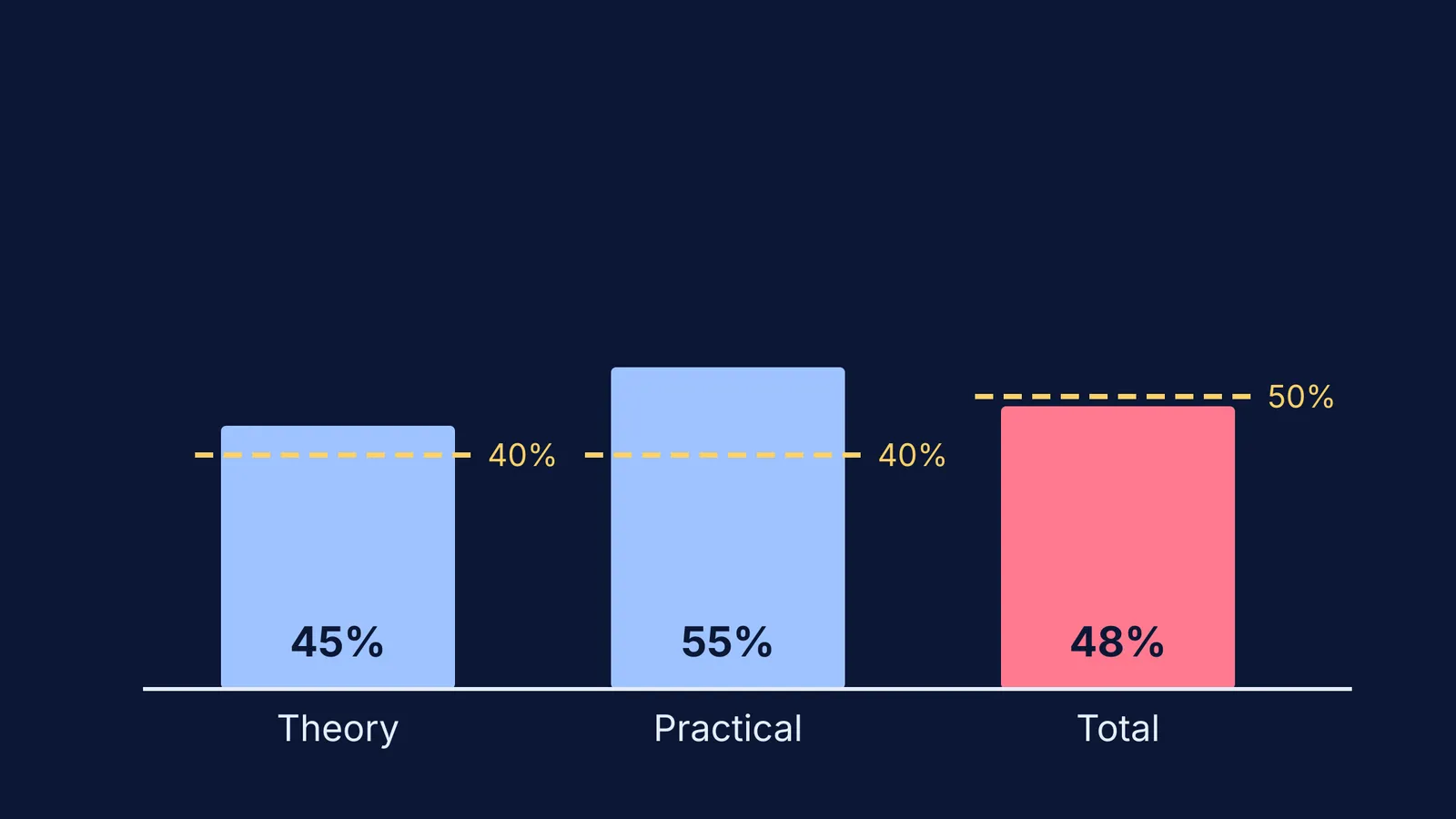
The NMC pass rule is 50% overall in the university theory and practical combined, with at least 40% in theory and 40% in practical separately. In two-paper subjects, the 40% theory minimum applies to both papers added together. There are no grace marks.
A worked example for one subject out of 300:
Theory: 52 + 38 = 90 out of 200, or 45%. The theory head is cleared, even though Paper 2 alone was under 40%.
Practical: 55 out of 100, or 55%. Cleared.
Total: 145 out of 300, or 48.3%. That is short of the 150 needed, so the subject is not passed.
Five more marks anywhere would have made it a pass. Clearing each head at 40% is not enough on its own, and a strong practical cannot rescue theory below 40%.
What does a supplementary exam mean?
If you do not pass the regular exam, you take the supplementary. The NMC guidelines say universities should hold it and declare results within 6-8 weeks of the main results, so students who pass can join the main batch.
You cannot start Phase II until you pass every Phase I subject.
Fail the Phase I supplementary and you move to the junior batch for teaching and exams.
Sitting only theory or only practical counts as an attempt; missing both does not.
The normal limit is four attempts, with Phase I finished within four years and MBBS within ten.
Students short of IA can be given remedial work and then sit the same batch's supplementary. For attendance, remedial classes are open only to students at 60% or above.
In October 2026 the NMC granted a one-time fifth "mercy" attempt to eligible students admitted from 2019-20 onwards. It calls this a transitional relaxation, not a precedent. Students who already used a mercy attempt get no sixth, and the ten-year limit stays.
How should you plan Phase I?
These steps follow the gates in the NMC guidelines:
Month 1: Write down the three gates for each subject and the dates of the internal exams.
Every month: Keep your own attendance count rather than waiting for a warning.
After each internal: Check theory and practical IA separately. If either is near 40%, ask the department about remedial work.
Weekly: Fill in your log book, because it counts toward IA.
Final two months: Practise full 3-hour papers to the blueprint, and do timed practicals.
When a Biochemistry pathway or Physiology mechanism won't stick, the Fermi Concept Library has a lesson for every concept in physics, chemistry, biology, mathematics and computing, so you can rebuild the basics before your next internal. If you don't know where to start, Fermi's AI tutor can work out what you already know and build a plan for the session.
Next, read about first-year college attendance rules, how to prepare for semester exams in college, and the path from MBBS to a specialisation.