

On this page
Engineering hostels often follow an unspoken rhythm: weeks of casual routines followed by a frantic 48-hour scramble. Students brew midnight coffee, download slide decks, and attempt to absorb five modules of engineering mathematics, circuit theory, or fluid dynamics in a single sitting.
Yet when the exam begins, formulas memorized at 4:00 AM evaporate, or a forgotten boundary condition derails a 14-mark numerical problem. Consistent academic performance does not require studying 12 hours a day. It requires understanding how memory encodes technical procedures and following a disciplined two-week plan.
Why does night-before cramming fail in engineering?
Cramming fails in technical degrees because engineering exams evaluate procedural application rather than passive recognition.
In a semester-long study using wearable trackers at MIT, Okano et al. (2019) found that sleep quality, duration, and consistency accounted for nearly 25% of the variance in academic performance. Crucially, sleep on the night directly before an exam showed no correlation with grades; sleep duration and regularity across the month and week beforehand determined scores. Students going to bed after 2:00 AM performed significantly worse regardless of total sleep. We know that sleep before an exam beats an all-nighter in every cognitive measure.
Cramming also induces a misleading feeling of competence. In research on learning schedules, Kornell (2009) found that spaced practice beat cramming for 90% of students. Yet 72% believed cramming had been superior. Re-reading notes creates immediate fluency, masking knowledge gaps until you confront a blank answer sheet.
How do you spot what professors will test?
In engineering faculties, question papers and marking rubrics follow distinct instructor cues.
Examining classroom signaling, Titsworth and Kiewra (2004) found that spoken organizational lecture cues increased organizational points in student notes by 39% and details by 35%, boosting test achievement by 15% to 45% compared to uncued lectures.
Audit your lecture notes for three high-yield signals:
Board derivations: Any proof or circuit your professor drew manually on the board—rather than clicking through on a slide—is a primary candidate for a major question.
Explicit warning markers: Phrases like "students often make a sign error here" identify tricky edge cases designed into numericals.
Unscripted class questions: Problems your instructor posed to the room reflect the core competencies needed to pass.
How do you use past papers for active retrieval?
Reading solved papers creates false familiarity. Past University Question Papers (UQPs) should serve as active testing tools.
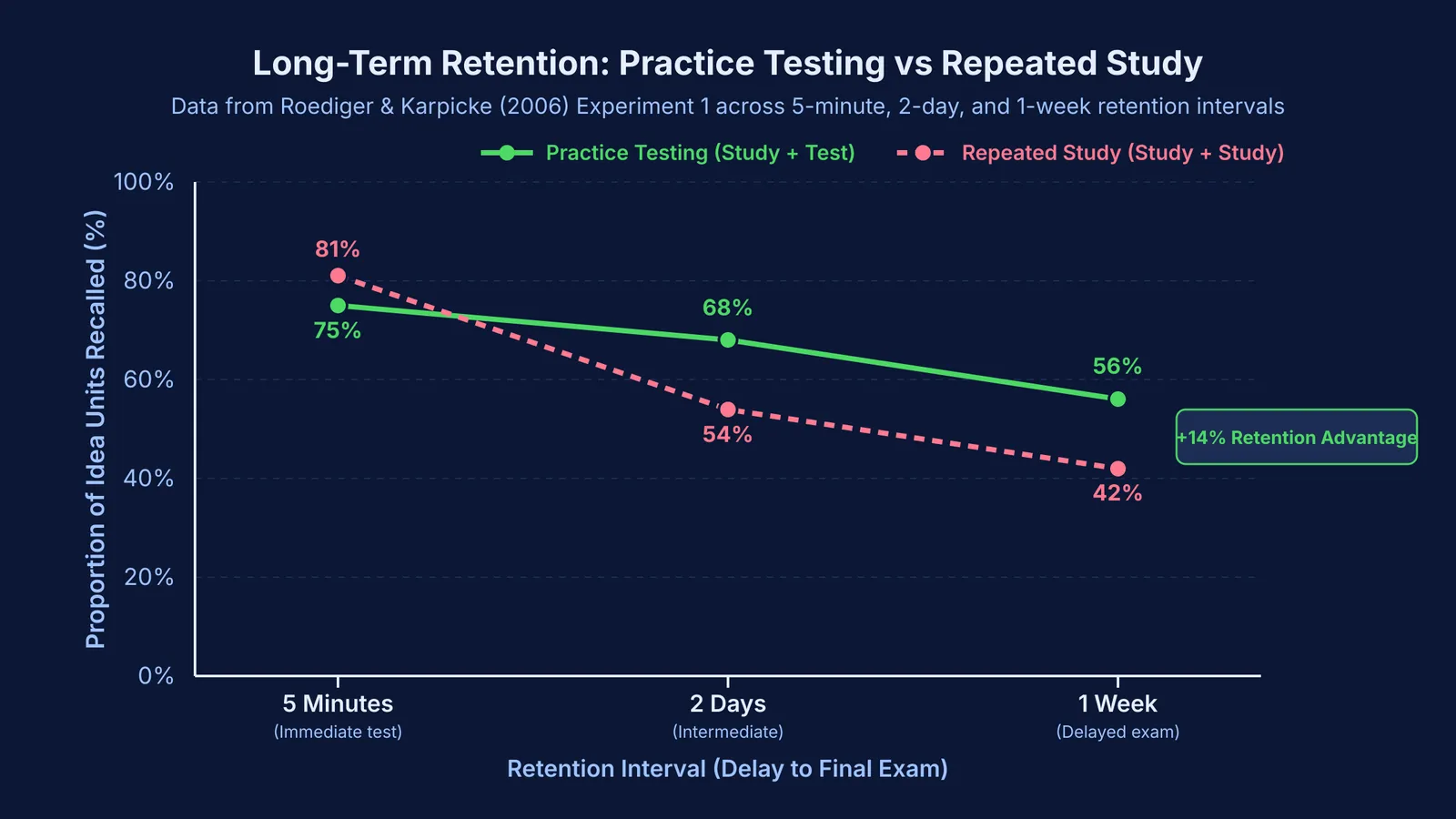
In memory trials, Roediger and Karpicke (2006) found that testing produced far greater one-week retention (56%) than repeated study (42%). The Dunlosky learning techniques review rated practice testing and distributed practice as the two most effective study methods available.
Additionally, Cepeda et al. (2008) showed that the optimal study gap is 10% to 20% of the retention interval. For an exam in 10 to 14 days, spacing reviews every 1 to 3 days locks in retention.
Use past papers through three disciplined steps:
Map frequency: Group questions from the last five years by module. A majority of marks derive from three or four recurring problem archetypes per unit.
Closed-book derivation sprints: Reconstruct derivations on blank paper without looking at notes. Annotate missed steps in red, review the gap, and retest the next day.
Solve numericals to final units: When you get stuck on multi-step numericals, the Fermi Problem Library provides worked problems with a step-by-step solver that explains the reasoning rather than printing an answer.
What does an effective two-week exam blueprint look like?
Drawing on the optimal study gaps identified by Cepeda et al. (2008) and the sleep consistency findings of Okano et al. (2019), a structured spaced revision schedule divides your final fortnight into manageable phases:
Days 14–11 (Triage and cue mapping): Organize syllabus units and map past papers against lecture cues. If you need to verify foundational principles across multiple syllabus units, the Fermi Concept Library maps every concept in physics, chemistry, biology, mathematics and computing, each with its own lesson and its place in the map.
Days 10–5 (Spaced retrieval cycles): Spend two to three hours daily per subject, interleaving two subjects per day. Rebuild derivations and solve past numericals cold. If you are unsure how to structure your daily practice sessions, Fermi's AI tutor can work out what you already know and build a plan for the session, so you sit down to a clear next step.
Days 4–2 (Timed mock papers): Complete a full three-hour past paper under real exam conditions. Grade your work strictly against the university marking scheme.
Day 1 (Consolidation and rest): Review one-page formula sheets and boundary condition notes. Stop studying by 9:00 PM and sleep before midnight. If you feel overwhelmed, free support is available through the Tele MANAS helpline (14416).


