

On this page
You took science in Class 12, but you also love history, economics or writing. Under India's four-year undergraduate rules, you can keep science as your main subject and still take a real share of humanities. Here is how the credits work and what to ask a university before you apply.
What is a liberal arts degree in India?
India's National Education Policy 2020 (section 11.1) describes the ‘liberal arts’ as a ‘knowledge of many arts’, in which mathematics, science, vocational and professional subjects and soft skills all count as arts. So in India, liberal arts means breadth plus one field you study in depth. It does not mean arts instead of science.
The policy (section 11.9) makes the four-year multidisciplinary bachelor's the preferred option. The University Grants Commission (UGC) turned this into rules in its Curriculum and Credit Framework for Undergraduate Programmes (December 2022). Under those rules, a major is the subject your degree is awarded in, and a minor is a second subject that broadens it.
Can a science student do a liberal arts degree after 12th?
Yes. The UGC framework sets eligibility for undergraduate programmes as a Class 12 certificate or equivalent (UGC framework, section 3.3). Each university sets its own subject requirements for each major, so check them for the major you want. Many universities admit through CUET (UG), whose scores are used for undergraduate admission at central universities and participating state, deemed and private universities (NTA CUET page). Others run their own tests, so check each university's admissions page.
One limit: a liberal arts degree does not lead to a BTech or MBBS, which have their own entrance exams. If that's your plan, our comparison of BSc physics and BTech engineering physics is a better place to start.
How do you combine science with humanities?
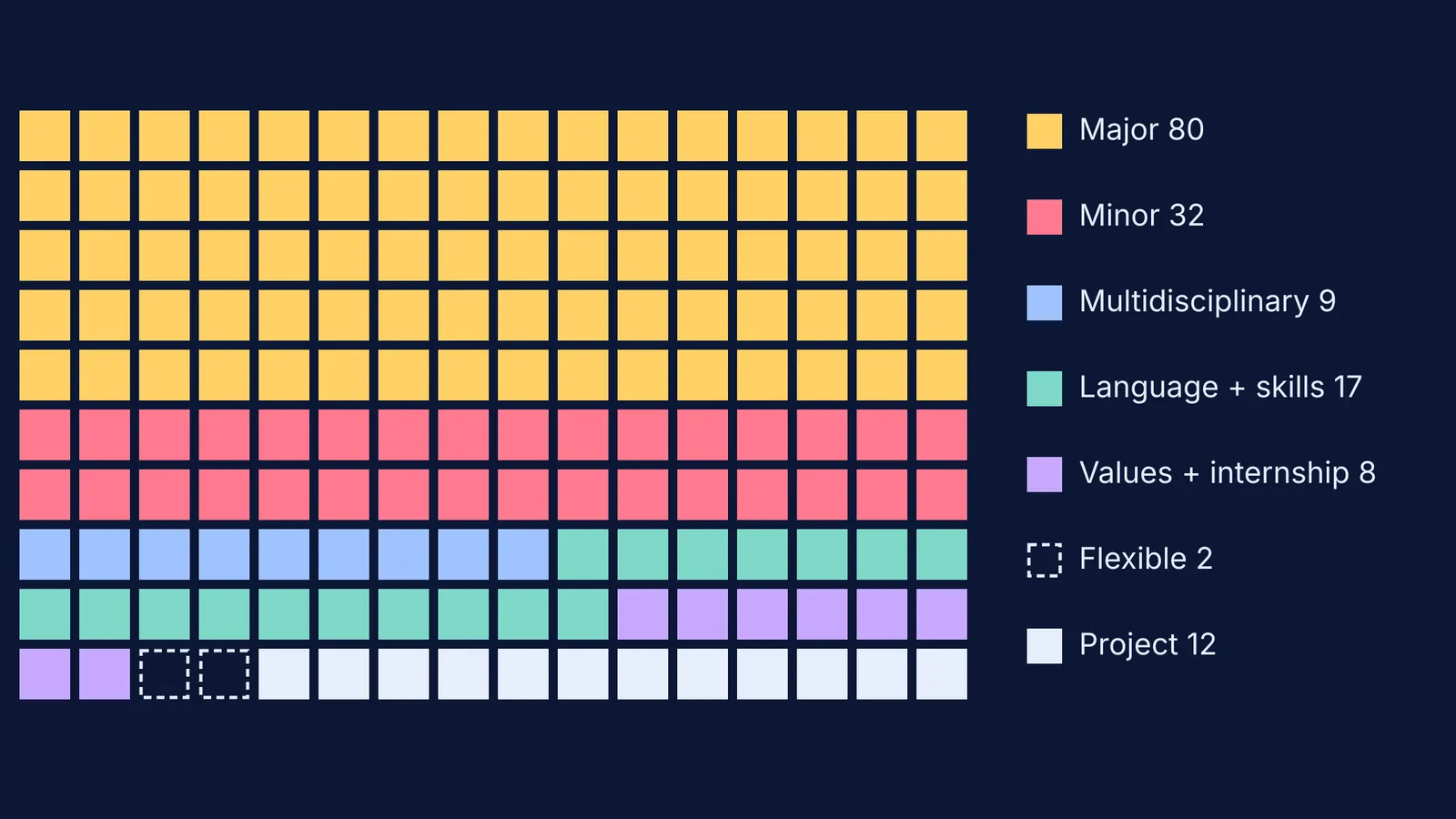
The credit maths shows how much room you get. In the UGC framework, a four-year honours degree carries 160 credits, and at least 80 of them must come from your major (UGC framework, Table 2). The same table sets a minimum of 32 credits for a minor and 9 for multidisciplinary courses. Another 12 credits go to a final-year research project, or to three extra courses if you don't take the research route.
A worked example: Riya majors in physics and minors in philosophy.
Physics major: at least 80 credits, about half the degree, so she still covers a full physics core
Philosophy minor: at least 32 credits, or roughly eight courses of 4 credits each
Multidisciplinary, language, skill and value-added courses plus a summer internship: about 36 credits, where she might take economics or writing
Final year: a 12-credit research project in physics, if she qualifies
If both subjects matter equally, the framework also allows a double major, with at least 64 credits from the second major in a four-year degree.
The honours-with-research route is open to students who score 75% or more in the first six semesters (UGC framework, section 3.2.3). For the full picture of exits and the fourth year, read our guide to the four-year UG honours degree under NEP.
What careers come after a liberal arts degree?
Your major still decides which jobs and postgraduate courses you qualify for. The minor broadens what you can do. In the World Economic Forum's Future of Jobs Report 2025, a survey of over 1,000 employers, seven out of 10 companies considered analytical thinking essential. The same report expects creative thinking, curiosity and lifelong learning to grow in importance up to 2030.
Some fields that use both halves of a degree:
Physics or maths with economics: data analysis, finance research, public policy
Biology with a social science: public health research, science policy
Chemistry with writing or a language: science journalism, technical writing
Computer science with philosophy or psychology: product design, AI ethics and policy
Questions to ask before you choose
Ask every university these five questions:
Is the degree a BSc or a BA when science is my major, and does it include lab work?
How many science credits will I actually earn by graduation?
Can I change my major after the second semester, and to which subjects?
Do you offer the fourth year with research, and who supervises it?
Where did last year's science majors go next: jobs, master's courses or research?
If your parents are worried, try saying this: ‘I'm not dropping science. Physics will be at least half my degree. The minor adds a second field, and I can ask to change my major after the first year if it isn't working.’
If you're majoring in a science, the Fermi Concept Library has a lesson for every concept in physics, chemistry, biology, mathematics and computing, so you can fill gaps before first-year courses build on them. If you don't know where to start, Fermi's AI tutor works out what you already know and builds a plan for the session.
Thinking about the same idea abroad? Our explainer on liberal arts colleges in the US covers size, financial aid and fit.


