

On this page
When families in India plan for undergraduate study in the United States, their initial lists almost always feature large research powerhouses like UC Berkeley, Michigan, or the Ivy League. According to the Institute of International Education (IIE Open Doors) report, the United States hosted 1,126,690 international students in the 2023/24 academic year, with India becoming the leading sender at 331,602 students. Yet fewer than 10% of those Indian undergraduates enroll in American liberal arts colleges, largely due to a common linguistic misunderstanding: assuming "liberal arts" refers only to humanities and excludes science, technology, or mathematics.
What is a liberal arts college in the US?
In the United States higher education system, the term "liberal arts" does not mean political liberalism or fine arts. It traces to the classical *artes liberales*—a curriculum designed to develop broad critical reasoning across mathematics, natural sciences, social sciences, and humanities.
Under the official Carnegie Classification of Institutions of Higher Education, these schools are designated as "Baccalaureate Colleges: Arts & Sciences Focus." To hold this classification, an institution must meet three strict structural criteria:
Award bachelor's degrees as at least 50% of all degrees conferred.
Maintain a strict undergraduate emphasis, granting fewer than 50 master's degrees and fewer than 20 doctorates annually.
Award at least 50% of its bachelor's degrees in foundational arts and sciences disciplines rather than narrow vocational fields.
Unlike specialized institutes that channel seventeen-year-olds into rigid degree tracks on day one, a liberal arts college encourages intellectual breadth. A student majoring in physics routinely studies political philosophy, while a neuroscience major analyzes literature or economics. For families talking about STEM careers beyond engineering and medicine, this model builds adaptable problem-solving skills rather than training for a single entry-level job.
How does undergraduate teaching differ from research universities?
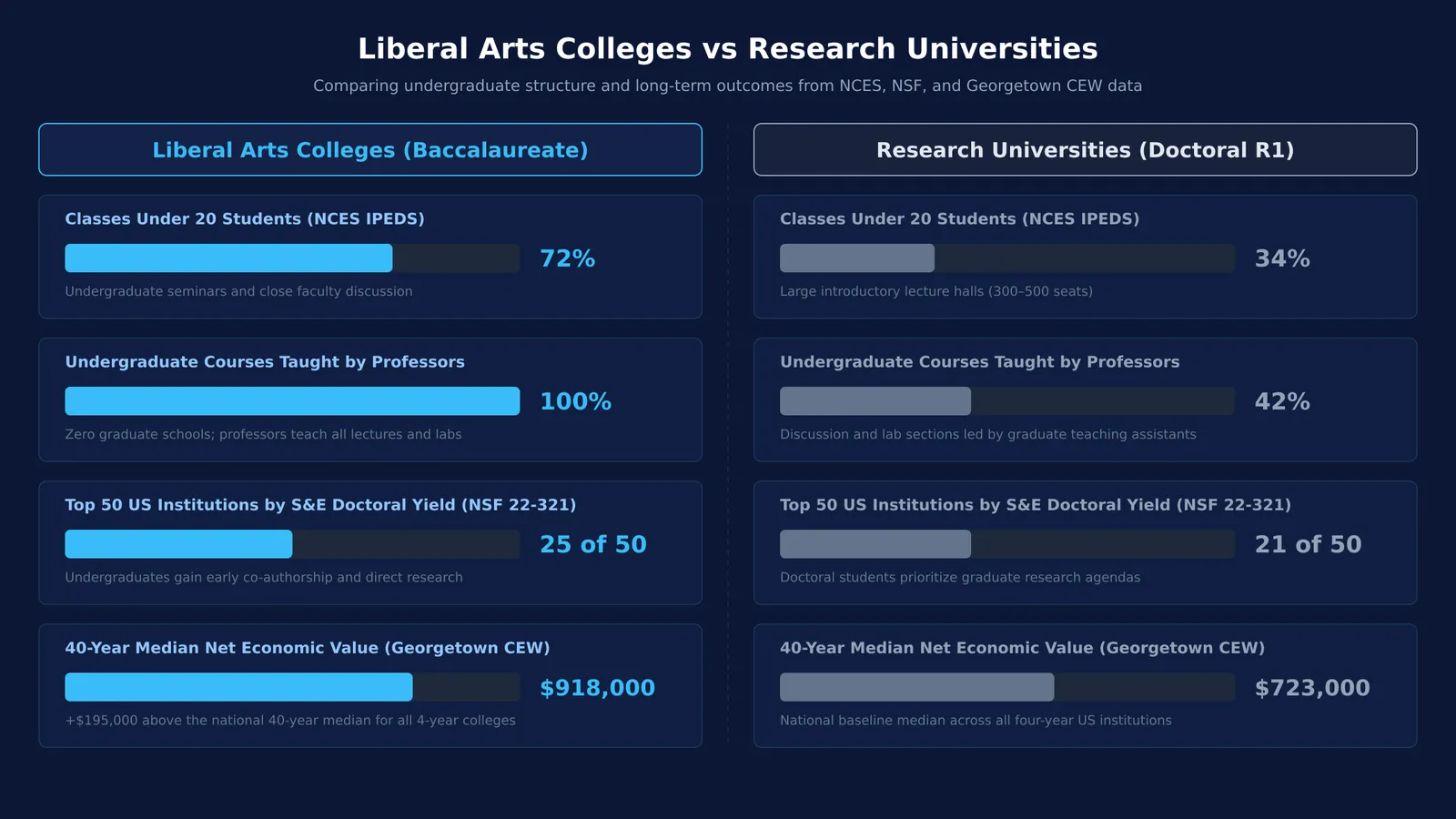
The primary difference between a liberal arts college and a major research university lies in where faculty attention goes. At a large state flagship or R1 research university, professors are evaluated primarily on securing research grants and training doctoral candidates. Undergraduates often spend their first two years in massive lecture halls seating 300 to 500 students, with discussion sessions and lab sections run by graduate teaching assistants.
By contrast, liberal arts colleges have no graduate schools. Every laboratory bench, seminar chair, and grant budget belongs entirely to undergraduates. Data from the National Center for Education Statistics (NCES IPEDS) shows that leading liberal arts colleges maintain student-to-faculty ratios between 7:1 and 9:1, compared to 18:1 or higher at large public universities. Furthermore, over 70% of classes at colleges like Williams, Amherst, Swarthmore, and Carleton seat fewer than 20 students, and professors teach every lecture and lab personally.
This dynamic creates an exceptional training ground for research. Undergraduates operate electron microscopes, co-author peer-reviewed papers, and present at national conferences during their second and third years. According to National Center for Science and Engineering Statistics (NSF report NSF 22-321), small baccalaureate colleges punch far above their size in research output: 25 of the top 50 US institutions ranked by institutional-yield ratio for science and engineering doctorates are baccalaureate colleges. Students seeking early undergraduate research internships find that professors know them by name and write detailed, personal recommendations for postgraduate study.
How does financial aid work for international applicants?
According to College Board data on college pricing, published tuition and living costs at top US colleges now exceed USD 85,000 to USD 90,000 per year, leading many international families to assume smaller private colleges are unaffordable. In reality, liberal arts colleges frequently offer the most generous international financial aid packages in the world, funded by massive per-student endowments.
Financial aid policies for international applicants fall into two distinct models:
Need-blind admissions: A small tier of institutions admits applicants without considering their family's ability to pay, while meeting 100% of demonstrated financial need with grant aid and zero student loans. Among liberal arts colleges, Amherst College and Bowdoin College offer fully need-blind admission to all international citizens.
Need-aware admissions with full-need funding: Many premier colleges—including Williams, Swarthmore, Pomona, Wellesley, and Carleton—evaluate financial need during admissions decisions. However, once an international student is admitted, the college guarantees to meet 100% of their calculated need.
At these full-need institutions, international financial aid packages average over USD 65,000 annually in outright grants, covering tuition, room, board, and health insurance. For middle-income families, attending a selective liberal arts college on need-based aid is often far less expensive than attending an out-of-state public university, where non-residents pay full tuition with virtually no aid.
Before entering such writing-intensive and analytical courses, students often need to strengthen foundational STEM skills. Fermi's AI tutor works out what a student already knows, builds a plan for the session, and teaches through it to build conceptual fluency before college begins.
Which students thrive at a liberal arts college?
A liberal arts college is not the right choice for everyone. Because these institutions typically enroll between 1,500 and 3,000 students, campus life is intimate and academically rigorous.
Consider this framework when deciding whether to apply:
Discussion versus lecture preference: You learn best in Socratic seminars where you are expected to speak, debate, and defend your reasoning, rather than listening passively in a packed auditorium.
Multi-disciplinary curiosity: You want to explore multiple subjects before committing to a major at the end of your second year, rather than locking into a single vocational track at age eighteen.
Long-term career mobility: A study by the Georgetown University Center on Education and the Workforce (Georgetown CEW) found that liberal arts colleges offer a 40-year median net present value of USD 918,000—nearly USD 200,000 higher than the median across all four-year institutions (USD 723,000)—because graduates build adaptable communication and analytical skills that lead to senior leadership roles.
Campus environment: If you thrive in bustling urban centres with 40,000 peers and major commercial sports culture, a self-contained campus in a small town may feel quiet.
Adapting to your first semester at college requires self-directed study habits and deep conceptual clarity. The Fermi Concept Library maps every concept across mathematics and the sciences, giving students the structured mastery needed to thrive in fast-paced college seminars.


