On this page
Most JEE aspirants prepare for two exams at once. JEE Main decides your NIT and IIIT options and is also the gate to JEE Advanced, which decides IIT admission. The two share subjects, but they are set by different bodies, built differently and scored differently. Here is what that means for your study plan.
How is JEE Main different from JEE Advanced?
JEE Main is run by the National Testing Agency (NTA). Its Paper 1 is for B.E./B.Tech admission at NITs, IIITs and other centrally funded institutions, and it is also the eligibility test for JEE Advanced, according to NTA's public notice of 24 October 2026.
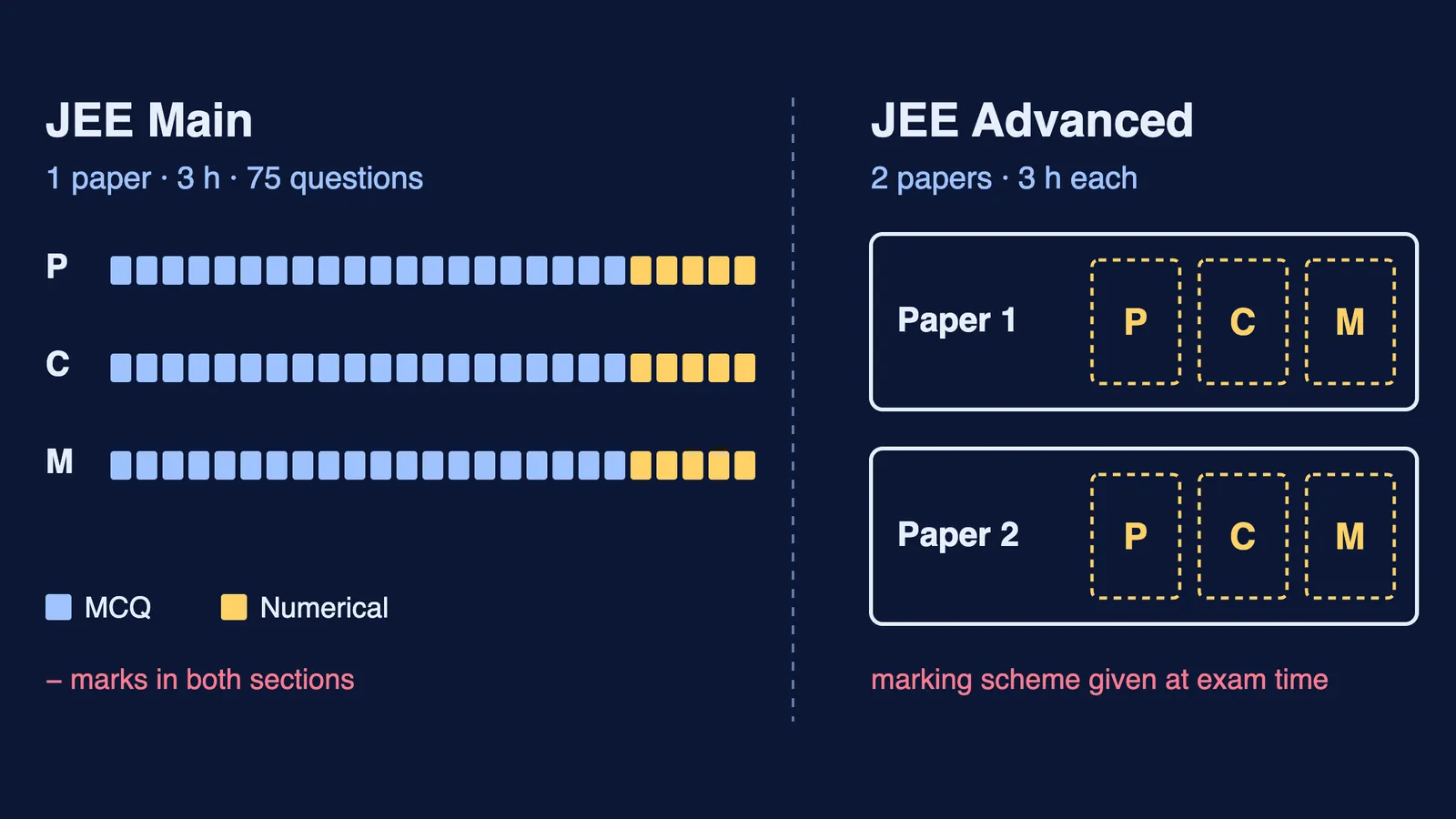
JEE Main 2027 Paper 1 is one 3-hour computer-based paper with 75 questions: 20 multiple-choice and 5 numerical-value questions in each of Physics, Chemistry and Mathematics (NTA notice).
JEE Advanced is run by the IITs, with IIT Roorkee as the organising institute for 2026 (JEE Advanced 2026 website). To sit it in 2026, you had to be among the top 2,50,000 successful candidates in the B.E./B.Tech paper of JEE Main, and a candidate could attempt JEE Advanced at most twice, in two consecutive years (JEE Advanced 2026 Information Brochure).
JEE Advanced has two papers of 3 hours each, both compulsory, and each has separate Physics, Chemistry and Mathematics sections (Information Brochure). The brochure says the questions are designed to test "comprehension, reasoning and analytical ability".
How do the marking schemes differ?
For JEE Main, NTA states in advance that there will be negative marking for incorrect answers in both sections, multiple-choice and numerical (NTA notice). So you know the rules before you sit a single mock.
JEE Advanced is less predictable on paper. The 2026 brochure says negative marks "may be awarded" for some questions, and that the marking scheme is given in the instructions at the time of the examination. The JEE Advanced website adds that the 2026 pattern stays consistent with previous years.
What this means for you:
For Main, practise one fixed scheme until your skip-or-attempt decisions are automatic. Our post on when to guess with negative marking has a drill for this.
For Advanced, practise reading the instructions for each section before you answer anything, using full past papers and the official mock tests on the JEE Advanced website (brochure).
Can one study plan prepare you for both?
Yes, because the subjects are the same and the deeper preparation Advanced asks for also helps in Main. Think of it as one core with two finishes.
The core is understanding: why a formula holds, when it applies and how chapters connect. Advanced rewards this most, because its questions test reasoning rather than recall. When a chapter feels like a list of formulas, go back to the idea behind it; the Fermi Concept Library covers every concept in physics, chemistry and mathematics, each with its own lesson and its place in the concept map.
The two finishes are speed and accuracy for Main, and depth and careful reading for Advanced.
A weekly plan that serves both
Monday to Thursday: learn or revise one chapter per subject from the core, then solve 15 to 20 standard problems per chapter.
Friday: one set of multi-concept problems, the kind that join two chapters, done slowly with no timer.
Saturday: a full Main-style mock in 3 hours, then mark every wrong answer as a concept gap, a wrong method or a careless slip.
Sunday: fix the week's mistakes. Wrong-method errors are worth redoing step by step; the Fermi Problem Library has worked problems with a step-by-step solver that explains the reasoning rather than printing an answer.
Example: you lost marks on a rotational motion question because you used conservation of energy where rolling with slipping makes friction do work. That is a wrong-method error. Redo it, then solve two more problems where friction does work.
When should you shift focus from Main to Advanced?
The calendar decides it. JEE Main 2027 Session 1 exams are on 20 to 24 and 28 January 2027, and Session 2 is in April 2027 (NTA notice). Advanced comes after Main; in 2026 it was held on 17 May (JEE Advanced website).
Before January, keep the weekly plan above and add Main mocks as the exam nears; our guide on how many JEE Main mocks to take each week gives plans for six, three and one month out. Between Session 1 and Advanced, tilt the Friday and Sunday slots towards multi-concept problems and full two-paper practice days. For the last stretch, see our 14-day JEE Advanced plan.
If you are not sure where to start this week, Fermi's AI tutor can work out what you already know and build a plan for the session, so you sit down to a clear next step.