On this page
Six months is real time, but it is not two years. If you are starting now, from very little, the honest goal is not "finish the syllabus". It is to learn the chapters that come up most, get fluent at the exam's format, and walk in knowing exactly what you chose to skip.
How much time do you actually have?
Less than six months. The JEE (Main) 2027 Information Bulletin lists Session 1 on 20 to 28 January 2027 and Session 2 on 2 to 7 April 2027. Counting from mid-November, that is about nine weeks to Session 1 and about twenty weeks to Session 2.
Session 1 applications close on 22 November 2026, or 26 November with a Rs 500 late fee, according to the NTA public notice of 24 October 2026. Apply even if you feel unready: Session 1 is one full paper under real conditions, and the bulletin says that if you sit both sessions, your better NTA score is used for the merit list.
Can you crack JEE Main in 6 months from scratch?
It depends on what "crack" means for you and where you start: clearing a qualifying cut-off is a different target from a seat at a particular college. Nobody can promise you a percentile.
Six months can cover the most-asked chapters, build speed and accuracy on them, and make the paper familiar. It usually cannot give a beginner deep command of every unit. The JEE Main 2027 syllabus has 14 units in Mathematics, 20 in Physics and 20 in Chemistry. The paper itself has 75 questions for 300 marks, 25 per subject, with +4 for a correct answer and -1 for a wrong one in both the MCQ and numerical sections, per the Information Bulletin. Because the three subjects carry equal marks, you cannot give up a whole subject.
How do you choose which chapters to study?
Count, do not guess. NTA posts recent shift question papers on the JEE Main website, so you can build your own frequency list.
Download five or six recent B.Tech shift papers.
For each question, write down which syllabus unit it belongs to. Keep a tally per unit, per subject.
Next to each unit, estimate how many days it would take you to learn it from your current level.
Sort every unit into one of three lists:
A list: shows up in most papers, and you can learn it in a week or less. Do these first.
B list: shows up often but takes longer, or shows up less but is quick. Do these after Session 1.
C list: rare in your tally and slow to learn. Leave these out, on purpose, and write them down.
Writing the C list down stops the guilt each time a skipped chapter appears in a paper.
What does a week look like?
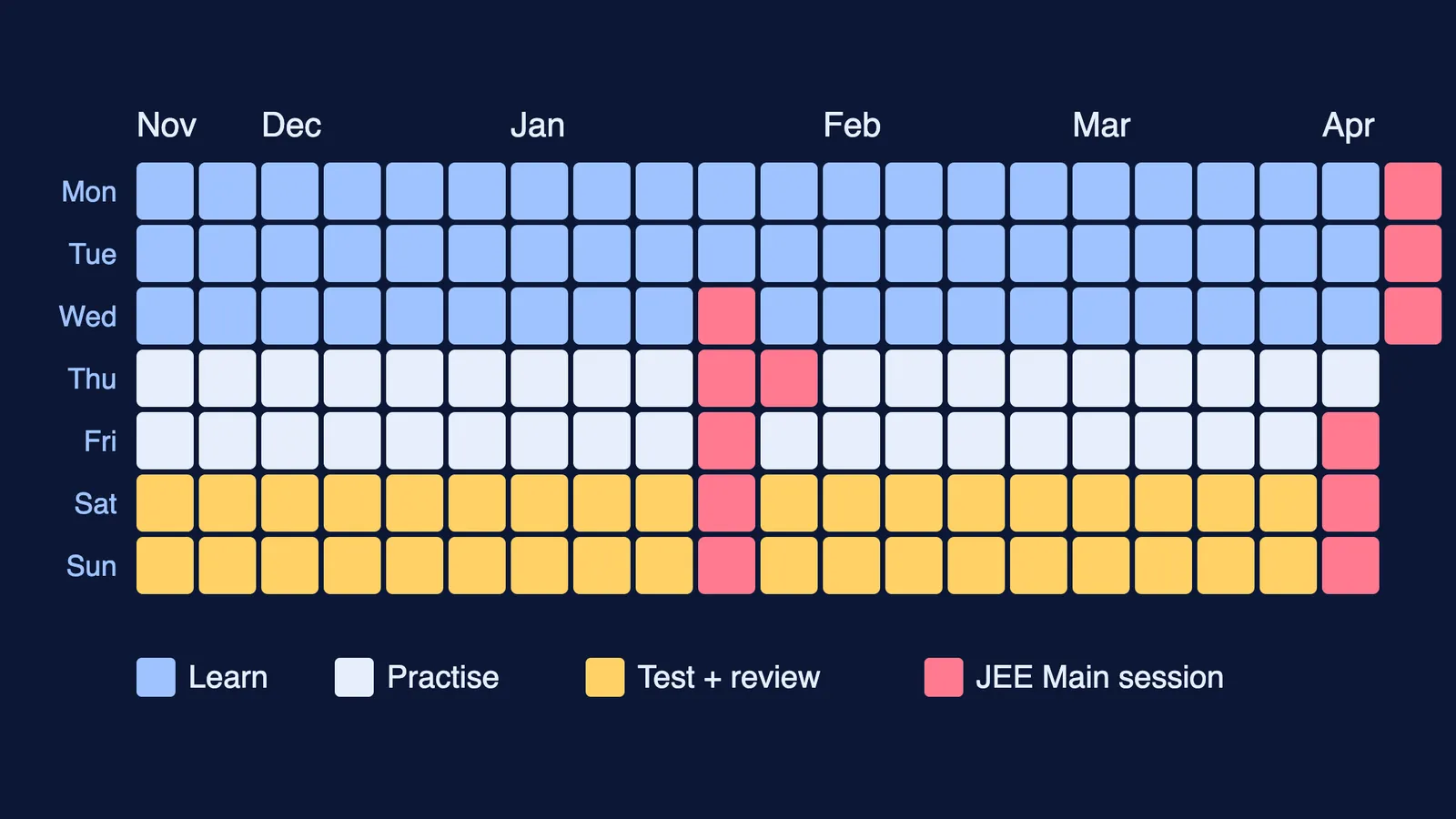
Use the same cycle every week.
Monday to Wednesday, learn: one or two A-list units. Read the theory once, then work the solved examples before looking at solutions.
Thursday and Friday, practise: previous-year questions on this week's units, timed.
Saturday, test: a timed test on everything covered so far, not just this week.
Sunday, review: go through every wrong answer and write down why it went wrong: concept, method, calculation or reading the question.
Weekly tests do more than measure you. In Roediger and Karpicke's 2006 study, students who took practice tests remembered more a week later than students who restudied, even though restudying made them feel more confident. A 2013 review by Dunlosky and colleagues of ten study techniques rated practice testing and spacing study out over time as the two with high utility. Testing old units along with new ones gives you both.
On practise days, when you get stuck on a method rather than a fact, the Fermi Problem Library has worked problems with a step-by-step solver that explains the reasoning rather than printing an answer. If the gap is a concept, the Fermi Concept Library has a lesson for each concept in physics, chemistry and mathematics.
What should the six months look like?
Mid-November to Session 1: A-list units only, on the weekly cycle. To try full papers early, see how to score a full mock before finishing the syllabus.
Session 1 (January): sit it as a real attempt. Afterwards, compare your subject scores with your tally and move units between lists if needed.
February and March: B-list units, plus more full mocks. This guide on how many JEE Main mocks to take a week covers the pace as the exam gets closer.
The last few weeks: stop adding new units and switch to the plan in three months left for JEE Main, compressed to the time you have.
Start today with one thing: download two recent papers and begin your tally.