On this page
You are halfway through the syllabus and your test series has a full-length mock on Sunday. Sit it. Just don't believe the total.
Should you give a full mock test before completing the syllabus?
Usually yes, if you change what you read from it. A full mock teaches you the paper (length, pace, sitting still), and it makes you pull answers out of memory, which is itself a way of learning.
In Roediger and Karpicke's 2006 study in Psychological Science, students who took recall tests on prose passages remembered more two days and one week later than students who restudied the passages the same number of times, even though restudying made students more confident.
Even questions you cannot answer are not wasted. Kornell, Hays and Bjork (2009) found that unsuccessful attempts to answer a question, followed by the answer, enhanced later learning compared with reading the question and answer together. Their materials were made-up general-knowledge questions and word pairs, not physics or chemistry, so treat it as a hint: trying a question from a chapter you haven't studied, then reading the solution, may prepare you for that chapter.
What a mid-syllabus mock does badly is predict. If many questions come from chapters you haven't started, your total mostly measures what you haven't covered.
What can a mock tell you halfway through, and what can't it?
It can tell you:
whether you can sit for the full duration and keep your accuracy in the last hour
how fast you work on chapters you have finished
which finished chapters leak marks through careless or wrong-method errors
how you choose and skip questions under negative marking
It cannot tell you:
your likely rank or final score
whether you are behind, because the paper doesn't know your coaching schedule
how strong you are in unfinished chapters, beyond a rough preview
If the total still stings, our guide to a very low first mock score and what to aim for next walks through it.
How do you score a mock when the syllabus isn't finished?
Use the finished-chapter rule. Before checking answers, mark each question F (from a chapter you have finished) or U (unfinished). Then work out two numbers:
Finished-chapter score: marks you got on F questions divided by the maximum marks available on F questions.
Coverage: F questions divided by all questions.
The finished-chapter score is your progress number; track it from mock to mock. Copy every U question into a preview list, to attempt again when you reach that chapter.
For example, take a made-up 90-question mock with 4 marks for a right answer and minus 1 for a wrong one, so 360 marks in all. 54 questions come from finished chapters, so coverage is 60%.
F questions: 30 right, 8 wrong, 16 skipped. That is 120 minus 8, or 112 out of 216: a finished-chapter score of 52%.
U questions: 4 right, 6 wrong, 26 skipped. That is 16 minus 6, or 10 marks.
Total: 122 out of 360, about 34%.
The 34% says little. The 52% is the number to beat next time, and the 8 wrong F answers are where to look first. If several of them used the wrong method, rework them in the Fermi Problem Library, where a step-by-step solver explains the reasoning rather than printing an answer.
When should you switch to full mocks?
Full mocks mix every chapter, and mixing problem types can help. In Rohrer, Dedrick and Stershic (2015), 126 seventh graders got the same maths practice problems over three months, either grouped by type or mixed together; the mixed practice led to higher scores on a surprise test given 1 or 30 days later. Before full mocks start to count, you can get that benefit from mixed tests built only from finished chapters, as in this interleaved practice plan.
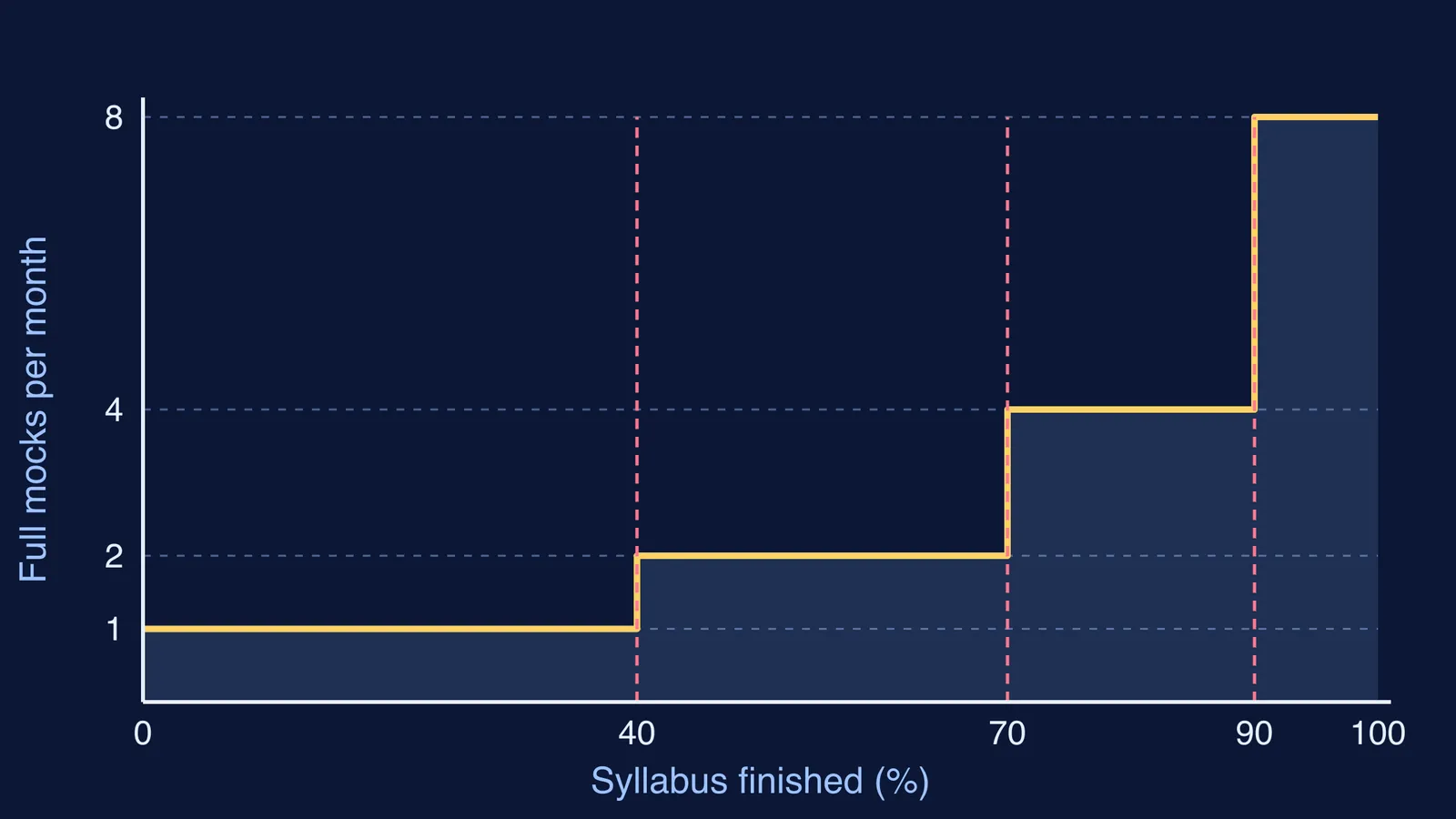
Here is the switch schedule we suggest. It is a rule of thumb keyed to coverage, not a study finding:
Under 40% of the syllabus finished: weekly chapter tests, mixed tests of finished chapters, and one full mock a month for timing.
40 to 70% finished: a full mock every two weeks, scored with the finished-chapter rule.
70 to 90% finished: one full mock a week. The total starts to mean something.
Over 90% finished, through the final stretch: two full mocks a week, with a review day after each.
Until 70%, don't let mocks eat the hours you need for new chapters. For a calendar version, see when to start full mock tests, month by month.
When a preview-list question needs an idea you haven't met, the Fermi Concept Library has a lesson for each concept in physics, chemistry, biology, mathematics and computing. Mark this Sunday's mock with F and U, and write down one number: your finished-chapter score.