

On this page
Most JEE and NEET timetables give you three kinds of test. The hard part is knowing which one to sit this week, and when to move up.
A chapter test covers one chapter, so you already know which idea every question needs. A part test (often called a unit or cumulative test) mixes several chapters. A full mock copies the real paper: JEE Main 2027 Paper 1 is a 3-hour exam, according to the NTA information bulletin for JEE Main 2027. NEET-UG 2026 had 180 questions in 180 minutes, according to the NTA information bulletin for NEET-UG 2026.
Why can't you just keep doing chapter tests?
Chapter tests train you to answer when you already know the topic. The real paper never tells you the topic. Researchers call the first kind of practice blocked and the second interleaved, and the difference shows up in results.
In a 2015 study by Doug Rohrer, Robert Dedrick and Sandra Stershic, 126 seventh-grade students worked through the same maths problems over three months, arranged either by topic or mixed. On a surprise test 30 days later, the mixed group scored clearly higher (effect size 0.79).
Testing itself also builds memory. In Roediger and Karpicke's 2006 experiments, students who took recall tests remembered more of a prose passage two days and a week later than students who restudied it. A 2017 meta-analysis by Adesope and colleagues found practice tests helped learning more than restudying and every other comparison condition it looked at.
When should you start full-length mock tests?
Watch for two triggers rather than a date: you have covered the whole syllabus once, and your part-test scores have stopped swinging wildly. For most Class 12 students that lands four to six months before the exam.
Before then, sit one full mock a month as a baseline. Score only the chapters you have studied; the point is practising three hours of focus and choosing what to skip.
The JEE Main 2027 bulletin lists Session 1 on 20 to 28 January 2027 and Session 2 on 2 to 7 April 2027. NTA has not yet announced the NEET-UG 2027 date; watch neet.nta.nic.in.
What ratio of chapter tests, part tests and full mocks each month?
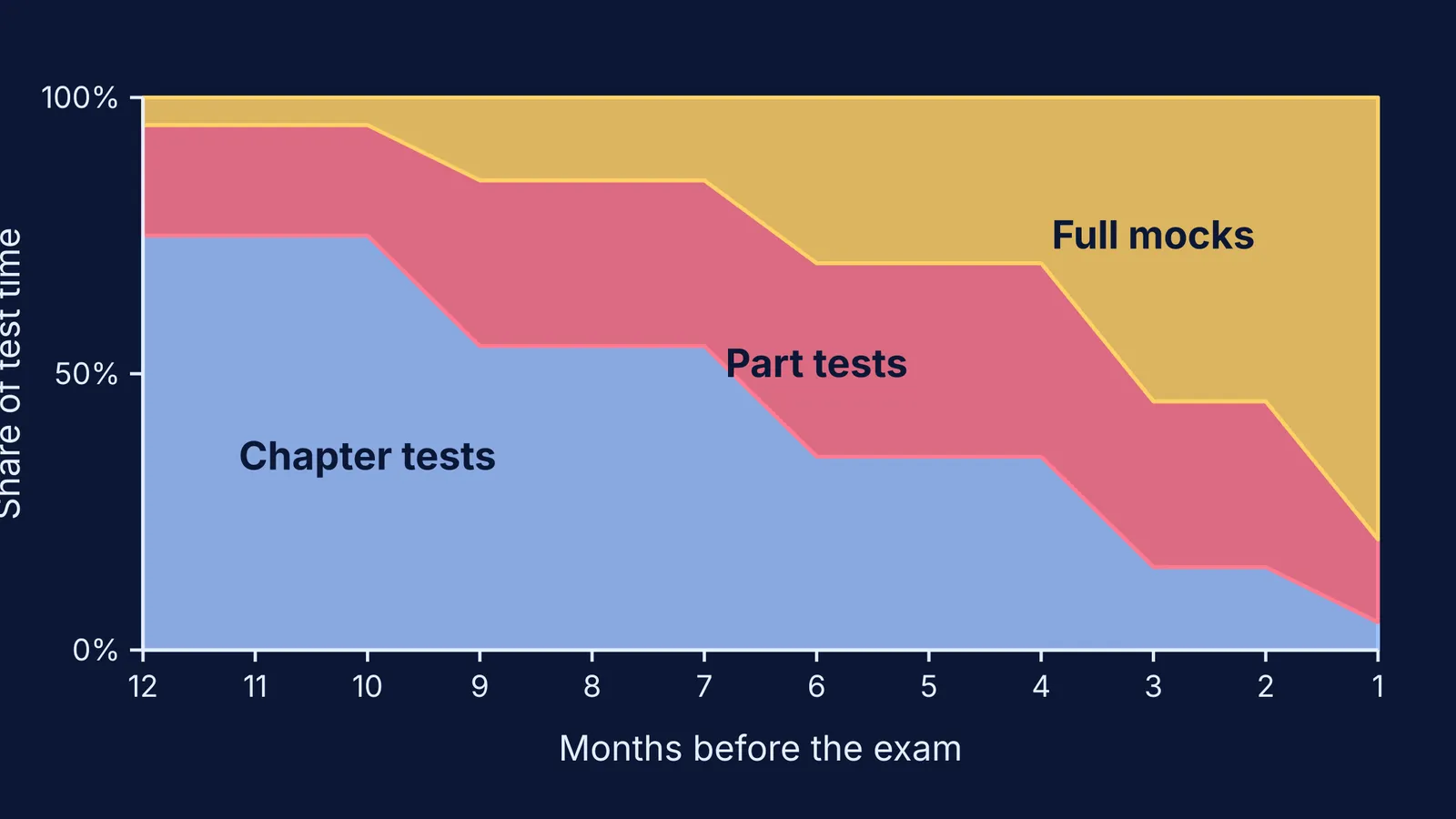
These are shares of your weekly testing time (the paper itself, not the review afterwards), counting back from your exam.
12 to 10 months out: about 75% chapter tests, 20% part tests, 5% full mocks (one baseline mock a month)
9 to 7 months out: about 55% chapter, 30% part, 15% full
6 to 4 months out: about 35% chapter, 35% part, 30% full (regular mocks once both triggers are met)
3 to 2 months out: about 15% chapter, 30% part, 55% full
Final month: about 5% chapter, 15% part, 80% full
How does the mix work in a real week?
Say you are taking JEE Main Session 1, which the JEE Main 2027 bulletin puts from 20 January 2027, and can set aside 12 hours a week for tests. It is late October, so the exam is about three months away and you are in the 15/30/55 band. That works out to roughly 6.5 hours of full mocks (two 3-hour papers), 3.5 hours of part tests and 2 hours of chapter tests a week. Each mock also needs a review the same or the next day; our 60-minute mock test review routine shows how. For papers in the real format, see how to use NTA's official mock tests.
NEET-UG 2026 was held on 3 May. If the 2027 paper falls at a similar time, a NEET student is about six months out, so the 35/35/30 band fits: on the same 12-hour week, roughly one full mock a week once the syllabus is covered.
How do you know you're ready to move up a level?
Run this checklist each Sunday:
Move a chapter into part tests after two good chapter-test scores in a row, with slips rather than unknown ideas behind your mistakes.
Move to regular full mocks when the syllabus is covered and part-test scores sit in a narrow range.
Step back when the same chapter costs you marks in two mocks running: give it a chapter test next week.
Never sit a mock you will not review.
If a chapter test shows you never understood an idea, the Fermi Concept Library has a lesson for every concept in physics, chemistry, biology and mathematics. If a mock shows you picked the wrong method, the Fermi Problem Library has worked problems with a step-by-step solver that explains the reasoning rather than printing an answer.
Mocks can feel heavy. If dread about scores affects your sleep or mood for weeks, talk to a parent, teacher or counsellor, or call Tele MANAS, the government's national mental-health helpline, on 14416.
For the last stretch, follow our week-by-week plan for the final month before JEE.


