

On this page
When people picture a career at the UN or WHO, they often imagine diplomats. But much of what global bodies do rests on scientists and engineers: people who read the evidence, model risks, run labs and build systems that work in many countries at once. If you like science and care about health, climate or poverty, this is a real route, and it starts with the subjects you study now.
What do scientists actually do in international organisations?
The work falls into three broad kinds.
Assessing evidence. Climate scientists write the reports governments use. For the IPCC's 2021 physical science report, 234 scientists from 66 countries contributed and built on more than 14,000 scientific papers, and the report was approved by 195 governments.
Responding to emergencies. WHO's Global Outbreak Alert and Response Network is a network of over 360 technical institutions that deploys experts to affected countries, in fields such as epidemiology and surveillance, infection prevention and control, and public health laboratory systems.
Running development projects. Development banks hire engineers and scientists for health, water and energy programmes. The World Bank Group Young Professionals Program lists streams including health, water, agriculture, climate, energy and digital transformation.
Not everyone in this work is on the organisation's staff. Many contributors work at universities, government institutes or hospitals and contribute to global work alongside their main job.
Which degrees lead to global health, climate and development work?
There is no single "international organisations" degree. What matters is a strong technical base plus one applied field. Common pairings:
Health: biology or medicine, then public health or epidemiology. Our guide on how to become an epidemiologist in India walks through the degrees.
Climate: physics, maths or chemistry, then atmospheric science, hydrology or environmental engineering.
Development: civil, electrical or computer engineering, or statistics and economics, then project or policy experience.
Across all three, statistics and clear writing matter as much as your core subject.
When can you apply, and what are the age limits?
Entry schemes have firm rules, and they change, so always read the current official page before applying. As of now:
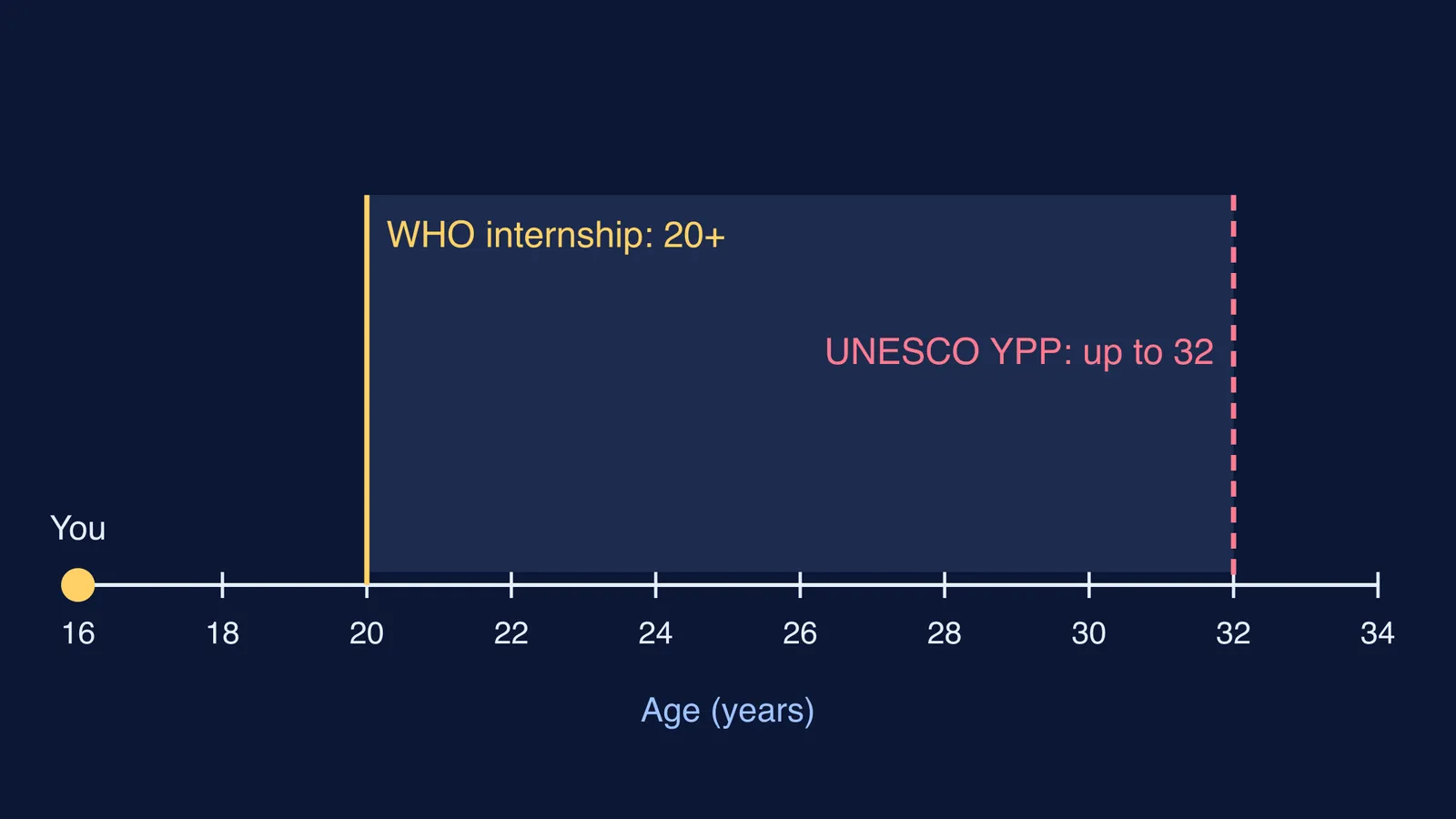
WHO internships require you to be at least 20 years old on the date of application and enrolled in a university course, or within 18 months of finishing one. You also need three years of full-time university study before you start. Internships run full time for 6 to 24 weeks.
UNESCO's Young Professional Programme asks for an advanced university degree, an age of 32 or under, and nationality of a non- or under-represented member state.
The World Bank Young Professionals Program has no age requirement but needs a graduate degree and 2 to 6 years of professional experience.
How do you start from Class 11? A five-stage plan
Class 11 and 12: keep maths strong, whichever stream you choose. Statistics, graphs and rates of change come up in outbreak curves, climate models and project budgets alike.
Undergraduate years: pick a core degree you enjoy. Do one research project or internship in an Indian lab or institute; many scientists start with research jobs that do not need a PhD.
Age 20 and later: after three years of university, apply for internships such as WHO's while still enrolled.
Master's or early PhD: specialise in one applied field. Write and present your work; reports and briefs are the daily currency of global bodies.
Early career: build 2 to 6 years of experience in a government body, university or NGO, the range the World Bank programme asks for. Many people move towards global roles from science policy work in government.
If a topic like probability or exponential growth still feels shaky at stage 1, the Fermi Concept Library gives every concept in physics, chemistry, biology, mathematics and computing its own lesson, so you can fill the gap before it widens.
What should you say when you contact someone in the field?
Find someone whose name appears on a public report or university page, and send a short message like this:
"Dear Dr [Name], I am a Class 11 student in [city] interested in [climate science or public health]. I read your work on [specific report or topic]. Could I ask you two questions by email: which subject helped you most, and what would you study again if you started now? Thank you for your time."
Keep it short, name something specific they did, and ask questions they can answer in five minutes. If they do not reply, that is normal; try someone else.
If you are not sure where to begin with the science itself, Fermi's AI tutor can work out what you already know and build a plan for the session, so you start each study block with a clear next step.


