On this page
When a district reports a cluster of dengue or a hostel full of students with food poisoning, someone has to count the cases, map them and find what they share. That person is an epidemiologist. It suits students who like biology and are not scared of numbers, and in India you do not need to be a doctor.
What does an epidemiologist actually do?
The US Centers for Disease Control and Prevention defines epidemiology as the study of the distribution and determinants of health-related states or events in specified populations, and the application of that study to control health problems. Distribution means the pattern of cases by time, place and person. Determinants are the causes and other factors that make disease more or less likely.
A doctor treats one patient; for an epidemiologist the patient is the community, and not only for infections: the CDC lesson also lists chronic disease, injuries and environmental health.
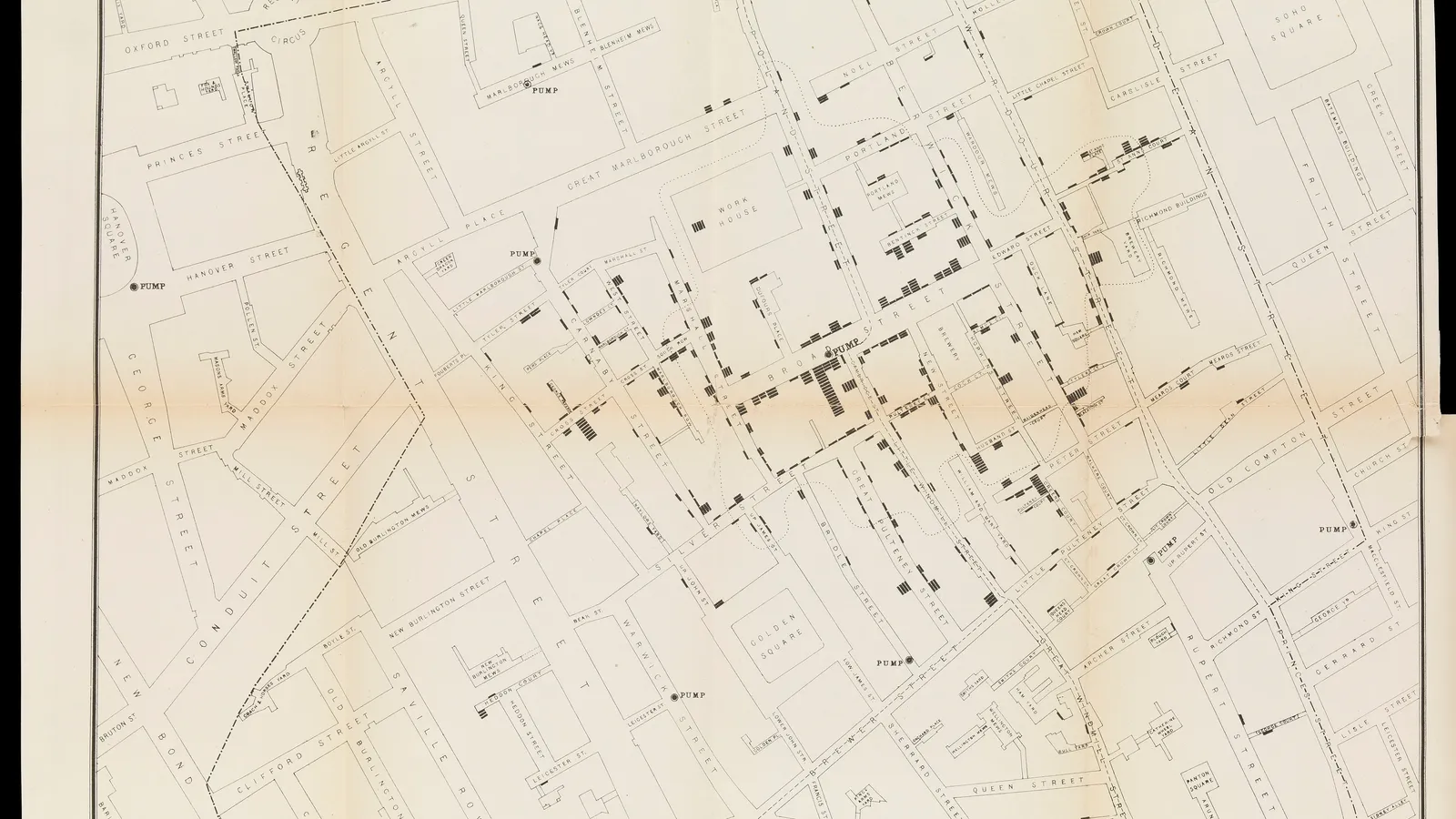
The idea is old. A map in John Snow's report on the 1854 cholera outbreak in Soho, London marks each death as a bar, and the bars crowd around the Broad Street pump. For another early pioneer, read how William Farr turned causes of death into vital statistics.
A real Indian job description shows the daily work. The National Centre for Disease Control terms of reference for a consultant epidemiologist include organising and analysing surveillance data from states, guiding outbreak investigations, training state and district epidemiologists, and turning data into conclusions that can be the basis for policy.
What should you study to become an epidemiologist in India?
The same NCDC eligibility table is the clearest map of the route. It asks for two degrees.
First, a bachelor's in any one of these:
MBBS, BDS, BAMS, BHMS or BUMS
BSc Nursing or B.Pharm
BSc in statistics, biostatistics, economics, mathematics, data science, computer science or life science
Second, a postgraduate degree:
MPH (Master of Public Health)
MD in Community Medicine or Preventive and Social Medicine
MSc in health informatics, biostatistics, applied statistics or epidemiology
MBA in healthcare management
One government-run option for the statistics side is the MSc Biostatistics at ICMR-National Institute of Epidemiology, Chennai: a two-year, four-semester course open to graduates in statistics or any bachelor's with statistics as an allied subject. If that path appeals, see what a BSc in Statistics leads to in India.
People already working in public health have two applied field programmes. The India FETP MPH at ICMR-NIE asks for an MBBS, work in public health and three years of public health experience. The India Epidemic Intelligence Service at NCDC is a two-year applied epidemiology training run in technical collaboration with the US CDC.
How much statistics does epidemiology need?
More than most biology students expect. The NCDC post says advanced Excel, including pivot tables, is mandatory, and working knowledge of SPSS, STATA or R is preferred.
Here is the kind of sum you would do on day one of an outbreak. The numbers are made up. At a wedding, 120 guests eat lunch. Of the 80 who ate the chicken dish, 36 fall ill. Of the 40 who did not, 4 fall ill.
Attack rate among those who ate it: 36 / 80 = 0.45, or 45 percent.
Attack rate among those who did not: 4 / 40 = 0.10, or 10 percent.
Relative risk: 0.45 / 0.10 = 4.5. People who ate the chicken were four and a half times as likely to fall ill.
That ratio points to a suspect, not a proof; lab tests on food samples come next. For diseases that spread person to person, see Kermack and McKendrick's mathematics of an epidemic.
If ratios and probability trip you up, the Fermi Problem Library has worked problems with a step-by-step solver that explains the reasoning rather than printing an answer.
Where do epidemiologists work in India?
One large employer is the government's Integrated Disease Surveillance Programme (IDSP), whose consultant epidemiologist post at NCDC supervises and trains state and district epidemiologists. The post sets a consolidated remuneration of Rs 90,000 for up to 3 years of post-qualification experience, Rs 1,20,000 for more than 3 and under 10 years, and Rs 1,50,000 for 10 years or more. Applicants must be below 45, and the work includes frequent travel to assigned states.
A plan from Class 11 to your first job
Class 11 and 12: take biology, and keep mathematics if you can. Treat the statistics chapter as a career subject, not a scoring chapter.
Undergraduate: choose one of the bachelor's degrees on the NCDC list. Join any survey or health camp project you can find.
Learn Excel properly, then start R.
Postgraduate: an MPH, or an MSc in epidemiology or biostatistics.
First jobs: surveillance, research project and data roles; read each notice's eligibility line by line.
If you are unsure where to begin with the biology or maths behind this, Fermi's AI tutor can work out what you already know and build a plan for the session, so you sit down to a clear next step.
Start this week: redo the wedding example with your own numbers.