On this page
Students often choose an undergraduate degree in statistics thinking it leads only to teaching or generic IT support. In reality, the degree provides one of the most versatile quantitative foundations in Indian higher education, directly connecting to corporate analytics, civil services, risk management, and scientific research. When families look beyond conventional professional degrees, as we discuss in our guide to talking about STEM careers beyond engineering and medicine, mathematical training stands out for its flexibility.
What career paths are open after a BSc in Statistics?
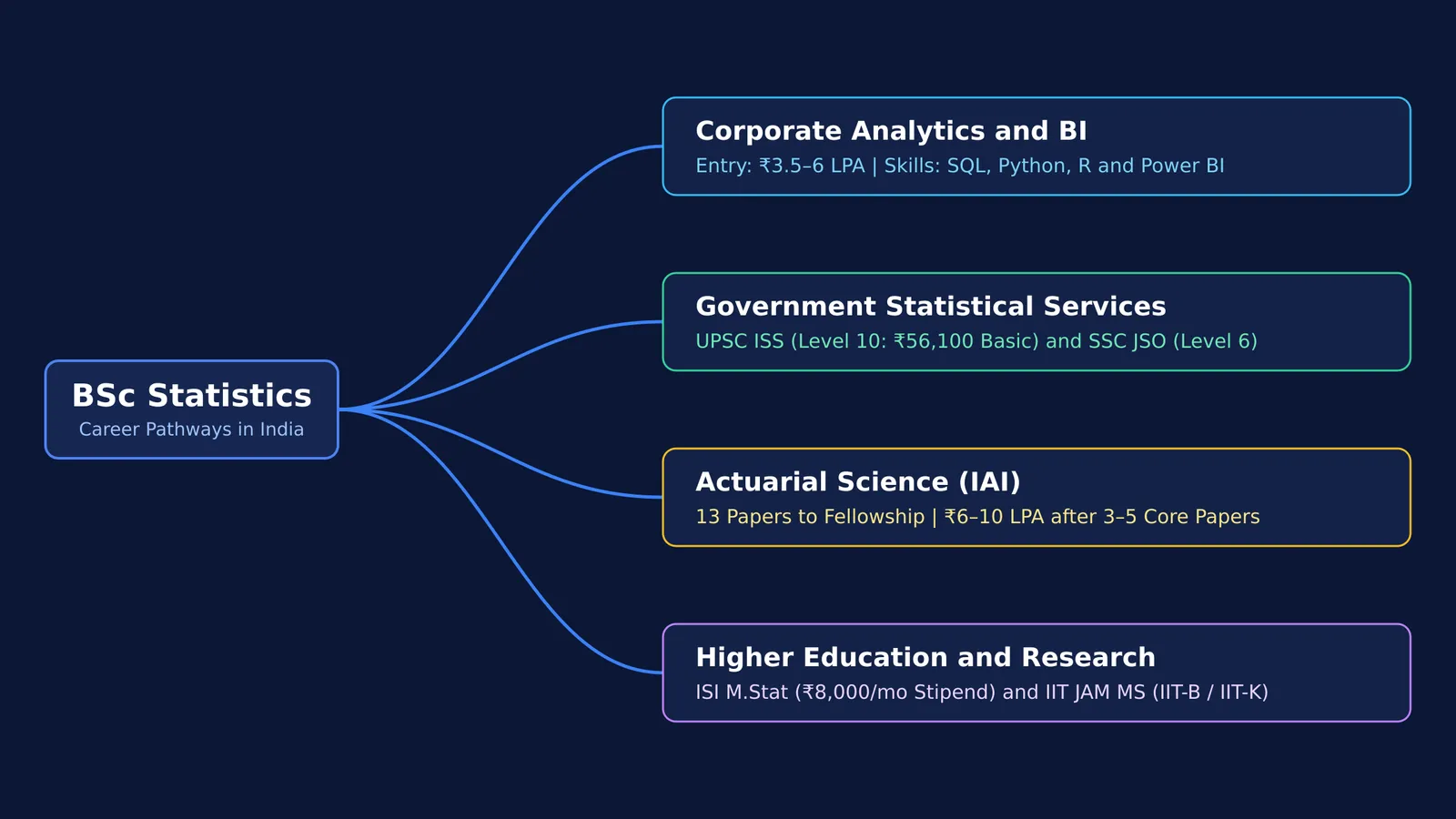
Four distinct avenues emerge after graduation:
Corporate Analytics: Applying predictive data analysis to business problems.
Government Statistical Services: Managing official surveys and national planning through civil service examinations.
Actuarial Science: Calculating financial risk and liabilities for insurance companies and pension funds.
Higher Education and Research: Transitioning into premier institutes for advanced postgraduate degrees in statistics and data science.
For fresh graduates entering private industry as junior data analysts, starting pay generally sits between ₹3.5 LPA and ₹6 LPA according to PayScale recruitment benchmarks. Progression to ₹10 LPA to ₹18 LPA typically follows within three to five years as analysts demonstrate proficiency in predictive modeling and business communication.
How can you enter government service through UPSC ISS and SSC?
The Indian government offers gazetted civil service status to statisticians through dedicated recruitment channels rather than generalist examinations. The premier route is the Indian Statistical Service (ISS) examination conducted annually by the Union Public Service Commission (UPSC), which accepts applicants holding a recognized bachelor's degree with Statistics, Mathematical Statistics, or Applied Statistics as a subject.
Eligible candidates must be between 21 and 30 years of age on August 1st of the examination year. The ISS selection process comprises a 1,000-mark written examination across six compulsory papers—General English (100 marks), General Studies (100 marks), two objective Statistics papers (200 marks each), and two descriptive Statistics papers (200 marks each)—followed by a 200-mark interview (UPSC). Successful candidates join the Ministry of Statistics and Programme Implementation as Junior Time Scale officers at Level 10 of the 7th Central Pay Commission with a starting basic pay of ₹56,100 per month.
A parallel gateway exists through the Staff Selection Commission Combined Graduate Level (SSC CGL) examination. The SSC recruits for the Junior Statistical Officer (JSO) post in MoSPI at Pay Level 6 (₹35,400 to ₹1,12,400), requiring a bachelor's degree with Statistics as a subject or at least 60% marks in Class 12 mathematics (SSC). Additionally, the Registrar General of India recruits Statistical Investigator Grade II officers through the same test, requiring Statistics in all three years of undergraduate study.
How do actuarial science and private analytics roles compare?
Actuarial science represents the formal intersection of advanced probability, financial mathematics, and commercial insurance. In India, the governing professional body is the Institute of Actuaries of India (IAI). Entry begins through the Actuarial Common Entrance Test (ACET) or direct student membership for graduates meeting specialized quantitative criteria.
The actuarial curriculum is organized into Core Principles, Core Practices, Specialist Principles, and Specialist Advanced stages (IAI). BSc Statistics graduates hold an advantage in early Core Principles examinations, particularly CS1 (Actuarial Statistics) and CS2 (Risk Modelling and Survival Analysis). Both subjects evaluate distribution theory, inference, and stochastic processes across a written theory paper and a hands-on computing paper in R. While completing all 13 papers to achieve Fellowship takes 4 to 7 years, students clearing 3 to 5 core papers routinely secure junior actuarial analyst positions with starting packages between ₹6 LPA and ₹10 LPA.
In contrast, corporate data analytics roles in technology firms and consulting enterprises prioritize database querying and exploratory reporting:
SQL: Writing complex relational queries and aggregations to extract business records.
Python or R: Using libraries like Pandas or tidyverse for statistical cleaning and hypothesis testing.
Data Visualization: Building interactive executive reporting dashboards in Power BI or Tableau.
Statistical Application: Explaining real-world tests without succumbing to common probability and reasoning mistakes often seen when analyzing conditional metrics.
What are the top higher education and research options?
While immediate employment is viable, pursuing a master's degree prepares you for research leadership, high-frequency quantitative finance, and senior data science positions. The two most prestigious domestic routes are the Indian Statistical Institute and the Indian Institutes of Technology.
The Indian Statistical Institute offers the Master of Statistics (M.Stat), a rigorous two-year postgraduate degree conducted at its Kolkata and Delhi centres (ISI). Admission is determined through the competitive ISI and CMI entrance examinations and interview. Notably, ISI charges no tuition fees and awards all enrolled M.Stat students a monthly stipend of ₹8,000 along with an annual contingency grant of ₹8,000 (ISI).
For the IIT system, admission proceeds through the IIT Joint Admission Test for Masters (JAM). Candidates taking the Mathematical Statistics (MS) test paper—which allocates 30% weight to pure mathematics and 70% weight to probability and inference—compete for seats in specialized programs like IIT Bombay's M.Sc. in Applied Statistics and Informatics and IIT Kanpur's M.Sc. in Statistics (JAM). A master's degree also fulfills the eligibility criteria for the Reserve Bank of India Grade B (Department of Statistics and Information Management) officer cadre.
When preparing for competitive quantitative entrance exams, students frequently struggle with multi-step distribution derivations and abstract proofs. The Fermi Concept Library organizes foundational theorems across mathematics and computing into structured lessons, while the Fermi Problem Library provides worked problems with a step-by-step solver that explains the reasoning rather than printing an answer. For learners who find abstract variance and sampling distributions easier to see than to read, the Fermi Simulation Lab offers interactive simulations to build strong intuition before sitting for rigorous written tests.