

On this page
A programmable logic controller (PLC) is the rugged computer that keeps a factory line running: it reads sensors, runs a program, and switches motors and valves. If you enjoy circuits and logic puzzles, your Class 11 and 12 physics is a good place to start.
What does a PLC actually do in a factory?
NIST defines a PLC as "a solid-state control system that has a user-programmable memory" for functions such as logic, timing, counting and PID control (NIST glossary).
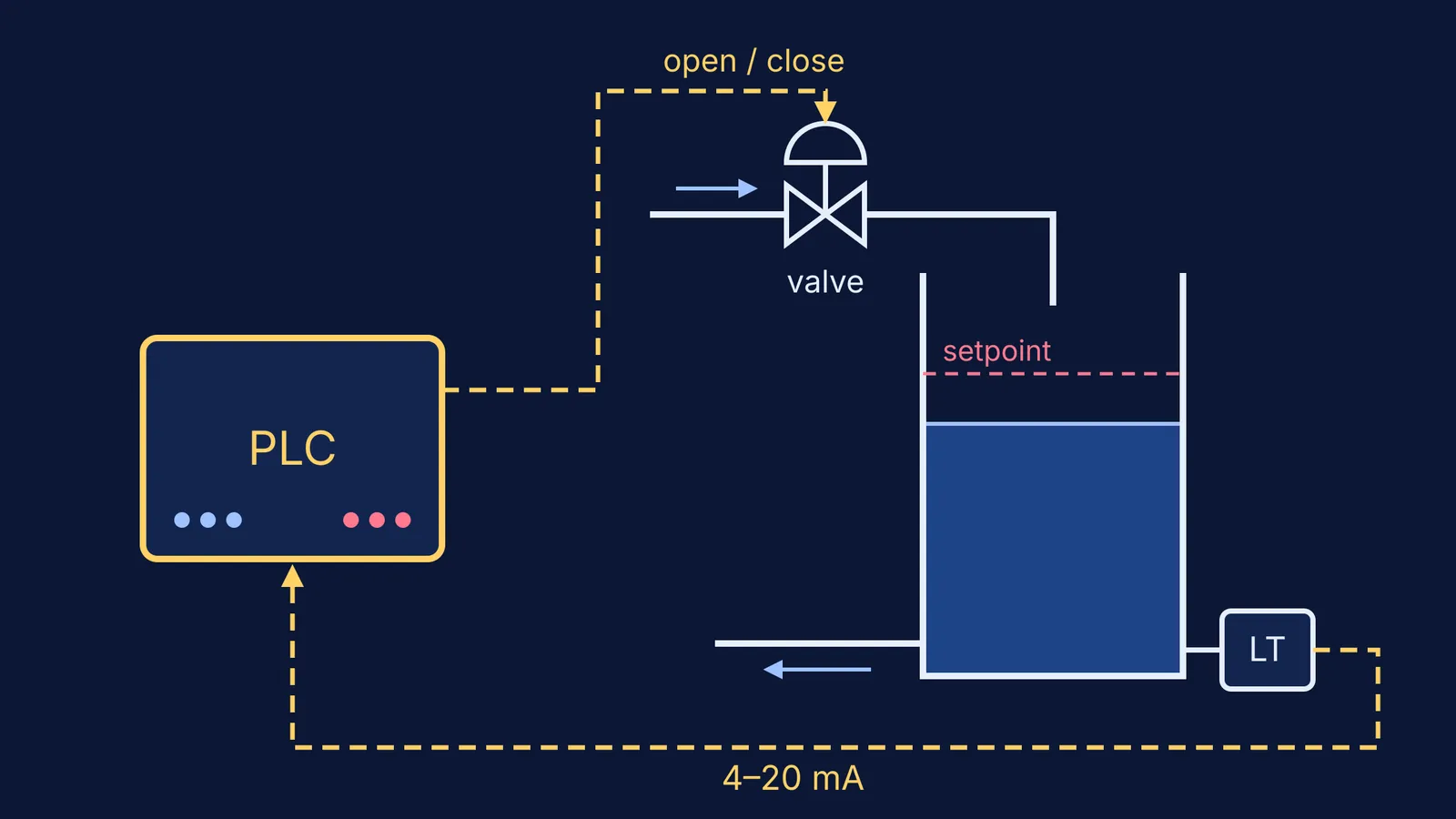
The PLC sits inside a control loop: sensors measure, the controller compares readings with set points, and actuators such as valves, switches and motors act (NIST, control loop).
Two more terms from job descriptions:
HMI: the hardware or software through which an operator interacts with a controller (NIST, HMI).
SCADA: a computerised system that gathers data and applies controls over long distances, as in power transmission and pipelines (NIST, SCADA).
PLC languages are set out in the standard IEC 61131-3, whose fourth edition (May 2025) covers structured text, ladder diagram and function block diagram (IEC 61131-3:2025). Ladder diagram is drawn like a relay wiring diagram, so it rewards anyone who can already read a circuit.
How does a sensor talk to a PLC? A worked example
Take the tank in the diagram. A level transmitter (LT) sends a current between 4 and 20 mA to the PLC. This "live-zero" signal is an industrial standard: because the range starts at 4 mA, a reading of zero points to a fault such as a broken wire (KSB, live-zero signal).
Say 4 mA means 0 m of water and 20 mA means 4 m. The PLC reads 14 mA. What is the level?
Span: 20 - 4 = 16 mA.
Reading above the bottom: 14 - 4 = 10 mA, or 10/16 = 0.625 of the span.
Level: 0.625 x 4 m = 2.5 m.
That is y = mx + c. Pass the current through a 250 ohm resistor and Ohm's law gives 1 V at 4 mA and 5 V at 20 mA.
Now the logic, with a setpoint of 3 m: below 2.8 m, open the inlet valve; at 3.0 m, close it. The gap between 2.8 and 3.0 m stops the valve chattering open and shut. If the signal falls well below 4 mA, close the valve and raise an alarm on the HMI. Good programs plan for the broken wire, not just the normal case.
Which school subjects matter for automation roles?
Current electricity and Ohm's law: every sensor signal, relay and motor circuit.
Logic gates: in ladder diagram, contacts in series act like AND, contacts in parallel like OR.
Straight lines and ratios: scaling signals, as above.
Mechanics and chemistry: pressure, flow and temperature are what the plant controls.
If current electricity feels shaky, fix that first. The Fermi Concept Library has a lesson for each concept in physics and mathematics, and the Fermi Simulation Lab has interactive simulations for ideas that are easier to see than to read.
What routes lead to PLC and SCADA jobs in India?
Each common entry point starts with electrical or instrumentation basics:
ITI after Class 10, in an electrical or instrumentation trade; see ITI or polytechnic after Class 10.
A diploma or B.Tech in electrical, electronics, or instrumentation and control engineering; read what instrumentation and control engineering covers before you pick a branch.
An apprenticeship after a diploma or degree, on a plant floor under supervision; see how apprenticeships for engineering graduates work.
For self-study, NPTEL lists a course called Industrial Automation and Control from IIT Kharagpur, taught by Prof. Alokkanti Deb (NPTEL course page).
Certificates come later. The International Society of Automation's Certified Control Systems Technician Level 1 asks for at least 5 years of combined education and training, including a minimum of 1 year of related work experience (ISA CCST requirements).
What is a good four-week starter plan?
Week 1: Solve ten circuit numericals on Ohm's law. For any you get wrong, the Fermi Problem Library has a step-by-step solver that explains the reasoning rather than printing an answer.
Week 2: Learn the terms above and draw the control loop of something at home, such as an overhead tank with a float switch.
Week 3: Draw a start/stop motor rung in ladder form: a start button, a stop button, and a seal-in contact that keeps the motor running after you let go of start.
Week 4: Watch the opening NPTEL lectures and redo the worked example for a temperature transmitter set to 0 to 150 degrees Celsius.
By the end of the month you will know whether this kind of thinking suits you.


