

On this page
Every time a robotic arm welds a car door, or a chemical plant maintains a reaction at exactly 150 °C, an instrumentation and control system is at work. Instrumentation and Control Engineering (ICE) is the specialized branch of engineering that designs the sensors and automated systems used to run modern industries.
If you are exploring engineering branches, ICE sits right at the intersection of electrical engineering, electronics, and computer science.
What exactly does an instrumentation and control engineer do?
They design, install and maintain the systems that keep manufacturing safe and automatic. The work has two main halves.
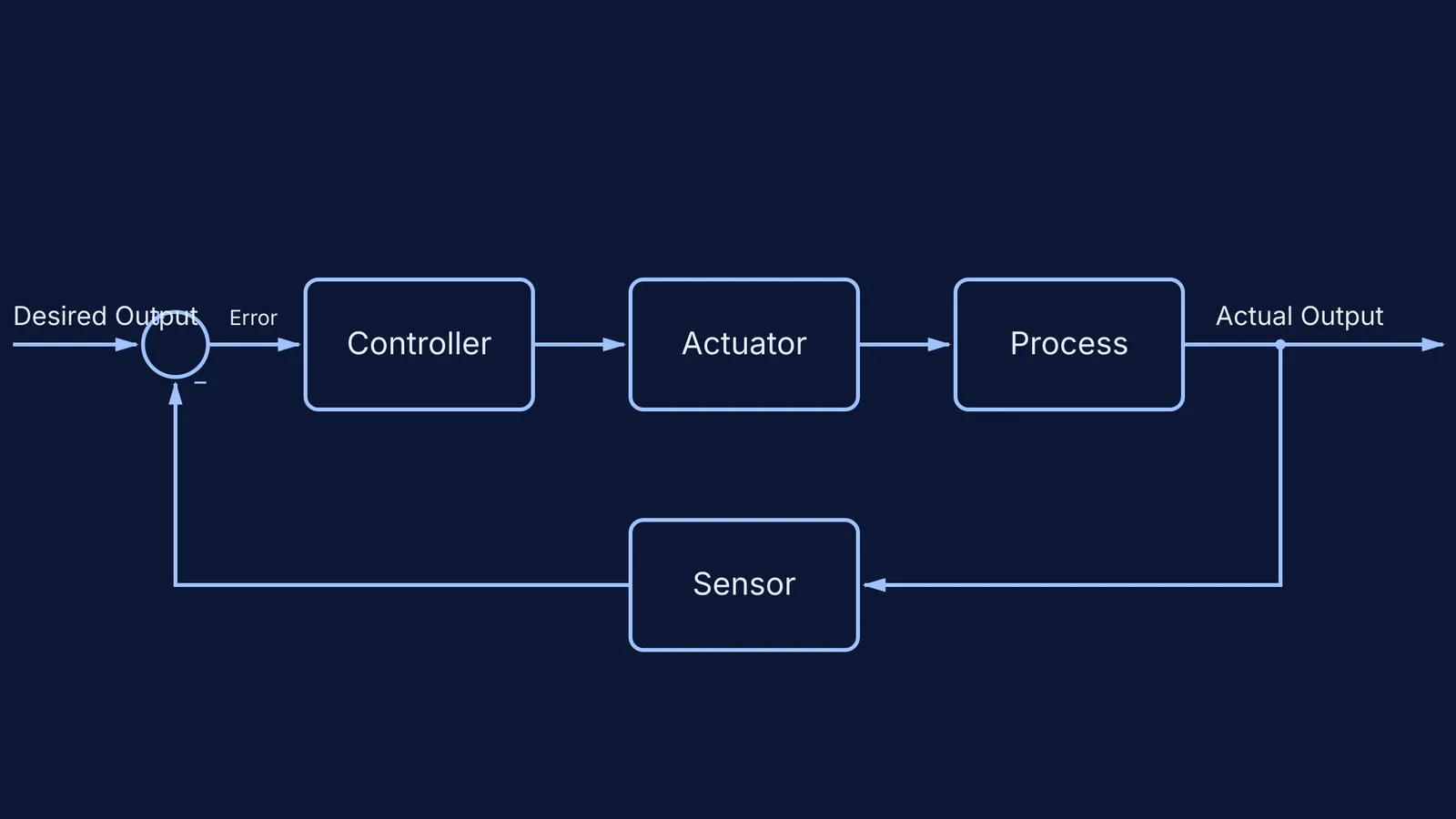
The "instrumentation" half deals with measurement. They specify the sensors (like thermocouples for temperature, or transducers for pressure) that monitor a physical process. For instance, they ensure that the sensors in an oil refinery are accurately reading the flow rate of volatile liquids.
The "control" half deals with the decisions. They program the "brains" of the factory—such as a Programmable Logic Controller (PLC)—to read the sensor data and act on it by opening valves or slowing motors. In a typical day, an I&C engineer might be reviewing Piping and Instrumentation Diagrams (P&IDs), calibrating a faulty sensor, or writing ladder logic code to automate a new conveyor belt. Their primary goal is to minimize human intervention and maximize efficiency, ensuring that a plant can run 24 hours a day without failures.
If you want a deeper look at the logic behind these decisions, you can explore how semiconductors and logic gates form the physical basis of control circuits.
How does ICE differ from electrical engineering?
While they share a foundation in physics and circuit theory, their goals diverge on the factory floor.
Electrical engineering focuses on power and energy. An electrical engineer designs the transformers, switchgear and large motors that drive the plant, dealing with high voltages and power distribution.
ICE focuses on feedback and information. An ICE engineer uses electronics to measure variables and keep a process stable, dealing with low voltages, data signals, and complex control algorithms. To put it simply, if a factory was a human body, the electrical engineer provides the heart and the muscles, ensuring energy reaches every limb. The instrumentation and control engineer provides the nervous system and the brain, sensing the environment and deciding how the muscles should react.
If you are studying these overlapping topics and find yourself confused by node analysis or voltage drops, testing your ideas in a DC circuits simulation can help clear up misconceptions. For a complete grounding in these topics, the Fermi Concept Library explains every concept in physics, chemistry, biology, mathematics and computing.
What is the syllabus for an instrumentation and control degree?
In India, the All India Council for Technical Education (AICTE) framework sets the standard for undergraduate engineering. According to the AICTE model curriculum, a typical B.Tech degree requires 160 credits over four years (AICTE).
Students start with a shared foundation of mathematics, physics and basic engineering sciences. By the third year, the core subjects become highly specialized:
Sensors and Transducers
Control Systems Engineering
Process Control
Industrial Automation
These courses are heavily mathematically driven. Students must become comfortable with differential equations and transform techniques to model how a system behaves over time.
What are the career prospects in industrial automation?
As manufacturing modernises, the demand for automation engineers is rising sharply. India installed 8,510 industrial robots in 2023, a 59% increase from the prior year (IFR).
The move towards Industry 4.0—where machines are connected to the Industrial Internet of Things (IIoT)—means that modern ICE engineers also need a solid grasp of networking and cybersecurity. If a hacker gains access to a plant's SCADA system, the results could be disastrous. Therefore, roles in this field are expanding from traditional hardware maintenance into sophisticated software management.
ICE graduates are highly sought after in sectors where precise control is non-negotiable. Major employers include:
Oil, gas and petrochemical refineries
Pharmaceutical manufacturing
Power generation and distribution grids
Automotive and electric vehicle (EV) manufacturing
How to choose between EE, ECE and ICE?
If you are filling out your engineering counselling forms, use this quick check to see which branch fits your interests:
Choose Electrical Engineering (EE) if you are fascinated by power generation, renewable energy grids, large machines, and high voltages.
Choose Electronics and Communication (ECE) if you want to design microchips, work on 5G networks, or build embedded systems and consumer electronics.
Choose Instrumentation and Control (ICE) if you like robotics, factory automation, and making hardware and software work together to control physical processes.
Whether you end up calibrating sensors on an oil rig or programming robotic arms for an assembly line, instrumentation and control engineering places you at the heart of the modern industrial economy.


