

On this page
Every air-conditioned office, hospital ward and metro station has an engineer behind it who worked out how much heat to remove, how much fresh air to bring in and how to move that air without wasting electricity. That is HVAC (heating, ventilation and air conditioning) engineering, and mechanical engineering is the usual way in.
What does an HVAC engineer actually do?
An HVAC engineer designs and checks the systems that control temperature, humidity and air quality inside buildings. Common roles:
Design engineer: calculates heat loads room by room, sizes chillers, air-handling units and ducts, and draws layouts, often at an MEP (mechanical, electrical and plumbing) consultancy.
Site engineer: installs and tests the system and sorts out clashes between ducts, beams and pipes.
Application engineer: matches an equipment maker's products to a project's load.
Energy and commissioning engineer: checks that a finished building performs as designed.
The Bureau of Energy Efficiency's Energy Conservation Building Code sets minimum energy standards for new commercial buildings with a connected load of 100 kW or contract demand of 120 kVA or more, so HVAC designers on those projects work to it.
Is HVAC a good career for mechanical engineering students?
The India Cooling Action Plan from the Ministry of Environment, Forest and Climate Change projects that national cooling demand will grow around 8 times by 2037-38 compared with 2017-18. The same plan expects cooling demand in buildings to grow nearly 11 times, with space cooling in buildings making up 74% of all cooling demand by 2037-38 in its reference scenario. It also notes, citing the International Energy Agency, that India used 69 kWh per person on space cooling against a world average of 272 kWh.
The IEA's Future of Cooling report found that air conditioners and electric fans account for nearly 20% of the electricity used in buildings worldwide.
The Indian Society of Heating, Refrigerating and Air Conditioning Engineers (ISHRAE), active since 1981, reports more than 25,000 members, including students.
Which mechanical subjects matter most for HVAC?
Three subjects carry the field: thermodynamics, heat transfer and fluid mechanics. The official GATE 2027 mechanical engineering syllabus lists refrigeration and air-conditioning under thermal sciences: refrigeration and heat pump cycles, properties of moist air and the psychrometric chart. What you revise for exams is what you use at work; our guide to choosing between GATE, a job or an MS after B.Tech covers that decision.
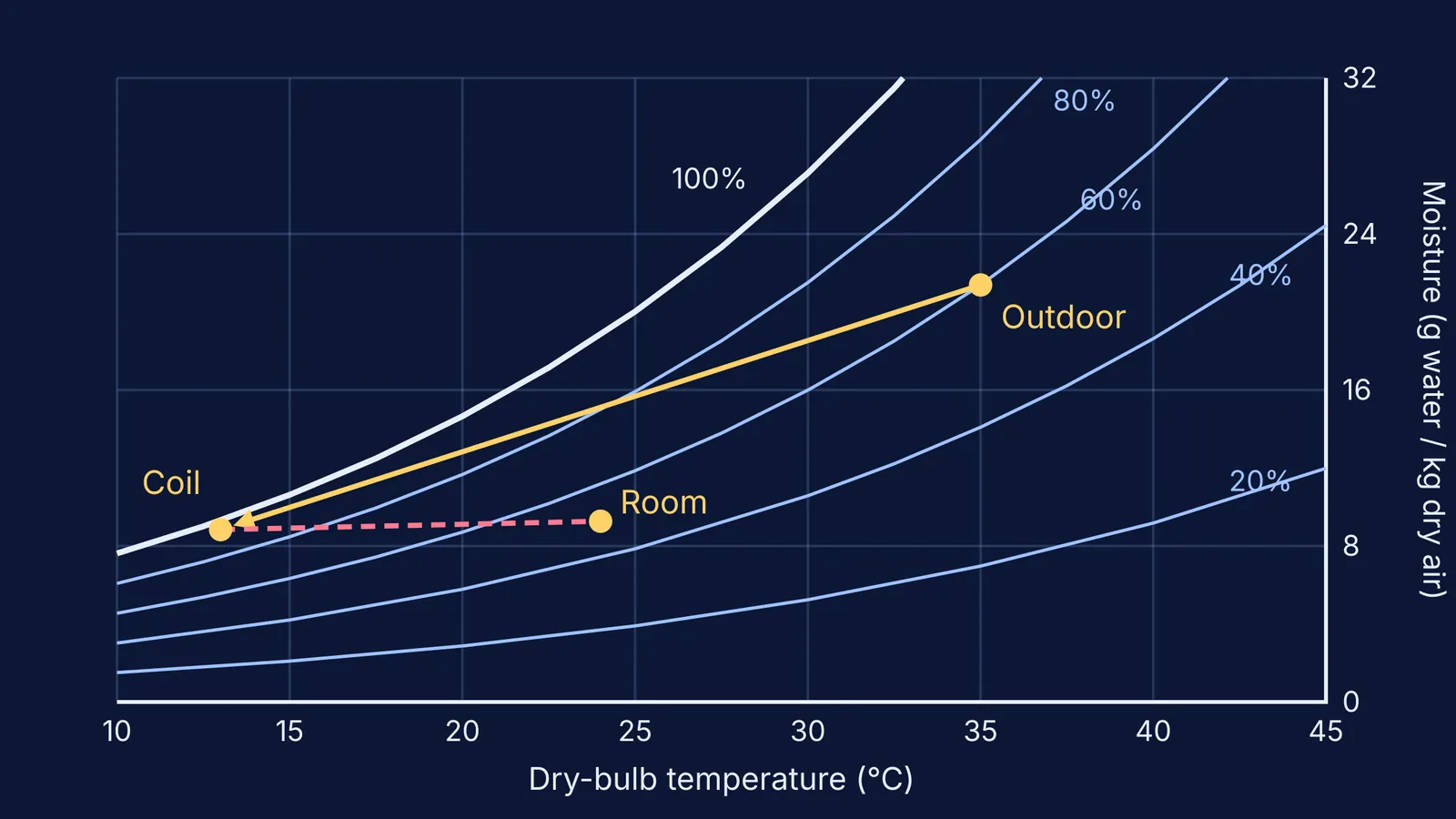
Psychrometrics is the study of moist air: how much water vapour air holds at each temperature, and what happens when you cool it. The chart at the top shows it. Humid outdoor air is cooled below its dew point at the coil, so water condenses out; the drier air then picks up heat and moisture in the room.
If the coefficient of performance still feels slippery, our explainer on how a refrigerator's COP relates to engine efficiency works through it. If cycles and heat flow are hard to picture, the Fermi Simulation Lab has interactive simulations for ideas that are easier to see than to read.
Still in school? CBSE's Class 12 skill subject Air Conditioning and Refrigeration (code 827) lists Psychrometry as the first subject-specific unit in its 2026-27 syllabus.
Worked example: how much cooling does a room need?
Sizing starts with a heat balance: heat removed = mass flow of air × specific heat × temperature rise.
You supply 0.5 kg of air per second to a seminar room.
Dry air's specific heat is about 1.006 kJ per kg per kelvin (Engineering ToolBox).
Air enters at 14 °C and the room is held at 24 °C, a rise of 10 K.
Heat removed = 0.5 × 1.006 × 10, about 5.0 kW.
One ton of refrigeration is 3.517 kW in NIST's conversion tables, so that is about 1.4 TR.
That is only sensible heat. Real designs add latent heat from moisture in breath and outside air, which is where the psychrometric chart comes in.
A four-year plan from B.Tech to HVAC
Year 1: make thermodynamics solid. Still choosing a branch? Read our comparison of the chemical and mechanical branches. For gaps in heat or entropy, the Fermi Concept Library has a lesson for every concept in physics, chemistry, biology, mathematics and computing.
Year 2: heat transfer and fluid mechanics; look into ISHRAE student membership.
Year 3: take the refrigeration and air-conditioning elective, do a cooling load calculation by hand before using software, and seek a summer internship with an MEP consultancy or HVAC contractor.
Year 4: base your project on a real building, such as your hostel's cooling load, then choose between an M.Tech in thermal engineering and a job.
When you write to a firm for an internship, be specific: "I am a third-year mechanical student. I have worked out the cooling load for my hostel block by hand and would like to see how your team does it on real projects. Could I join your team for six weeks this summer?"
Start tonight with the room you are sitting in: list every source of heat in it.


