

On this page
A heat engine and a refrigerator look like opposite machines. One turns heat into work; the other spends work to pump heat out of a cold box. For a reversible device they are the same machine run in two directions, and one short formula links their scores. It is a standard textbook result, and it is easy to get right once you see where the formula comes from.
What is the relation between refrigerator COP and heat engine efficiency?
The efficiency of a heat engine is the work it delivers divided by the heat it takes from the hot reservoir: η = W/Qh = 1 − Qc/Qh (OpenStax University Physics, Heat Engines).
The coefficient of performance of a refrigerator is the heat removed from the cold reservoir divided by the work done on it: COP = Qc/W = Qc/(Qh − Qc) (OpenStax, Refrigerators and Heat Pumps).
The same OpenStax chapter puts the link plainly: either a refrigerator or a heat pump is an engine running in reverse. For a reversible cycle, reversing it keeps the sizes of Qh, Qc and W and only flips their directions. So you can derive the relation in three lines:
Energy conservation for one cycle gives Qc = Qh − W.
Divide by W: COP = Qc/W = Qh/W − 1.
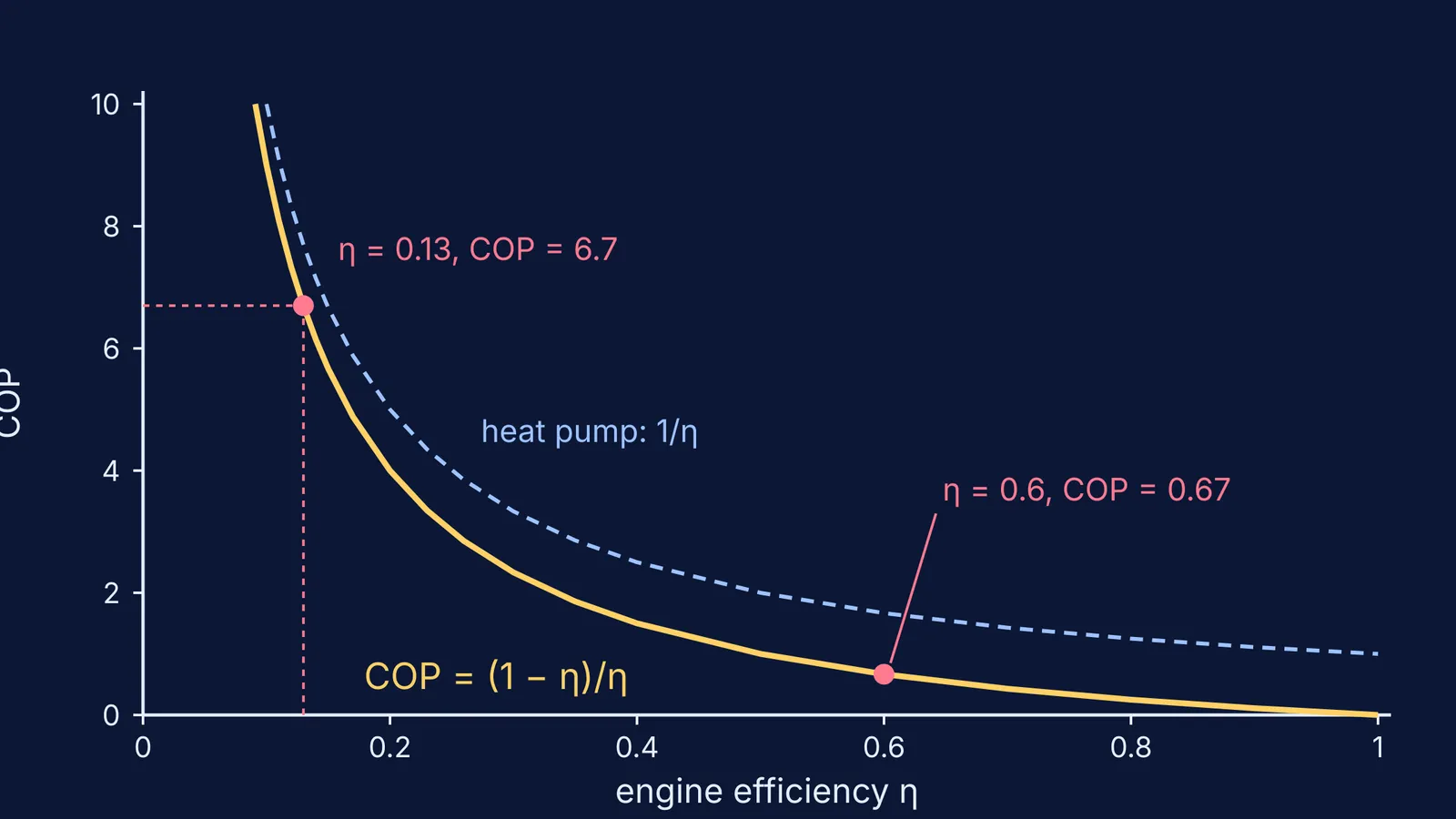
Since Qh/W = 1/η, COP = 1/η − 1 = (1 − η)/η.
Why does a poor engine make a good refrigerator?
Read the formula slowly. When η is small, the engine turns only a sliver of Qh into work and dumps most of it as Qc. Run backwards, that same machine needs only a sliver of work to move a large Qc. Small W on the bottom of a fraction means a large COP.
The Carnot formulas show where small η comes from. A Carnot engine has η = 1 − Tc/Th, and a Carnot refrigerator has COP = Tc/(Th − Tc) (OpenStax, The Carnot Cycle). Put the first into (1 − η)/η and you get (Tc/Th) ÷ ((Th − Tc)/Th) = Tc/(Th − Tc), the second formula exactly. Both are controlled by the temperature gap. A small gap makes a weak engine and an efficient refrigerator; a large gap does the reverse.
Worked example: a freezer in a 35 °C kitchen
Take an ideal freezer compartment at −5 °C in a kitchen at 35 °C on a hot summer day.
Convert to kelvin: Tc = 268 K, Th = 308 K. The gap is 40 K.
Efficiency of the same device run as a Carnot engine: η = 1 − 268/308 = 40/308 ≈ 0.13.
COP from the relation: (1 − 0.13)/0.13 ≈ 6.7.
Check with the Carnot formula: 268/40 = 6.7. They agree.
So each joule of work can, in the ideal limit, remove about 6.7 J from the freezer. Now try Example 4.2 in the OpenStax Carnot cycle section, an engine with η = 0.60 between 750 K and 300 K. Run backwards, it would have COP = 0.40/0.60 ≈ 0.67, and 300/450 gives the same. Large gap, good engine, poor refrigerator.
Real refrigerators are not reversible, so their COP sits below this ideal value. The relation is a ceiling, not a prediction for a shop label. If you want to see why the gap matters so much on hot days, read our post on why a refrigerator works harder in summer.
How is a heat pump's COP different?
A heat pump is scored on the heat it delivers to the warm side, so its coefficient is Qh/W (OpenStax, Refrigerators and Heat Pumps). For the reversible case that is simply 1/η, which is always one more than the refrigerator's COP. In the freezer example, the heat pump figure would be about 7.7.
Which mistakes cost marks on this question?
Use this checklist before you mark an answer final:
Temperatures in kelvin, never Celsius. 35/(35 − (−5)) is not a COP.
Refrigerator COP is Qc/W; heat pump COP is Qh/W. Read which one the question asks for.
COP can be greater than 1. Efficiency cannot. If your η exceeds 1, recheck.
The formula (1 − η)/η is for the same reversible device run both ways. Do not apply it to two unrelated real machines.
Sign conventions: use magnitudes of Qh, Qc and W in these formulas.
If a numerical keeps going wrong at the same step, the Fermi Problem Library has worked problems with a step-by-step solver that explains the reasoning rather than printing an answer. If the definitions themselves feel shaky, the Fermi Concept Library gives each concept in physics its own lesson.
To picture what the engine is doing before you reverse it, try our guide to reading work from the PV loop of a heat engine cycle, and for the hardware, see how a refrigerator makes things cold.


