

On this page
If you have just finished a BSc and can't decide between an MSc, a PhD or a job, there is a middle route many students never hear about: working as project staff on a government-funded research project. You get paid, you work in a real lab, and you find out whether research suits you before you spend years on it.
What is a project assistant in a research lab?
A project assistant is a temporary staff member hired on one research grant, not a permanent government employee. The job lasts only as long as the grant. You work under the principal investigator (PI), the scientist who won the funding.
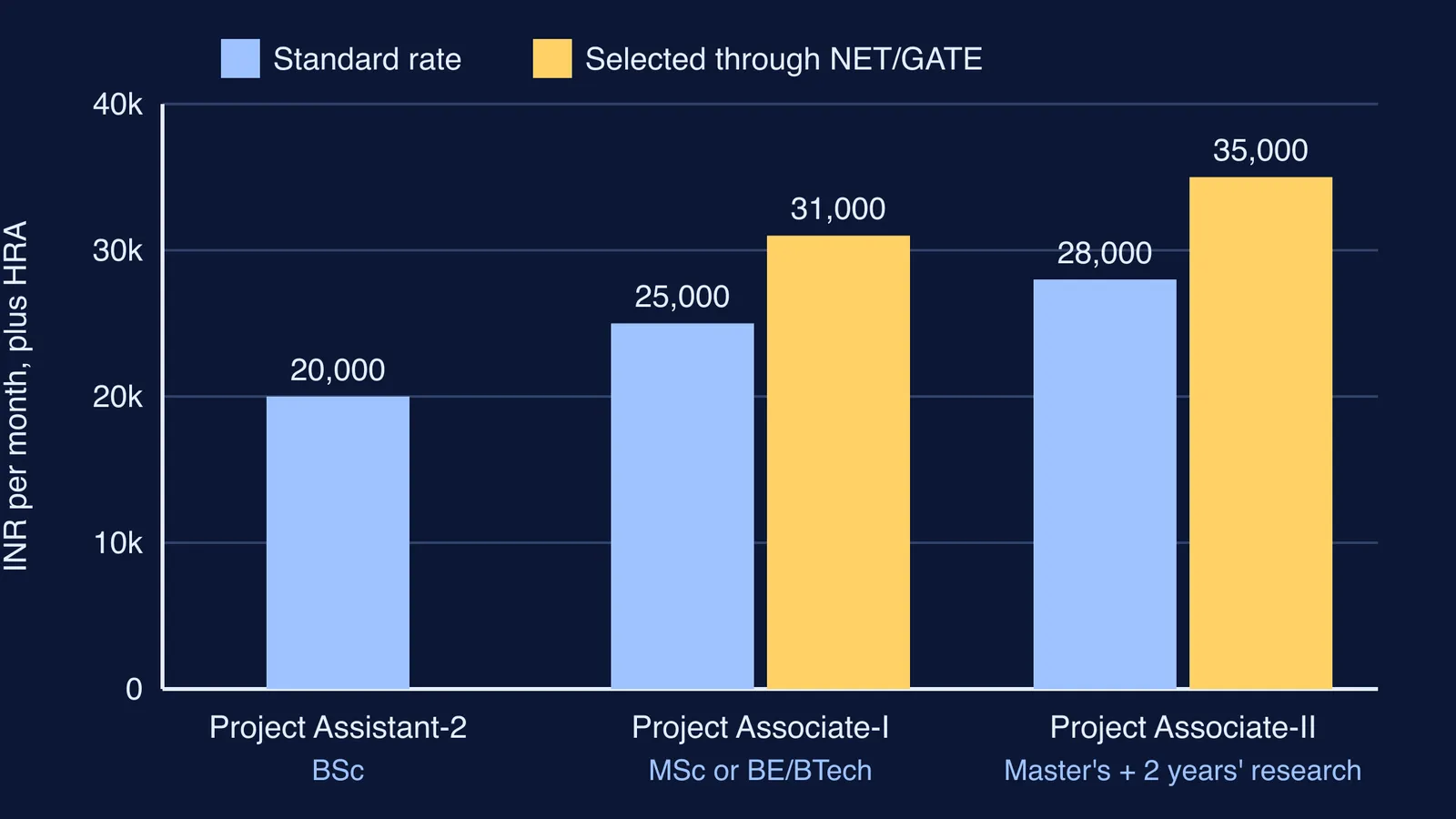
CSIR labs use a standard set of posts. On CSIR-IGIB's list of approved project positions, Project Assistant-2 needs a "B.Sc./3 years Diploma in Engineering & Technology" and pays ₹20,000 a month plus HRA, with a maximum age of 35.
The next step up, Project Associate-I, needs a master's degree in the natural or agricultural sciences, or a bachelor's in engineering, technology or medicine. The same list says it pays ₹31,000 plus HRA if you were selected through NET, GATE or a similar national exam, and ₹25,000 plus HRA if you weren't.
CSIR-CFTRI's project staff guidelines give the same pay figures. They also say no one can be engaged as a project assistant or associate for more than 5 years in total, across all projects.
Other funders and individual grants can set different terms, so treat the advertisement as the final word.
Where do you find project assistant openings after BSc?
CSIR's central list. The CSIR recruitment page collects notices from its labs, including walk-in interviews for project staff, with the advertisement number and last date for each. The CSIR home page lists 37 laboratories across five clusters.
Each lab's own careers page. Look for "Opportunities", "Careers" or "Project positions". Labs post their own project ads here.
Universities and institutes. IITs, IISERs, IISc and central universities post project jobs funded by grants their faculty hold.
Your own professors. They may hear about openings before they are posted.
A simple weekly plan: bookmark the careers pages of 10 to 15 labs in your subject and check them every Sunday. Keep a sheet with the post, qualification, last date and mode (online or walk-in).
How do you apply for a project assistant post?
Read the advertisement twice: the exact qualification wording, the age limit on the closing date, the documents asked for.
Read one recent paper from the PI's group so you know what the project does.
Make a one-page CV: BSc marks, lab courses, any project, and instruments or software you have used.
For walk-ins, carry originals and self-attested copies of everything the ad lists.
If you want to write to a PI about an advertised post, keep it short:
"Dear Dr [surname], I completed my BSc in Chemistry from [college] in 2026 with [marks]. I saw your advertisement [number] for a Project Assistant on [project]. In my final-year project I did [technique], and I read your recent paper on [topic]. I have attached my CV. Could you tell me if the post is still open? Thank you, [name]."
Interviews often test the basics of your BSc subject and the techniques the project uses. If a few core ideas have gone fuzzy, we built the Fermi Concept Library to give each concept in physics, chemistry, biology, mathematics and computing its own lesson, so you can revise the ones the project depends on.
What does a project assistant job teach you before higher studies?
A year on a project shows you what research is like day to day: repeating experiments, keeping a careful lab notebook, cleaning data, reading papers and working to grant deadlines.
Surveys of undergraduates link research experience with plans for further study. In a 2004 survey of 1,135 US undergraduates from 41 institutions who had done research, psychologist David Lopatto found that over 83% began or continued to plan for postgraduate education in the sciences. The 51 students who dropped those plans reported significantly lower gains from their research. A project year is one way to test a plan before you commit to it.
To get the most out of the year:
Ask the PI early which tasks you can own, not just help with.
Prepare for your next exam alongside the job. Our guide to IIT JAM for BSc students covers one common route. The Fermi Problem Library has worked problems with a step-by-step solver that explains the reasoning, which helps when you are studying in the evenings.
Before you leave, ask for a letter. Here is how to ask a supervisor for a reference letter.
If the year shows you that the bench is not for you, that is useful too. There are research careers that don't need a PhD, and a project year counts as real experience for any of them.


