On this page
When is the right time to ask your supervisor?
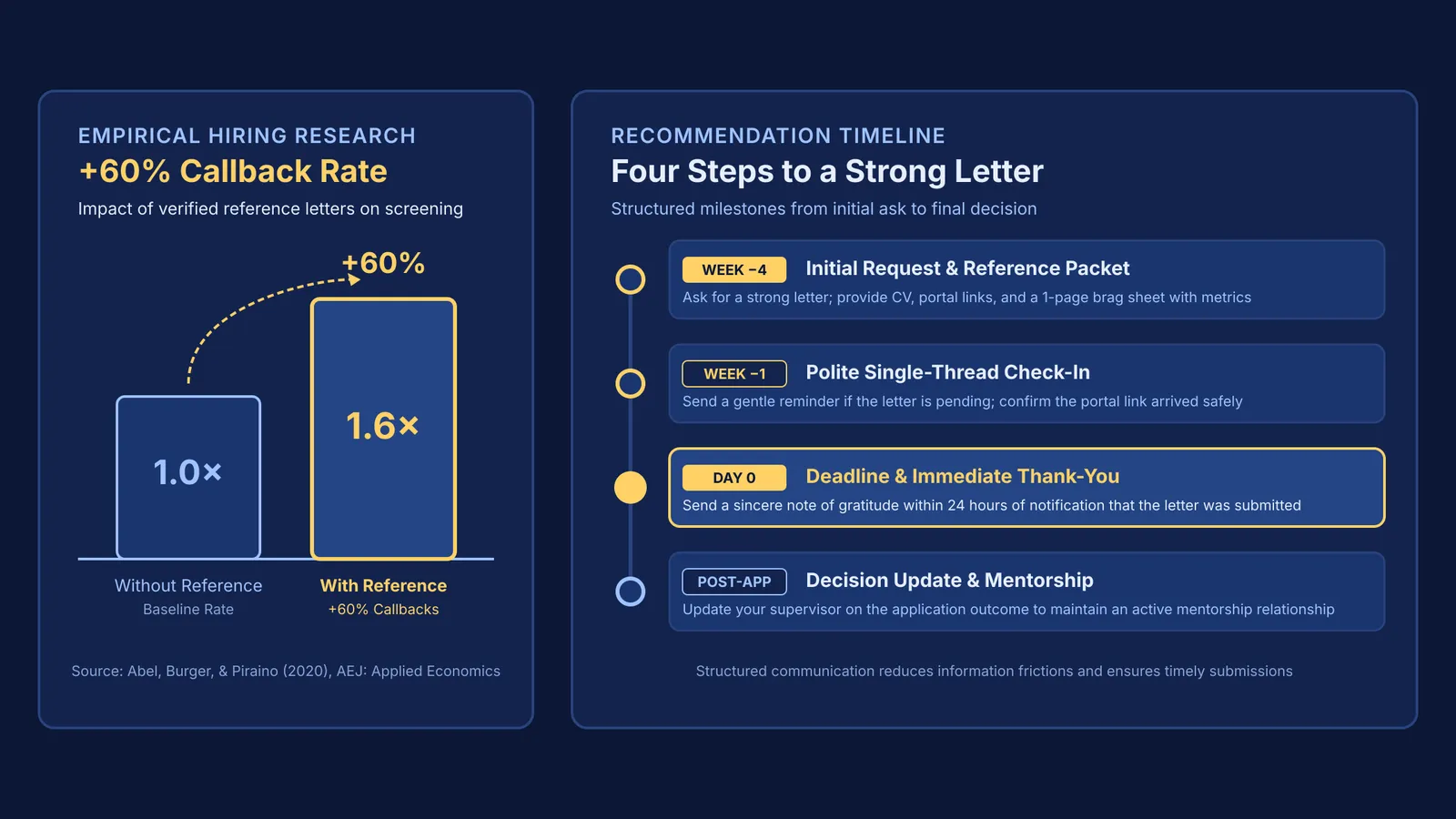
Securing a strong recommendation depends on two distinct moments: an informal check-in during your internship, and formal notice before your application deadline. In the *American Economic Journal: Applied Economics*, Martin Abel, Rulof Burger, and Patrizio Piraino (DOI: 10.1257/app.20180666) showed that reference letters increase job applicant callback rates by 60 percent by providing verified third-party evidence of candidate skills.
Make your initial inquiry during the final two weeks of your internship. Whether completing corporate work or undergraduate research internships in a university laboratory, your accomplishments and code commits are freshest in your supervisor's mind during your exit review. Confirming their willingness to write on your behalf before you vacate your desk ensures you stay connected after your tenure ends.
When you are ready to submit an application, give your recommender 3 to 4 weeks of advance notice. Mentors juggle grant applications, teaching, and deliverables; last-minute requests arriving days before a cutoff invite rushed, generic praise.
A meta-analysis by Nathan R. Kuncel and colleagues in the *International Journal of Selection and Assessment* (DOI: 10.1111/ijsa.12060) found that recommendation letters provide incremental predictive validity for degree completion and academic motivation beyond test scores and grades. Giving recommenders sufficient lead time ensures they can substantiate those qualities with specific examples.
What should you include in your reference packet?
Even supportive mentors struggle to recall specific contributions months after an internship concludes. Admissions research by Eli Ben-Michael, Avi Feller, and Jesse Rothstein (DOI: 10.3386/w30940) shows that the evaluative benefit of recommendation letters scales with demonstrated applicant strength. To help your supervisor highlight your achievements effortlessly, compile a concise reference packet in a single document.
A well-organized reference packet contains three core components:
Logistics: The institution, target position, submission portal link, and firm deadline, noting whether you waived your right to view the letter.
Updated CV: Highlighting technical tools, instruments, and software you used during your internship.
Brag sheet: A one-page summary of 3 or 4 milestones detailing the technical challenge, your specific method, and the measurable outcome.
Clarity on core principles matters when summarising technical work. If you need to refresh concepts or verify terminology before assembling your summaries, the Fermi Concept Library offers clear lessons across science and computing to help you describe your project contributions accurately. If your internship involved literature reviews, our guide on how to read scientific literature offers practical structuring tips.
How do you phrase the request without sounding presumptuous?
Avoid asking vaguely whether a mentor can write "a letter." That question often yields a lukewarm, generic note. Admissions research by Jesse Rothstein in *Economics of Education Review* (DOI: 10.1016/j.econedurev.2022.102285) indicates that evaluators look for concrete qualitative distinctions rather than routine praise; a generic letter that merely confirms attendance can inadvertently signal mediocrity.
Instead, ask whether they feel able to write a *strong* letter. This phrasing respects their reputation and offers a polite out if they cannot evaluate your performance in depth.
Use this concise template for your request:
Subject: Reference Request — [Your Name] — [Target Programme] (Deadline: [Date])
Dear [Supervisor Title and Last Name],
I hope you are having a productive week. I am preparing an application for [Programme/Role] at [Institution] and would be deeply grateful if you felt comfortable writing a strong recommendation on my behalf. My work on [Specific Project] was central to developing my skills in [mention 1 or 2 areas, e.g., experimental design or numerical modelling].
The deadline is [Date, 3 to 4 weeks away] via an automated link. To make drafting straightforward, I have attached a brief packet with my updated CV, project milestones, and programme details. Please let me know if you would like to discuss this over a brief call. Thank you for your continued mentorship.
Sincerely, [Your Name] [Contact Information]
How should you follow up without micromanaging?
Following up requires balancing diligence with respect for your recommender's time. Because former employer references reduce information frictions in selection decisions (DOI: 10.1257/app.20180666), keeping reminders structured ensures the letter arrives without straining the relationship.
Follow this systematic schedule:
The one-week reminder: If the application portal shows your recommendation pending 7 days before the cutoff, reply directly to your original email thread with a polite two-sentence note. Mention the upcoming deadline, confirm the submission link arrived safely, and ask if any additional details are needed.
The submission thank-you: Within 24 hours of notification that your letter has been submitted, send a brief note of gratitude acknowledging their effort and advocacy.
The outcome update: Once decisions are released, share the outcome regardless of whether you received an offer. Mentors appreciate knowing how candidates fared, and keeping in touch maintains support for your first semester in college or postgraduate studies.
If your upcoming application involves technical assessments or numerical problem solving, working through structured explanations in the Fermi Problem Library will help you keep your reasoning sharp and structured before interview rounds begin.