

On this page
Like physics but want to work on real problems outdoors? Geophysics points the waves, gravity and magnetism of Class 11 and 12 at the ground under your feet, to find oil, minerals and groundwater and to track earthquakes.
What is geophysics, and what does a geophysicist do?
Geophysics is the physical science of the Earth's processes and properties, from its shape to its gravitational, magnetic and electromagnetic fields (Wikipedia overview of geophysics). In practice, a geophysicist measures something at the surface, such as the time a wave takes to bounce back or a tiny change in gravity, and works out what lies below.
CSIR's National Geophysical Research Institute (NGRI) in Hyderabad was established in 1961 and works on seismology, geodesy, geomagnetism, gravity and magnetic studies, and groundwater exploration (India Science and Technology portal). The National Center for Seismology, under the Ministry of Earth Sciences, is the government's nodal agency for monitoring earthquakes in India, round the clock (NCS).
Where can you study geophysics after 12th?
There are two doors: a programme straight after Class 12, or a physics degree and then a geophysics master's.
IIT (ISM) Dhanbad. Its Department of Applied Geophysics was set up in 1957, during the International Geophysical Year, and offers a 5-year integrated M.Tech, a 3-year M.Sc. Tech, a 2-year M.Tech in earthquake science and a PhD (IIT (ISM) department page). It admits through JEE, JAM and GATE, with an annual intake of 21 in the integrated M.Tech and 55 in the M.Sc. Tech.
IIT Kharagpur. In 2021 the institute introduced a 4-year BS in exploration geophysics, one of six subjects, with admission through JEE Advanced (Careers360 report).
Banaras Hindu University. BHU's Department of Geophysics runs an M.Sc. (Tech) course; in April 2023, 20 of its students were selected by ONGC as geophysicists (Careers360 report).
Weighing science against engineering? Our guide to choosing between BSc physics and BTech engineering physics sets out the trade-offs.
What physics does a geophysicist actually use?
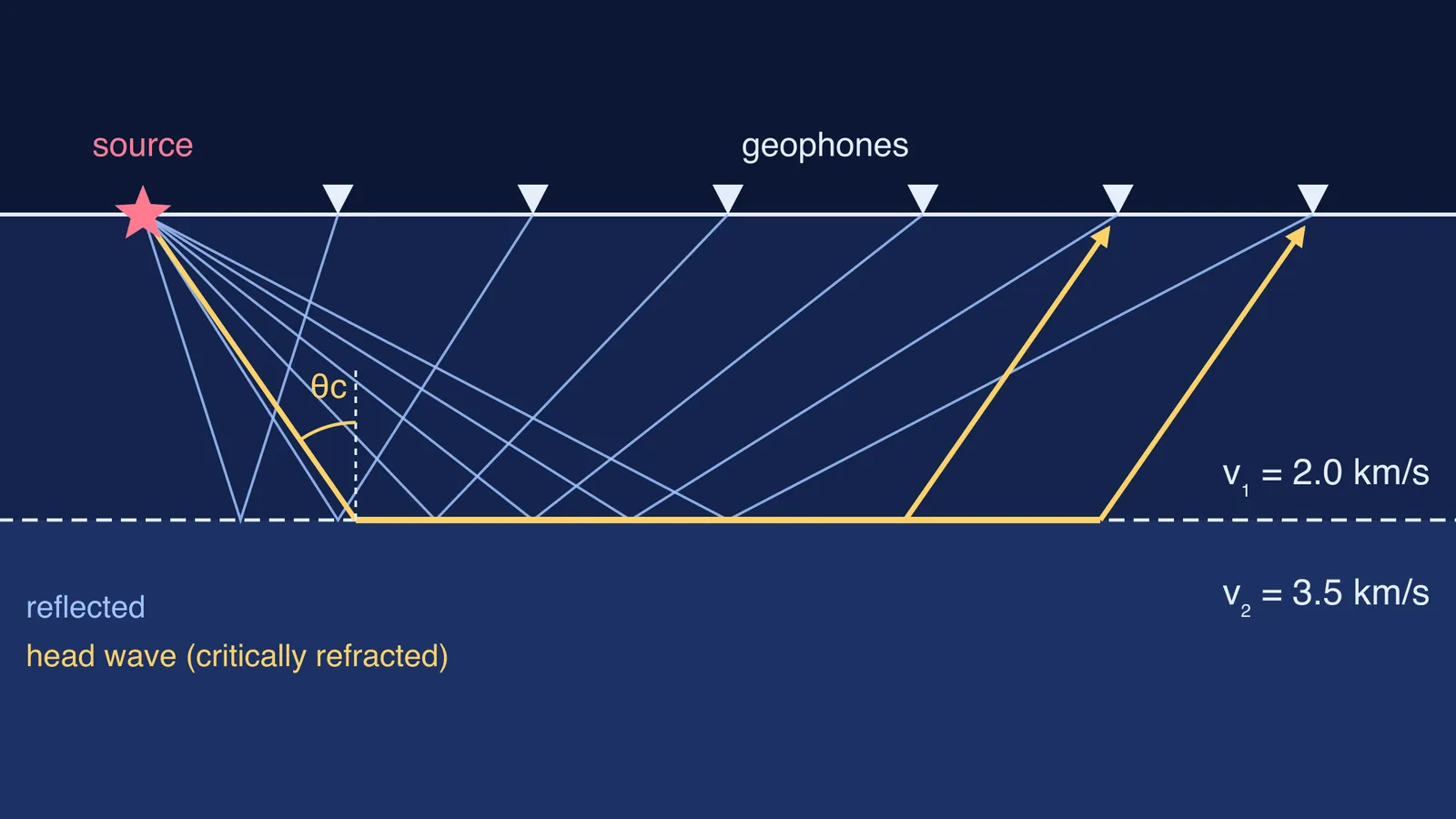
The diagram above shows a seismic survey: a surface source sends a wave down and a line of geophones listens. Suppose the top layer carries P-waves at 2.0 km/s, the rock beneath at 3.5 km/s, and the boundary is 1 km down.
Straight down and back. The wave travels 2 km in total, so the echo arrives after 2 ÷ 2.0 = 1.0 s.
A geophone 2 km away. The wave bounces halfway along, so each leg is √(1² + 1²) ≈ 1.41 km: 2.83 km in all, about 1.41 s. How this delay grows with distance gives the speed and depth.
The critical angle. Snell's law, the one you use for light, gives sin θc = 2.0 ÷ 3.5 ≈ 0.571, so θc ≈ 34.8°. A wave meeting the boundary at this angle runs along the faster rock and leaks back up as a head wave, which far enough out reaches the geophones first.
That is school optics and kinematics, applied to rock. Seismologists use the same timing idea; our post on finding earthquake distance from the P and S wave gap works through it. If refraction is hard to picture, the Fermi Simulation Lab has interactive simulations for the ideas that are easier to see than to read.
What jobs can you get with a geophysics degree?
Oil and gas exploration. ONGC hires Geophysicist (Surface) and Geophysicist (Wells) graduate trainees at E1 level using GATE scores in Geology and Geophysics (geophysics section) or Physics. Both posts ask for a postgraduate degree in geophysics, or a listed equivalent, with at least 60% marks (Careers360 summary of ONGC recruitment through GATE).
Government survey and groundwater. UPSC's Combined Geo-Scientist Examination recruits for the Geological Survey of India and the Central Ground Water Board. The 2027 notice lists 127 vacancies, including 35 Assistant Geophysicist posts at GSI, with the preliminary exam on 10 January 2027 and an age band of 21 to 32 (Free Press Journal report). Geophysicist posts accept an M.Sc. in geophysics, physics, applied physics or related subjects.
Seismology and research. Earthquake monitoring at NCS, research at NGRI, or a PhD.
A plan if geophysics appeals to you now
Make waves, optics, gravitation and electromagnetism strong in Class 11 and 12; they are the field's main tools. If one feels shaky, the Fermi Concept Library gives every concept in physics and mathematics its own lesson.
Keep maths sharp: calculus and vectors appear in every geophysics course.
Pick your entrance: JEE Advanced for the integrated and BS programmes, or a BSc in physics with maths, then IIT JAM or a university test.
Try one Earth-physics problem a week. Start with how gravity changes inside the Earth.
Learn basic Python. IIT (ISM)'s geophysics department runs laboratories for seismic data processing and for global optimisation and deep learning.
If you keep asking how you would measure that, work the three steps above tonight and see how it feels.


