

On this page
An earthquake sends out several kinds of waves. Two travel through rock: P waves and S waves. They leave the source together but reach a seismograph at different times, and that delay works like a ruler.
Why do P waves arrive before S waves?
P waves push and pull the rock along their direction of travel; S waves shake it sideways. For the history of how they were first told apart, see how Oldham found P, S and surface waves on seismograms. The British Geological Survey says P waves travel fastest, so they are the first energy to arrive on a seismogram, and the slower S waves arrive after them.
In typical continental crust, P waves travel at 5–7 km/s and S waves at 3–4 km/s, according to the British Geological Survey.
Because both waves start at the same instant, the slower S wave falls further behind with distance. As IRIS puts it, the farther the seismic waves travel, the larger the gap between the P and S wave becomes.
How do you find the distance from the S−P time difference?
Call the distance d and the speeds vP and vS. Each wave takes distance divided by speed to arrive:
P wave: tP = d/vP
S wave: tS = d/vS
The gap: Δt = d/vS − d/vP
Take d out as a common factor: Δt = d × (vP − vS)/(vP·vS). Rearranging gives the formula you need:
d = Δt × vP·vS/(vP − vS)
The fraction vP·vS/(vP − vS) has units of km/s. Read it as kilometres of distance for every second of gap.
What distance does a 20-second gap give?
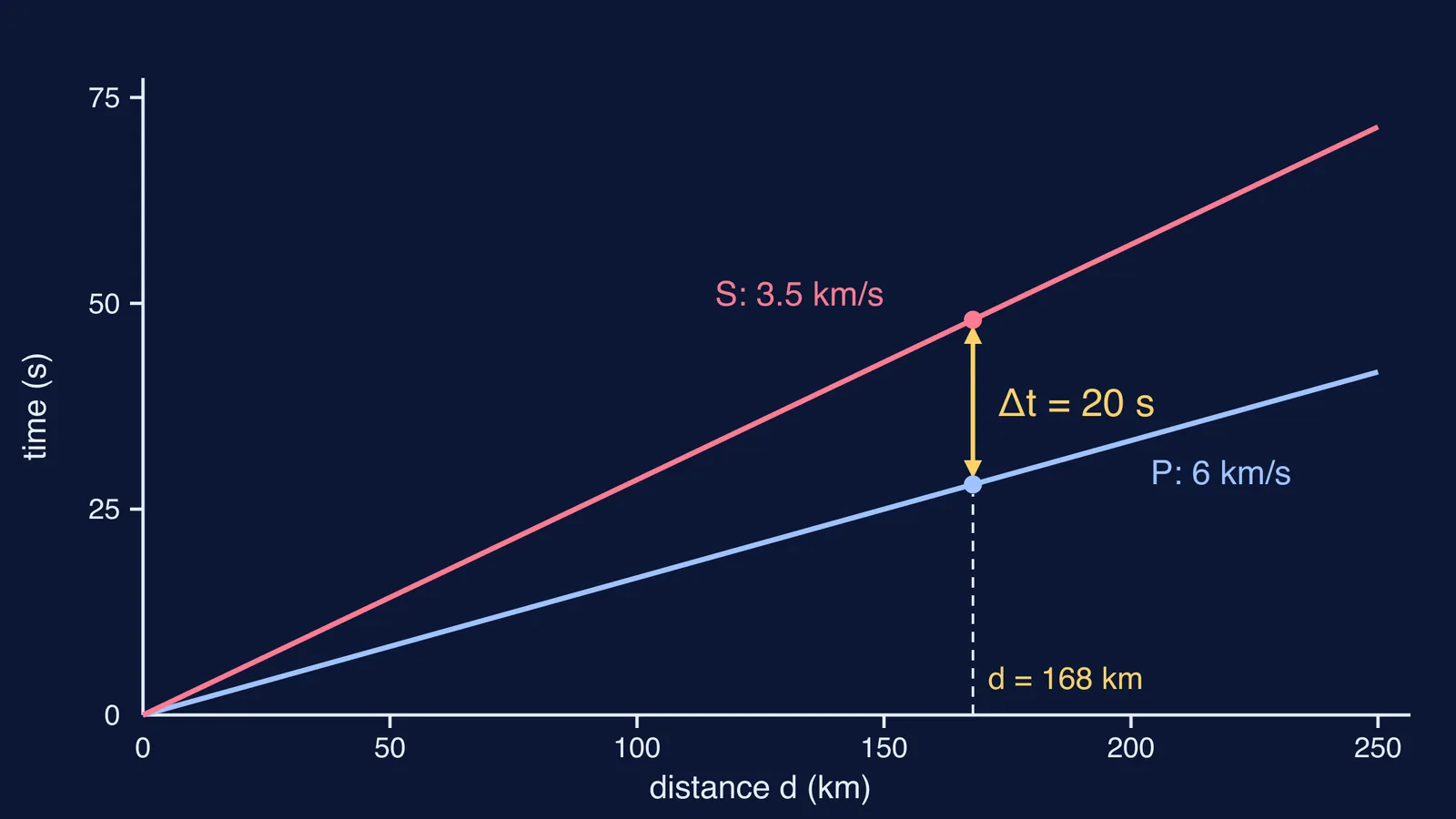
A station records the P wave at 10:15:04 and the S wave at 10:15:24. Use vP = 6 km/s and vS = 3.5 km/s, both inside the crustal ranges from the British Geological Survey.
The gap is Δt = 20 s.
The multiplier is (6 × 3.5)/(6 − 3.5) = 21/2.5 = 8.4 km/s.
The distance is d = 20 × 8.4 = 168 km.
Check: the P wave takes 168/6 = 28 s and the S wave takes 168/3.5 = 48 s. The difference is 20 s, as recorded.
You also get the start time: the P wave was 28 s in transit, so the rupture began at 10:14:36.
The speeds you choose matter. Keep vP = 6 km/s but use the S speed of 4 km/s quoted by IRIS. The multiplier becomes 24/2 = 12 km/s, and the same 20 s gap now gives 240 km. One speed changed and the answer moved by more than 40%. In practice, the USGS says the distance from each station is determined from standard travel-time tables and travel-time curves. In an exam, use exactly the speeds the question gives you.
How many seismic stations do you need to locate an earthquake?
One station gives a distance but no direction, so the source could be anywhere on a circle around it. With the S minus P time at three stations, you can find the epicentre, as the British Geological Survey explains. Michigan Tech's classroom guide calls this trilateration: draw a circle around each station with its distance as the radius, and the point where the circles overlap is the approximate epicentre.
In India, this monitoring is the job of the National Center for Seismology, the government's nodal agency under the Ministry of Earth Sciences. It maintains a network of more than 170 stations and runs a 24x7 monitoring centre. Read more on why Delhi lies in a high earthquake risk zone.
What does the simple formula leave out?
Focus, not epicentre. Your d runs in a straight line to the point underground where the rupture began. For a nearby earthquake with its focus at depth h, the distance along the surface to the epicentre is roughly the square root of (d² − h²).
Speeds change with depth. The British Geological Survey gives P speeds above 8 km/s in the mantle and core, and S speeds of 4.5 km/s in the mantle. For distant earthquakes the waves bend, and travel-time curves replace the straight-line formula.
How do you solve an S−P exam question step by step?
Write the two travel times, tP = d/vP and tS = d/vS.
Subtract them and set the result equal to the measured gap.
Solve for d, then check by working out both travel times.
If asked when the earthquake happened, subtract tP from the P arrival time.
The same template handles any two-signals, one-source problem, such as counting the seconds from lightning to thunder, where light arrives almost instantly and only the sound speed matters.
If your answers keep coming out wrong because of the method, the Fermi Problem Library has worked problems with a step-by-step solver that explains the reasoning rather than printing an answer. If the wave types themselves feel hazy, the Fermi Concept Library gives each physics concept its own lesson.
Try it now: pick a gap of 12 s, use 6 and 3.5 km/s, and check that you get about 101 km.


