

On this page
Why is Delhi classified under seismic Zone IV?
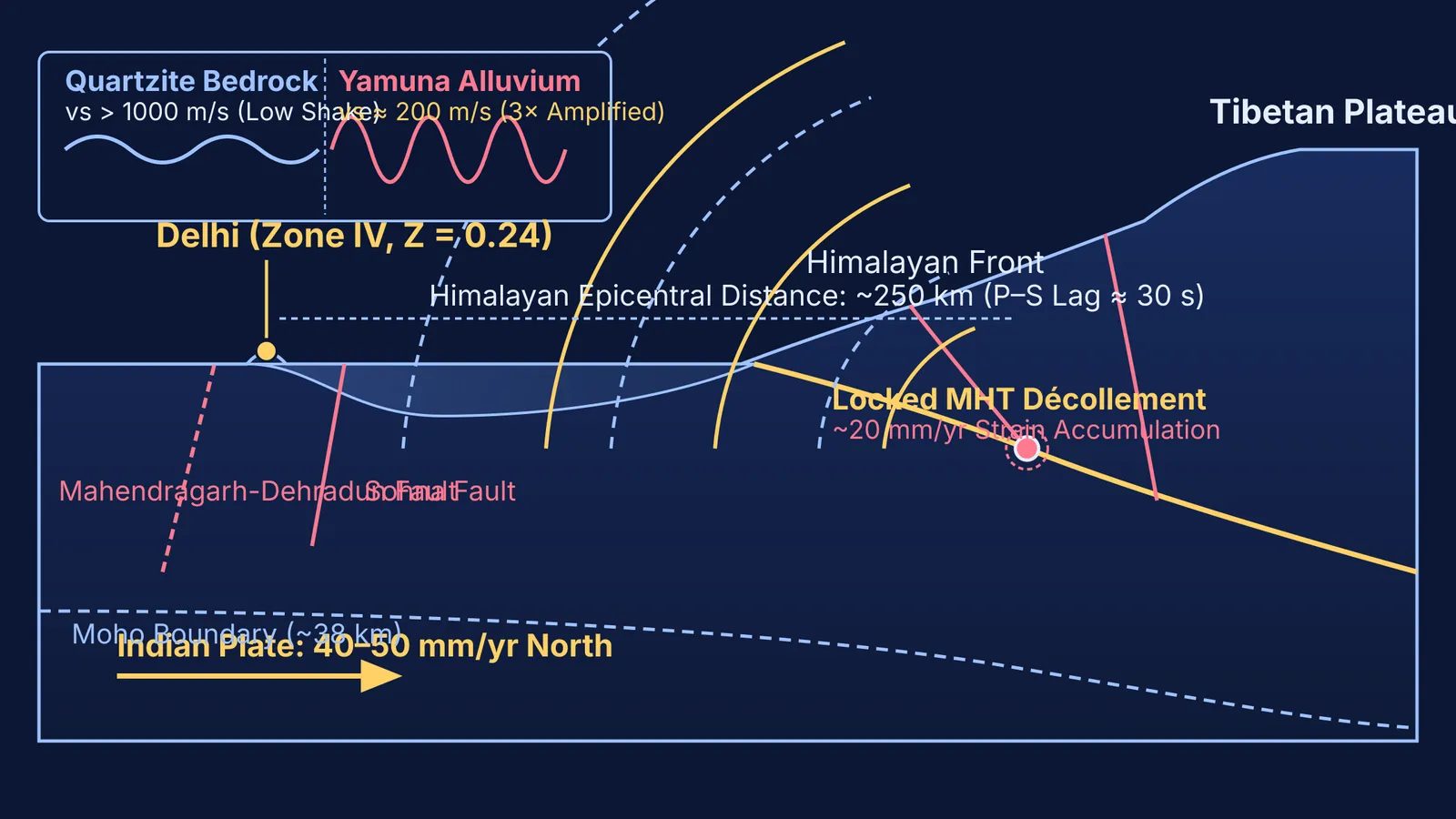
Under the Indian standard for earthquake resistant design, the Bureau of Indian Standards places Delhi in Zone IV, a high-damage risk zone where tremors reach Medvedev-Sponheuer-Karnik (MSK) intensity VIII. In engineering design, Zone IV assigns a zone factor Z of 0.24, representing an effective peak ground acceleration (PGA) of 0.24g (about 2.35 m/s²) during the Maximum Considered Earthquake. Everyday structures are designed against the Design Basis Earthquake at Z / 2, or 0.12g. To map these hazards locally, the National Centre for Seismology conducts seismic microzonation to identify how different soil types amplify earthquake shaking.
How does the Himalayan collision drive seismic risk?
The main engine of Delhi's seismic hazard lies 200 to 250 kilometres north, along the Himalayan collision boundary. Over 50 million years ago, India collided with Eurasia. Geodetic measurements by Bilham et al. (1997) show the Indian plate still moves northeast into Asia at 40 to 50 millimetres per year, propelled by deep mantle currents described in Arthur Holmes and the convection currents inside the Earth.
About 18 to 20 millimetres per year of this shortening is absorbed across the Himalayas. Because the Main Himalayan Thrust fault stays locked between earthquakes, the crust stores strain like a compressed spring. As shown by Bilham, Gaur, and Molnar (2001), an ongoing slip deficit of 2 metres per century accumulates in locked gaps. When rock friction fails, high-energy waves radiate across the plains directly toward Delhi.
Which local fault lines cross the capital?
Delhi also sits atop active local faults. The capital marks the northern subsurface terminus of the Aravalli fold belt, known as the Delhi-Haridwar Ridge. Flanking this ridge are several active faults: the Mahendragarh-Dehradun Fault (MDF), Sohna Fault, Great Boundary Fault, Mathura Fault, and Delhi-Moradabad Fault.
Records in Current Science show these local faults can produce earthquakes between magnitude 6.0 and 7.0. In 1720, a local tremor produced intensity IX shaking that damaged Old Delhi, while in 1960, a magnitude 6.0 earthquake struck the Delhi-Gurgaon border.
Why does soft alluvial soil amplify seismic waves?
Delhi's danger varies with local geology. The Delhi Ridge exposes hard quartzitic bedrock, while the Yamuna floodplains rest on deep, loose alluvium: silt, sand, and clay. Shear waves travel through bedrock at over 1,000 metres per second, but drop to 150 to 300 metres per second in Yamuna alluvium according to geotechnical velocity surveys.
Because wave energy flux is conserved across geological boundaries, as explained in reflection of waves at fixed and free ends, lower acoustic impedance amplifies wave amplitude by 2 to 4 times. A sediment layer of thickness H also resonates at frequency f₀ = v_s / (4H). For a 60-metre alluvial layer with shear-wave velocity 240 metres per second, f₀ is 1.0 Hz, matching the natural sway frequency of a 10-storey building and inducing destructive resonance. The Fermi Simulation Lab has interactive simulations for the ideas that are easier to see than to read, showing how wave speeds change across media boundaries and why resonance amplifies standing waves.
How do P-waves and S-waves determine warning times?
Earthquakes radiate two principal body waves through the crust, first mapped by Andrija Mohorovičić and the Moho below Earth's crust: compressional P-waves (roughly 6.0 kilometres per second in crustal rock, as detailed in crustal velocity models) and shear S-waves (approximately 3.5 kilometres per second). S-waves carry the destructive transverse motion, making the P-to-S arrival delay a critical warning window.
For a Himalayan quake 250 kilometres away:
P-wave arrival: t_P = 250 km / (6.0 km/s) ≈ 41.7 seconds.
S-wave arrival: t_S = 250 km / (3.5 km/s) ≈ 71.4 seconds.
Warning interval: Δt = t_S − t_P ≈ 29.7 seconds.
This 30-second window lets automated systems shut gas mains and stop trains. In the Fermi Problem Library, worked problems with a step-by-step solver that explains the reasoning rather than printing an answer guide students through the wave kinematics of seismic pulses.
What makes a structure resilient in Zone IV?
Surviving Zone IV shaking demands earthquake-resistant construction under Indian standards, which mandate ductile detailing so structures absorb energy without brittle collapse:
Ductile ties: Closely spaced steel ties at beam-column junctions confine concrete during cyclical swaying.
Eliminating soft storeys: Ground-floor stilt parking without shear walls concentrates lateral loads, triggering pancake collapses.
Immediate response: Drop, Cover, and Hold On beneath a sturdy table, avoiding elevators and unreinforced exterior walls.


