

On this page
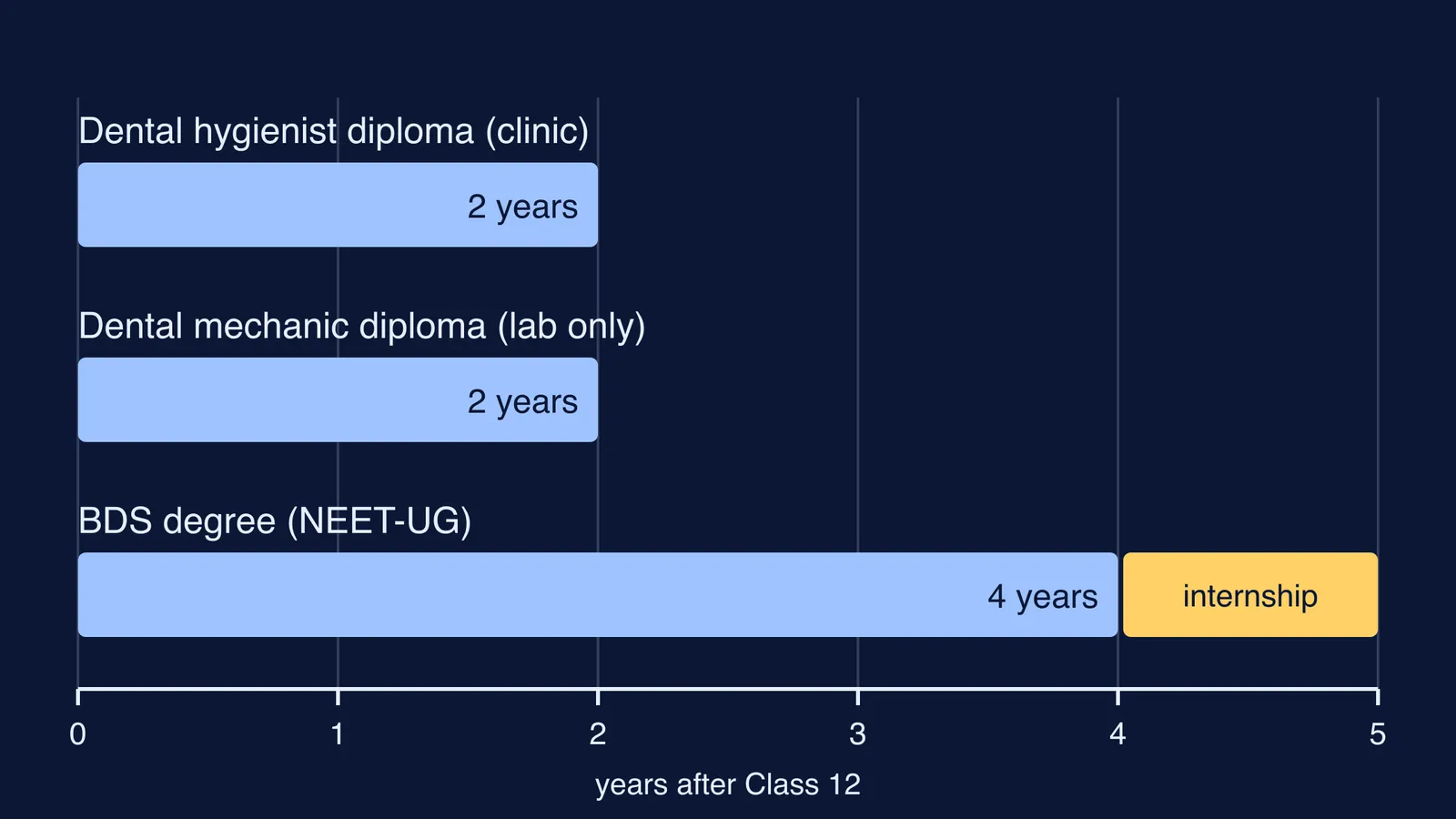
Not every job in a dental clinic starts with NEET-UG and a BDS seat. Two allied roles, the dental hygienist and the dental mechanic (the person most people call a dental technician), have their own two-year diplomas run inside dental colleges. If you like biology, enjoy careful handwork or want to start working sooner, they are worth a proper look.
What does a dental hygienist do in India?
Under the National Dental Commission Act, 2023, a dental hygienist is a person, not a dentist or medical practitioner, who scales, cleans or polishes teeth, or gives instruction in dental hygiene. The Dental Council of India's 2008 course regulations add that the hygienist works under the supervision of a registered dental surgeon.
The syllabus in those regulations shows what the work involves:
cleaning and polishing teeth, including ultrasonic scaling
applying topical fluoride
taking and processing dental X-rays, with radiation safety
teaching oral health to children, parents and whole communities
That teaching matters. The World Health Organization estimates that oral diseases affect nearly 3.7 billion people, and its prevention advice includes twice-daily brushing with fluoride toothpaste, a diet low in free sugars, and stopping tobacco and areca nut.
What does a dental technician do?
The same Act defines a dental mechanic as a person qualified to do the laboratory work needed for prosthetic rehabilitation of dental and maxillofacial structures and for orthodontic appliances. In plain words: dentures, crowns, bridges, and the wires and plates used to straighten teeth. The 2008 regulations limit the mechanic to purely mechanical laboratory work done at the instance of a registered dental surgeon, with no chairside work.
It is a craft job built on materials science. The first year covers applied physics and mechanics, applied chemistry, dental materials and metallurgy. Over the two years, each student must complete a practical quota that includes 20 complete acrylic dentures, plus crowns, bridges and wire work.
If that physics and chemistry feels rusty, the Fermi Concept Library gives every concept in physics, chemistry and biology its own lesson, so you can close one gap at a time before the course starts.
How do you get into a dental hygienist course?
Both diplomas follow the Dental Council of India regulations of 2008:
Class 12 or equivalent with physics, chemistry and biology
at least 17 years old at admission or within three months of it, and medically fit
two academic years, taught in English
run by dental colleges that are recognised or permitted to teach BDS from the third year onwards, with at most 20 seats
a primary exam after year one and a final exam after year two, needing 50% in each paper's written and practical parts and 75% attendance
The minimum teaching time is 840 hours in year one and 660 in year two for hygienists, mostly practical and clinical. For mechanics it is 930 and then 895 hours, mostly at the lab bench. The regulations set no national entrance test, so ask each college how it admits students.
Those notices sit on the regulator's gazette list. The 2020 amendment to the hygienist regulations, like its twin for mechanics, changed only the application and recognition fees colleges pay, not the rules above.
How is this different from BDS?
A BDS graduate is a dentist who diagnoses and treats. Under the Revised BDS Course Regulations, 2007, BDS takes four academic years of 240 teaching days each plus a one-year paid rotating internship. Admission is based solely on NEET marks, and general-category candidates need at least the 50th percentile.
The 2023 Act groups hygienists, mechanics and dental operating room assistants as dental auxiliaries, with a national register kept separately from the one for dentists. For the dentist's own route, read our guide on whether BDS is a good option after NEET.
Which route fits you? A five-question check
Answer these with a parent if you can:
Do I want to talk to patients all day? Yes leans hygienist; no leans technician.
Do I enjoy fine handwork with wax, metal and ceramics? That leans technician.
Do I want to diagnose and plan treatment myself? Only BDS leads there.
Does finishing in two years, rather than five, matter for my family right now?
Am I happy to work under a dentist's direction for most of my career?
Before you pay a fee, ask the college:
Is this diploma recognised by the dental regulator, and can I see the letter?
How many dental chairs or lab benches do students actually use?
Is there a qualified tutor hygienist or tutor mechanic on the staff?
Where did last year's batch find work?
We found no official national salary data for either job, so check any figure a college quotes with its past students.
Still comparing paths after Class 12 PCB? Our guides to allied health science courses and operation theatre and anaesthesia technology cover the neighbouring options.


