On this page
If you have just finished Class 12 science and want to work with medicines, two pharmacy courses start straight away: the two-year Diploma in Pharmacy (D.Pharm) and the four-year Bachelor of Pharmacy (B.Pharm). Both are regulated by the Pharmacy Council of India (PCI). This guide compares them and ends with a checklist for families.
What is the difference between D.Pharm and B.Pharm?
D.Pharm is a diploma. Under PCI's Education Regulations 2020, the course lasts two academic years, plus 500 hours of practical training spread over at least three months, with at least 250 of those hours spent dispensing prescriptions.
B.Pharm is a degree. PCI's revised B.Pharm regulations set it at eight semesters, or four academic years. Its syllabus goes on to medicinal chemistry, pharmacology, industrial pharmacy and pharmaceutical jurisprudence.
In short: D.Pharm gets you into a pharmacy sooner; B.Pharm also opens the regulatory, industry and research routes that ask for a degree.
Who is eligible for D.Pharm and B.Pharm after 12th?
D.Pharm: a pass in 10+2 science with Physics, Chemistry and Biology or Mathematics, per the Education Regulations 2020.
B.Pharm: a pass in 10+2 with English and Physics, Chemistry, and Mathematics or Biology (PCM, PCB or PCMB), per the B.Pharm regulations. In the first semester, PCM students take remedial biology and PCB students take remedial mathematics.
Neither PCI regulation lists NEET as a requirement. Minimum marks, entrance tests and counselling vary by state and university, so read your state's admission brochure. Our guide to how B.Pharm admission works after 12th explains those tests.
If you are a PCM student facing remedial biology, or a PCB student worried about organic chemistry, the Fermi Concept Library has a lesson for every concept in physics, chemistry, biology and mathematics, so you can fill gaps before term starts.
Can you register as a pharmacist with D.Pharm?
Yes. Under section 32 of the Pharmacy Act, 1948, a person aged 18 or over who has passed an approved examination or holds an approved qualification can register with their State Pharmacy Council. State councils accept both a D.Pharm and a B.Pharm, as the Jharkhand State Pharmacy Council's registration page shows.
Registration matters because section 42 of the Act says no person other than a registered pharmacist may compound, prepare, mix or dispense medicine on a doctor's prescription.
One rule to watch is PCI's Diploma in Pharmacy Exit Examination. On 20 February 2026, PCI withdrew a December 2025 circular that had held back registration for the 2022-23 D.Pharm batch until the exit exam was held, Medical Dialogues reported. If you choose D.Pharm, ask your State Pharmacy Council about the current rule in your final year.
Which jobs need B.Pharm rather than D.Pharm?
With either qualification plus registration, you can work as a pharmacist in a retail or hospital pharmacy. A degree adds options:
Drug inspector: Rule 49 of the Drugs and Cosmetics Rules, 1945%20dt_19.10.1993_%20Rule%2049_Qulaification%20of%20Inspectors.pdf), as substituted in 1993, requires a degree in pharmacy, pharmaceutical sciences, or medicine with clinical pharmacology or microbiology, so a diploma alone does not qualify.
M.Pharm and research: GPAT, now conducted by NBEMS under an agreement with PCI, is the national exam for scholarships for M.Pharm entry, and M.Pharm builds on a bachelor's degree.
Industry: for production, quality and other company roles, see our guide to six places pharmacists work after B.Pharm.
How does lateral entry from D.Pharm to B.Pharm work?
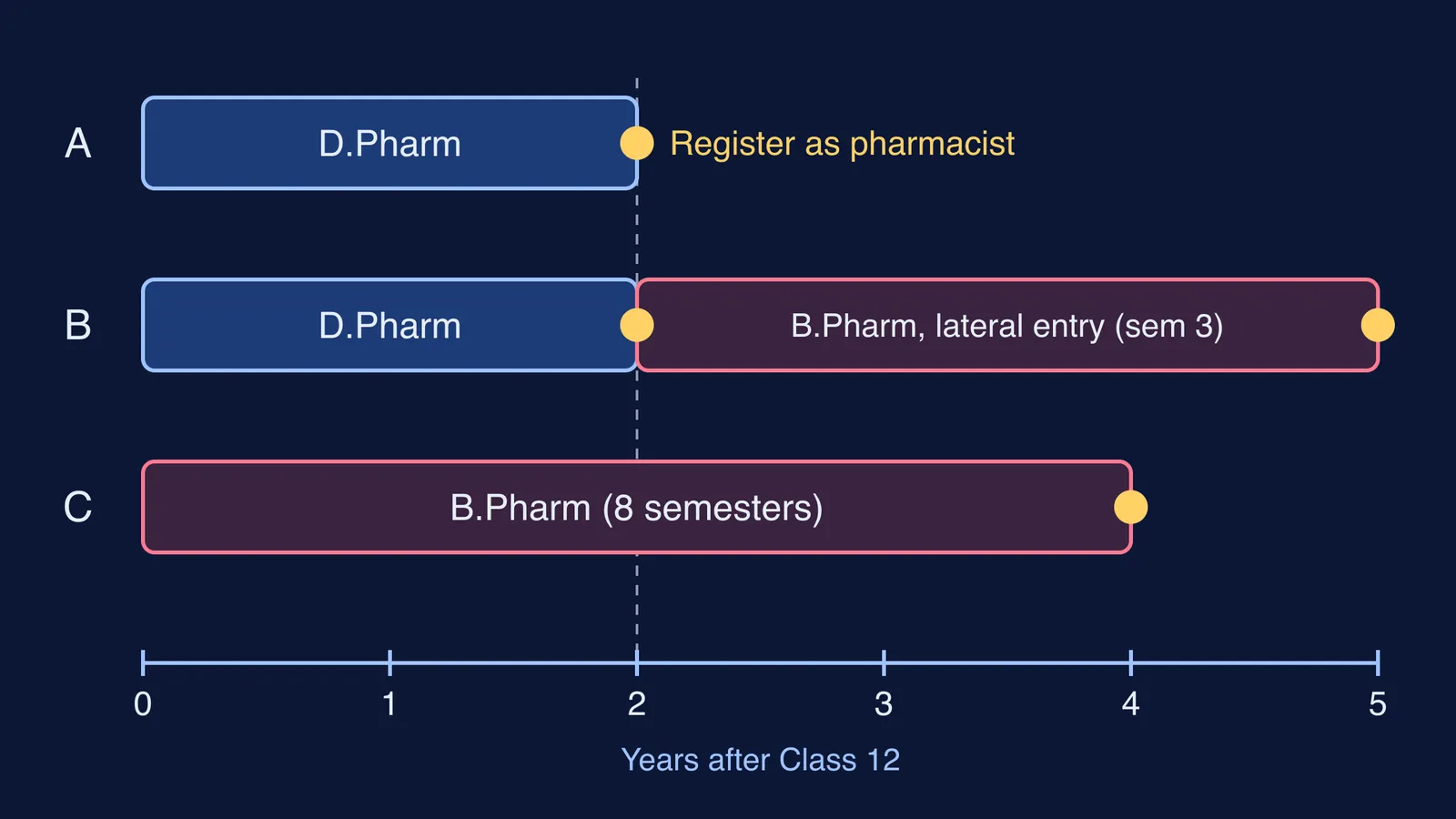
A D.Pharm from a PCI-approved institution lets you join B.Pharm in the third semester and finish in six semesters, or three years, under the B.Pharm regulations. Lateral entrants get 52 credits transferred from D.Pharm and take extra courses in communication skills and computer applications.
A worked example: Riya finishes Class 12 in 2027.
Direct B.Pharm: she graduates around 2031, four years later.
D.Pharm, then lateral entry: two years of D.Pharm plus practical training, then three years of B.Pharm, so around 2032.
D.Pharm only: she can register and start work once the two-year course and its practical training are done.
Route 2 costs roughly one extra year compared with route 1, but it gives her a registrable qualification at about the two-year mark. That suits a family that needs an earning option early.
D.Pharm or B.Pharm: a checklist for students and parents
Must you start earning within about two years, or can the family fund four years of study?
Is the goal a pharmacy counter, or regulation, industry or research? If drug inspector or M.Pharm appeals, lean towards B.Pharm.
Which subjects did you take in 10+2, and are you ready for the remedial course B.Pharm adds?
Is the college PCI-approved for this course and year?
If D.Pharm: does a PCI-approved college nearby offer lateral entry, and what is the current exit-exam rule?
Have you asked a working pharmacist what their day looks like?
A question parents can ask, without pressure: "Picture yourself at 25. Are you at a pharmacy counter, in a lab, or inspecting a factory?" The answer usually points to one route.
Fill in the checklist together this week, then shortlist two PCI-approved colleges for the route you chose.